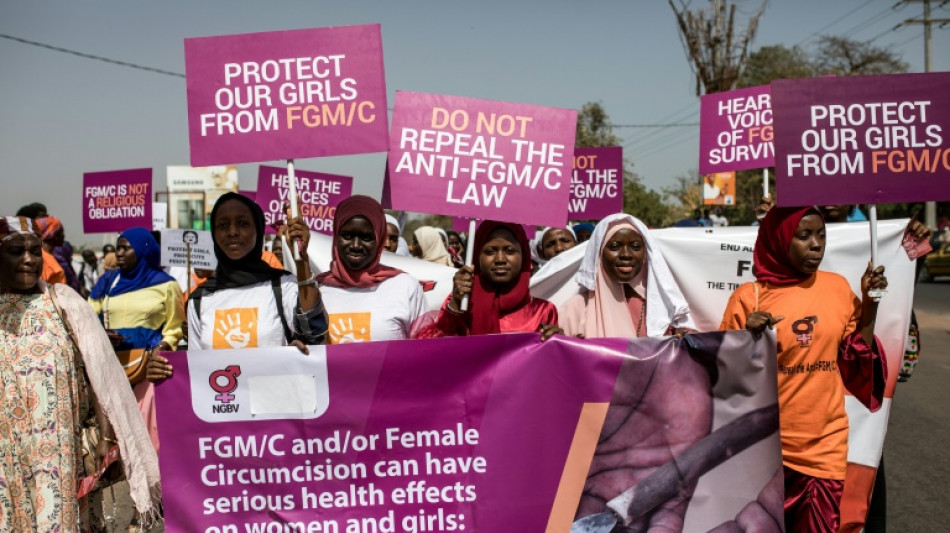
Gambia MPs uphold ban on female genital mutilation / Photo: © AFP

 Brazil football clubs face massive sponsorship blow from betting ban

 ChatGPT maker wants to be the App Store for AI as safety concerns grow

 Women fight fires and sexism in Indonesian Borneo

 Forsling's OT blast lifts Florida over Carolina in NHL opener

 Hurricane Polo sweeps over Mexico's Pacific coast, heads inland

 Grynspan pulls ahead in race to lead UN: diplomat

 Trump touts AI boss pledge to self-regulate

 Oil down, but stocks lower as bond yields rise

 England break down stubborn Czechs to claim first Nations League win

 UN Security Council extends Haiti anti-gang force by 6 months

 Manchester City guilty of Premier League charges: What comes next?

 Man City chief Soriano slams Premier League 'conspiracy theory'

 Hurricane Polo sweeps over Mexico's Pacific coast

 Man City must be relegated after guilty verdict says club's former chairman

 German far-right aims to lead Saxony-Anhalt govt in December

 Little damage as Hurricane Polo sweeps over Mexico's Pacific coast

 Manchester City guilty of breaking financial rules - Premier League

 FIFA boss Infantino blasted as would-be 'emperor' by UEFA's Ceferin

 Stocks move lower despite oil prices dropping

 AI driving up innovation investment: UN

 UN Security Council extends Haiti mission by 6 months

 Man Utd do not deserve medals if Man City stripped of titles: Rooney

 Vana Completes Expanded Staking as Part of the Vega Upgrade, Publishes Expanded VANA Token Economics

 Spain to cap gas price hikes, extend fuel discounts

 'We just need rain': Germany's Rhine river hits new low
Gambian lawmakers voted on Monday to uphold a 2015 ban on female genital mutilation, rejecting a controversial bill seeking to overturn the law after months of heated debate and international pressure.
Legislators killed the bill by voting against all the proposed amendments to the 2015 text that would have decriminalised the practice.
Rights groups and the United Nations had urged MPs to reject the bill, saying it threatened years of progress and would have seen The Gambia become the first country to overturn a ban on female genital mutilation (FGM).
Table banging could be heard in the packed parliamentary chamber as MPs rejected each of the four clauses.
"The Women's (Amendment) Bill 2024, having gone through the consideration stage with all the clauses voted down, is hereby deemed rejected," said Fabakary Tombong Jatta, the speaker of the National Assembly.
"I rule that the bill is rejected and the legislative process exhausted," he added.
The bill had been making its way through parliament since March, deeply dividing public opinion in the Muslim-majority West African country.
The text, introduced by MP Almameh Gibba, says that "female circumcision" is a deep-rooted cultural and religious practice, but anti-FGM campaigners and international rights groups say it is a harmful violation against women and girls.
FGM involves the partial or total removal of the female external genitalia or other injury to the female genital organs, and can lead to serious health problems including infections, bleeding, infertility and complications in childbirth.
The Gambia is among the 10 countries with the highest rates of FGM, with 73 percent of women and girls aged 15 to 49 having undergone the procedure, according to 2024 figures from UNICEF.
A UN report from March said that more than 230 million girls and women worldwide are survivors of the practice.
- 'Sets an example' -
"This vote is a significant victory for women and girls in The Gambia," Divya Srinivasan, from women's rights NGO Equality Now, told AFP after the decision, adding that it reflected the country's dedication to upholding gender equality.
"We hope this sets an example in the immediate region as well as in the whole continent," she added.
Amnesty International also welcomed the decision to uphold the 2015 ban.
"In 2015, the adoption of the Women's (Amendment) Act, which criminalizes and sets out punishments for performing, aiding and abetting the practice of FGM, represented a significant milestone in the country's efforts to safeguard girls' and women's rights," said Samira Daoud, Amnesty International Regional Director for West and Central Africa, in a statement.
"It was essential that this progress was protected," she added.
But the rights organisation also said the government must do more to uphold the law and address the "root causes of the issue to change attitudes and norms in order to empower women and girls".
Former Gambian dictator Yahya Jammeh, now in exile, banned FGM in 2015, branding it outdated and not a requirement of Islam.
Parliament later that year adopted the first law specifically banning the practice, which is now punishable by up to three years in prison.
But in reality, FGM has not been eradicated in The Gambia, with the first convictions for performing the procedure only taking place last year.
It was those convictions which caused the issue to flare up in the tiny West African country.
After referring the Women's (Amendment) Bill 2024 to a parliamentary committee in March, Gambian legislators last week backed the committee's conclusions calling for the ban to be maintained.
The report from the joint committee on health and gender said that repealing the ban "would expose women and girls to severe health risks and violate their right to physical and mental well-being".
It also said it had consulted Islamic scholars who confirmed the practice was not a requirement of Islam, an argument commonly used by FGM advocates.
E.Gasser--VB