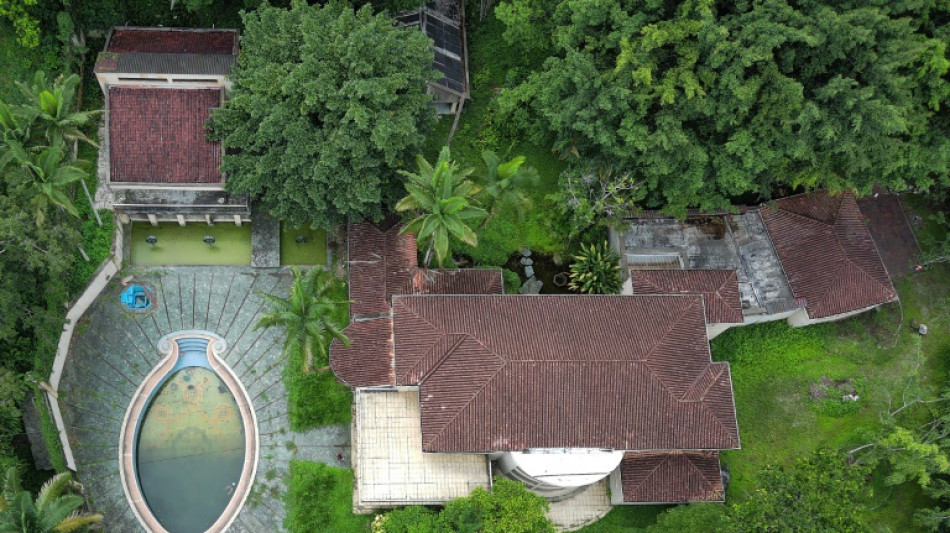
Colombian dens of iniquity recycled to serve victims / Photo: © AFP

 Libya's pay strike rallies teachers across divided nation

 Four-member crew blasts off for International Space Station
 i-payout Expands True Local Payment Capabilities to Help Enterprises Pay Recipients Globally
 Botched US execution prompts global calls to scrap death penalty

 Algeria adopts law imposing death penalty on forest arsonists
 France unveils cost-cutting 2027 budget as borrowing costs rise
 Brazil court orders removal of fake posts amid patron saint election row
 Italy's firefighting planes return home after scorching summer

 How airlines try to make sure pilots are safe to fly
 Bolivia's attorney general arrested for alleged money laundering and drug trafficking

 Zverev beats Norrie to kick off Sinner-less China Open

 Wall Street stocks rise after bond yield spike eases
 Finland investigates suspected break-ins at MPs homes

 London's Bayeux Tapestry show to offer audio tour for blind people

 Smouldering bins, halted trams as French pupils protest

 Malone Life and Pensions Expands Internationally Beyond the European Union
 England paceman Archer rested for ODI tri-series
 Queiroz exits Ghana as Black Stars crisis deepens

 ALEX BODI VE ALMAN ŞİRKETLER GRUBUNDAN HALLE’DE 166 DAİREYE YATIRIM
 อเล็กซ์ โบดี และกลุ่มบริษัทจากเยอรมนีลงทุนในอพาร์ตเมนต์ 166 ยูนิตที่เมืองฮัลเลอ

 ALEX BODI A NĚMECKÝ KONCERN INVESTUJÍ DO 166 BYTŮ V HALLE
 ALEX BODI OCH TYSK KONCERN INVESTERAR I 166 LÄGENHETER I HALLE
 England forward Toney pleads not guilty to nightclub assault

 Tom Kim finishes marathon Asian Games second round under floodlights

 Work on migrant return hubs progressing well, EU countries say
In a mansion with golden faucets and an oyster-shaped bathtub, Colombian paramilitary fighters and drug lords once planned the most horrific crimes. Now, the opulent property will be put to the service of their victims.
In Medellin, the luxury Montecasino estate was a venue for planning the assassinations of presidential candidates and massacres of rural people accused of supporting leftist guerrillas, according to the testimony of former hitmen.
It was owned by brothers Carlos, Vicente and Fidel Castano -- heads of the United Self-Defense Forces of Colombia (AUC), a US-designated "terrorist" organization set up to fight the FARC guerrilla group and known for human rights abuses.
Murderous drug kingpin Pablo Escobar attended meetings and parties hosted at the house in El Poblado, Medellin's most exclusive neighborhood.
With its marble floors and immense gardens, the house was seized by the state in 2010 after the brothers' demise.
Five years later, it was handed over to Colombia's Victims' Unit -- a group created to identify and aid the estimated 9.5 million people who suffered in the country's decades-long civil conflict.
It was leased at first to private entities, but now, on the orders of Colombia's first-ever leftist president, Gustavo Petro, Montecasino is to be managed by the country's forensic police.
A laboratory will be built there to identify mortal remains in a country where more than 111,000 people are believed to have gone missing in the decades-long conflict over ideology, territory, trafficking routes and revenge.
"No one could have imagined all the crimes and abuses taking place in that house," Claudia Patricia Vallejo, a departmental director of the Victims' Unit, told AFP of Montecasino.
"Many people were tortured there," she added.
- Still in the dark -
Luz Galeano, 60, hopes the initiative will finally shed light on the fate of her husband, Luis Laverde, who disappeared without a trace in 2008.
"I've looked for him everywhere, but I still don't know what happened to him or who was responsible," she told AFP at her home in Medellin, clutching a photo of her mustachioed husband.
Laverde was abducted from a bus in Medellin at a time that residents of the city were under siege from AUC fighters targeting sectors under guerrilla control.
On the day of his inauguration on August 7, 2022, Petro had pledged to use assets seized from criminal groups towards a "productive economy" in service of those most in need.
The task of selling or leasing thousands of seized properties was confided to a special assets unit (SAE) in the finance ministry.
SAE president Daniel Rojas recently reported that an audit from two years ago showed that only about a fifth of the 33,000-odd properties under the unit's control were producing an income -- a figure yet to be updated.
The office of the comptroller general of Colombia recently reported the theft of luxury watches and other items from SAE-managed properties, with losses running into the millions.
- State policy -
In Chia, a city near the capital Bogota, stands further testimony to the once untouchable status and opulence of Colombia's drug lords: a towering castle built in 1898 to later serve as a presidential palace, and bought by Escobar associate Juan Camilo Zapata.
After Zapata's assassination in 1993, the Castillo de Marroquin was seized by the SAE, which leased it to a company that organized weddings and concerts there.
Under Petro's directive, the castle will be handed to the National Pedagogical University with about 9,000 students.
The building itself will be turned into a museum, while a large part of the grounds will be set aside for academic, cultural and sporting activities.
For university rector Helberth Choachi, repurposing criminally-attained assets for the public good should not be a decision of individual governments, but fixed state policy.
"All assets... from drug trafficking, responsible for so many human rights violations in this country, (should) pass in an act of reparation to public entities and the communities who were hardest hit," he told AFP.
A.Ruegg--VB