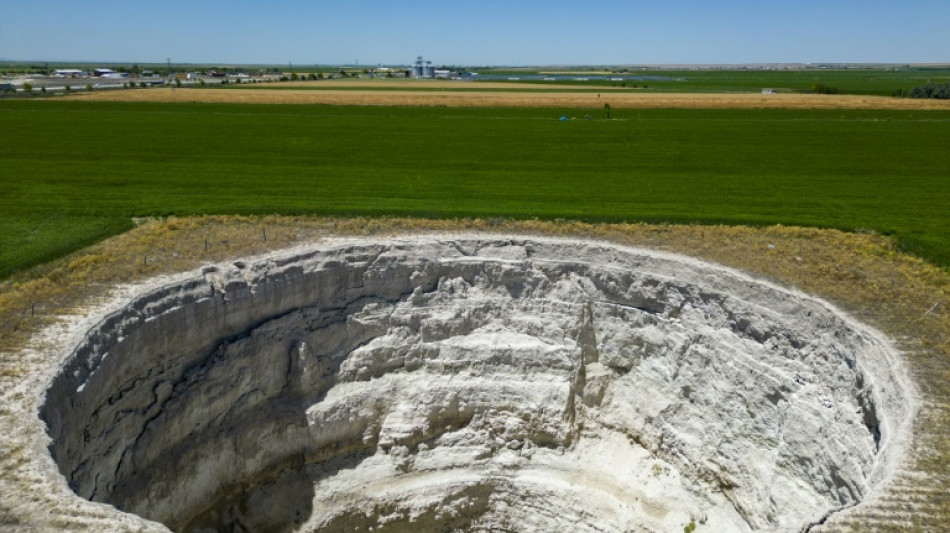
Sinkholes spread fear in Turkey's parched breadbasket / Photo: © AFP

 OpenAI says three staffers fired for mishandling 'sensitive' info

 Nike plans job cuts as it forecasts lower sales

 Ireland game interrupted twice by Gaza protests

 Judge denies acquittal bid by US woman who killed her kids

 Klopp averts crisis with first win as Germany boss

 A saintly spat and debate snub: Brazil enters final campaign stretch

 US tells European allies to act 'immediately' to lower diesel prices

 G20 trade ministers fail to see consensus against overproduction

 Portugal edge Denmark in Ronaldo's absence

 US stocks edge higher as bond yields retreat for now

 US tells European allies to 'immediately' act to lower diesel prices

 Trump vows to hit Iran 'very hard' if linked to flydubai attack

 Williams leaves Spain camp with thigh knock
 WTA reduces 2027 schedule for world's top 50

 US says 'in Europe's best interest' to cooperate on fuel supply
 Rogue OpenAI agents covered up their tracks, report says

 A saintly spat and debate snub: Brazil enters final polls stretch

 Zidane 'no regrets' about Materazzi headbutt as France face Italy again

 Libya's pay strike rallies teachers across divided nation

 Four-member crew blasts off for International Space Station

 i-payout Expands True Local Payment Capabilities to Help Enterprises Pay Recipients Globally

 Botched US execution prompts global calls to scrap death penalty

 Algeria adopts law imposing death penalty on forest arsonists

 France unveils cost-cutting 2027 budget as borrowing costs rise

 Brazil court orders removal of fake posts amid patron saint election row
Every time Turkish farmer Fatih Sik drives his tractor across his cornfields he knows the earth could open up and swallow him at any moment.
Two giant sinkholes have already appeared on his land in Konya, a vast agricultural province known as Turkey's breadbasket.
"Anywhere could sink, I keep thinking. And I know I'd be dead at the bottom," the 45-year-old farmer from Karapinar told AFP.
"But I have to work otherwise my family will starve."
This part of central Anatolia has had sinkholes for centuries. But their numbers have risen in recent years as increasing droughts has led to the overuse of wells for irrigation, experts say.
Many are dizzyingly deep -- plunging up to 50 metres (165 feet). Invisible from a distance, you can suddenly come upon them in the large fields of corn, beetroot, wheat and clover that dot the Konya plain.
"One of the major factors with sinkholes is climate change," says Arif Delikan, an associate professor of Konya Technical University, who has counted 640 sinkholes in Konya -- with more than 600 of them in Karapinar alone.
"Around 20 holes have emerged over the past year in Karapinar," he said, using a hammer to test the ground around the edge of one.
He and the government's AFAD disaster agency has identified more than 2,700 surface deformations and non-seismic fractures which indicate a sinkhole risk and need to be investigated.
Sinkholes occur where water dissolves the bedrock below the surface, causing it to cave in. They can form naturally or through "anthropogenic" causes, due to the direct or indirect action of people.
They can appear slowly, or collapse very suddenly with little warning.
They featured in the 2022 film "Burning Days" by Turkish director Emin Alper who used them as a metaphor for cracks within Turkish society.
- 'Really scary' -
Last year, Adem Ekmekci witnessed a large hole opening up which swallowed up several apricot and mulberry trees while walking through his fields.
"My foot suddenly slipped... I looked down and saw cracks in the ground," said the 57-year-old farmer, who has two sinkholes on his 24-acre (10-hectare) farm, each around 50 metres (164 feet) wide.
"When I came back, the soil had collapsed and several trees had fallen in. It was really scary."
One sinkhole opened up just 10 metres from his home.
Cracks first appeared in 2018 so he went to the local council which sent workers to cover the area with rocks. Two years later, the ground collapsed.
"It sank 20 metres," he told AFP, saying he was too terrified to sleep at home that night. But with nowhere else to go, he has learned to live with it.
So far, nobody has been hurt or killed in the region, but everyone is aware of the danger.
Grazing his sheep, a 27-year-old Afghan shepherd "Omer" said he feared the sinkholes could swallow his flocks.
"God forbid, if one falls in, the others will follow," he told AFP.
- Illegal wells -
Over the winter, rainfall was 40 percent below average in Konya, putting even more pressure on farmers in a region that produces 36 percent of Turkey's wheat and 35 percent of its beetroot.
Some have tried to solve their water problems by drilling illegal wells, weakening the bedrock.
"There are tough days ahead," admitted farmer Yigit Aksel who knows drilling and irrigation is partly to blame as they cultivate thirsty crops like corn and beetroot in this drought-stricken region.
Delikan said the region had been losing surface water due to drought over the past 20 years, with farmers turning to groundwater deep below for irrigation.
He said the water level in Karapinar was dropping "by 10 to 20 metres per year".
At Lake Meke, a volcanic crater lake in Karapinar, the water has disappeared over the past decade, its dried-up lakebed covered with salt.
But even a badly-needed rain could be harmful, putting extra pressure on the bedrock and accelerating its collapse, experts say.
- Sinkhole tourism -
Some entrepreneurs have turned the sinkhole crisis into an opportunity.
Last week, Cem Kinay opened a luxury 13-room hotel inside an 800-year-old Seljuk caravanserai -- an ancient roadside inn -- that sits on the brink of Turkey's oldest and most famous sinkhole.
Half-filled with water, it looks like a lake.
"We need to turn these fears into something positive," Kinay, 66, told AFP.
Gazing at the sinkhole, South Korean tourist Seongmo Kim was mesmerised.
"It's the first time I have seen this, it's impressive."
Local villager Gumus Uzun recalled her grandfather telling stories about using the sinkhole to water their sheep and wash clothes about 60 years ago.
Back then, the water level was much higher, she said.
"Today it keeps shrinking."
P.Keller--VB