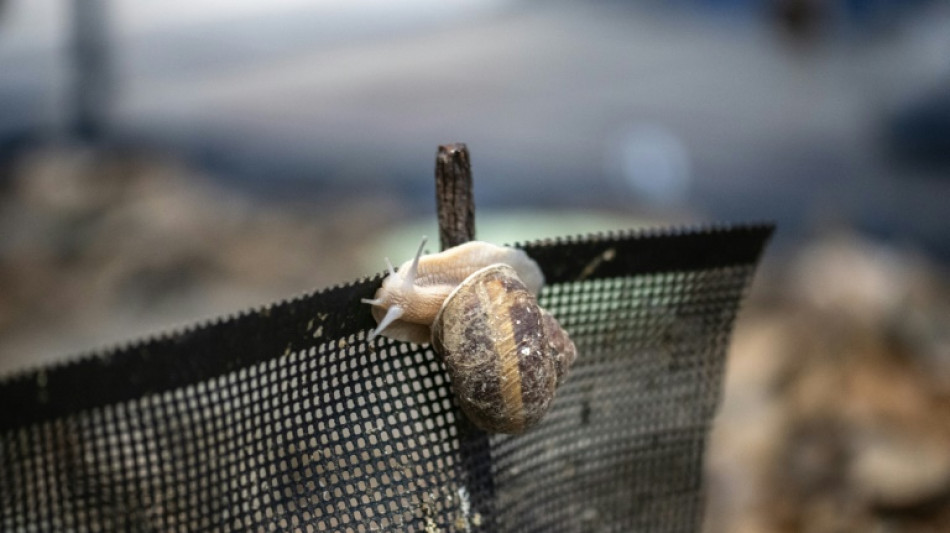
Japan's escargot entrepreneur achieves the 'impossible' / Photo: © AFP

 Intense heat puts births in jeopardy, UN tells Fiji talks

 US arrests woman accused of spying for China on Taiwan leader's family

 Yemen military announces broad strikes against Houthis

 Zuckerberg skewered again on screen in 'The Social Reckoning'

 Fiji urges 'just' climate transition, financing at pre-COP gathering

 Thailand's Jeeno overcomes late wobble to win Lotte Championship

 Brazil heads to run-off as Bolsonaro pulls off shock first place finish over Lula
 EU, China to hold Beijing talks to avert trade war

 Bolsonaro edges past Lula as nail-biter Brazil vote goes to a run-off

 Rubio visits Iceland as US boosts Arctic presence

 Bolsonaro leads Lula as nail-biter Brazil vote goes to a run-off

 Patriots inflict first Bills defeat as Chiefs keep winning

 Pacific nations take centre stage at 'pre-COP' climate summit

 Ronaldo can return to Portugal team if he wants: coach Jesus

 Portugal move into Nations League knockout stage, Germany held

 Ronaldo-less Portugal beat Norway to reach Nations League quarters

 Bosnian Serb strongman claims election win, thanks Trump and Putin

 Israel wear black armbands in Ireland tie over Hamas attack

 'I fear it could drag on': anxiety takes hold in Ethiopian city wrested from rebels

 Brazil's Lula and Flavio Bolsonaro face off in knife-edge election

 UK Green party adopts 'Zionism is racism' policy

 Rio favela residents vote with little hope

 Evenepoel puts worlds 'disappointment' to bed with European crown

 Two-time winning Arc trainer Rouget bows out in emotional farewell

 Battling Djokovic stuns top seed Zverev at China Open

Far from Parisian bistros serving up Burgundy snails, one Japanese man has figured out how to farm the slimy species -- a feat that has long eluded the French.
Toshihide Takase, 76, says he is "the only person in the world" breeding this specific delicacy after four decades of trial and error to find the right conditions.
French embassy and industry insiders also believe that Takase, who has invested a small fortune and taught himself everything about the creature, is a unique case.
Stuffed with butter, garlic and parsley then baked, Burgundy snails -- or escargots de Bourgogne -- have been part of French gastronomy since the 19th century.
But they are notoriously difficult to farm because they don't take well to crowded conditions and grow slowly, usually taking two or three years to reach adult size.
The mollusc, whose scientific name is helix pomatia, has been a protected species in France since 1979 to save it from extinction.
The vast majority of the several thousand tonnes of snails eaten by the nation each year are foraged from woodlands in central and eastern Europe.
Around five percent are homegrown in France, but these are a different species, helix aspersa, which are easier to farm and do not have the "Burgundy" name.
"My sister gave me tinned escargots as a present after a trip to France" 45 years ago, Takase told AFP.
"But they didn't taste good, and smelled bad," said the retired entrepreneur.
Takase became obsessed with producing them himself, even though "at first, everybody acted like I was stupid".
- Perfect conditions -
He stubbornly devoured books on the subject and met French helix aspersa breeders to learn more.
It's a niche interest anywhere, but highly unusual in Japan, where sea snails are part of the rich cuisine but land snails are seen as a pest that can harm crops.
After seven years of bureaucratic wrangling, Takase was granted a permit to rear helix pomatia and imported 100 specimens from France to start his farm.
The indoor facility in Matsusaka, a town between Osaka and Nagoya, is called the Mie Escargots Development Laboratory.
Crates of live Burgundy snails are stacked in three layers on custom-built metal racks, with humidity and temperature carefully controlled.
Next door is an active metalwork foundry -- the first business set up by Takase, who used to manage several ventures.
He says the farm can produce up to 600,000 snails a year, with growth time reduced to just four months.
To achieve this, he adds a calcium-rich powder made from oyster shells to the humid soil, which helps the gastropods grow big and strong fast.
"They love it," said Takase, who spent 20 years developing his own nutritious snail food from soybeans and corn.
Their feeding containers are washed by hand every three days, because "snails love cleanliness", he added.
- 'At what price?' -
Visitors to the "laboratory" get the chance to taste Takase's snails, which cost 9,900 yen ($60) for a pack of 30. There are different prices for restaurants or bulk sales.
For now, business is small-scale and domestic, but he is keen to pass on his know-how to French snail farmers and has launched talks with the embassy in Japan.
William Blanche, co-president of France's National Federation of Heliciculture, told AFP the species has a "reputation for being impossible to breed".
It's "ironic" that Burgundy snails eaten in France have been nowhere near the province of the same name, he said, so is intrigued by Takase's project.
Even so, Blanche questioned how successful it could be.
"Would our consumers, who are used to different snails, be interested -- and at what price?"
A French snail industry insider, who spoke on condition of anonymity, also raised an all-important point.
"They must taste good," he said, sceptical that farmed Burgundy snails would be as delicious as wild ones with their "strong woodland taste".
But "I dream of one day seeing escargots de Bourgogne made in France," he added. "The marketing buzz would be huge."
J.Marty--VB