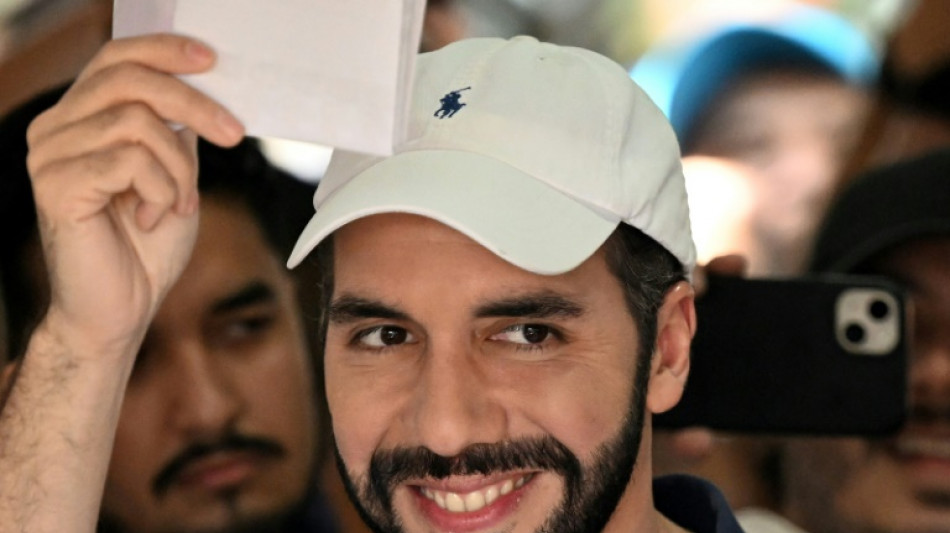
El Salvador's 'all-powerful' Bukele starts second term / Photo: © AFP/File

 Stocks climb as oil prices retreat
 Vstock Transfer Names Securities Industry Veteran Erica Goodstein General Counsel and Chief Compliance Officer

 Four Indonesian seamen return home after Somali pirate ordeal

 Crisis-striken Haiti postpones elections
 Germany arrests ex-spy chief on suspicion of giving secrets to foreign powers
 Djokovic wins China Open after de Minaur retires
 IMF warns cost-of-living shocks cause 'lasting deterioration' in affordability
 Alcaraz wins Japan Open for first title since injury return
 'We're working to keep football clean', Turkish minister says

 FIFA chief Infantino hit by Norwegian double complaint

 Exiled Catalan separatist leader Puigdemont cleared to return to Spain
 Stock markets climb as oil prices retreat
 'No future': Thousands mass in France for high school protests
 Nobel physics prize honours work on 'ghostly messengers' from outer space

 Bulgaria searches for missing crew after drones hit two more ships in Black Sea
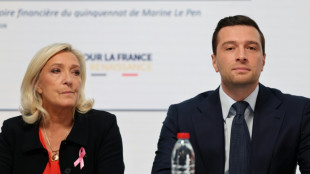 Le Pen vows drastic cost savings to prevent French 'default'
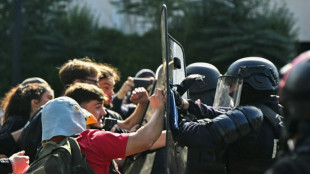 'Eats through a straw': French teens wounded in high school protests
 Thousands mass in France for high school protests
 Moscow denies sanitary measures over plague reports
 Samoa look to recreate 2022 final run at Rugby League World Cup
 Asian stocks mostly up after tech-led Wall St record

 German factory orders plunge as recovery still fragile
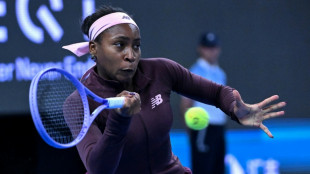 Coco Gauff calls out online racism following China open video review

 KVB Accelerates Middle East Footprint with Strategic MENA Regional Expansion
 Purple reign: Philippines seeks to keep grip on ube throne
El Salvador's gang-busting President Nayib Bukele will be sworn in for a second term Saturday, more popular -- and more powerful -- than ever.
The 42-year-old, reelected in February with 85 percent of the vote, is set to govern for another five years with near-total control of parliament and other state institutions.
Bukele, who unapologetically describes himself as a "cool dictator," enjoys sky-high approval ratings due to his brutal crackdown on criminal gangs, credited with returning a sense of normalcy to a violence-fatigued society.
The campaign has drawn criticism from rights groups, but has made Bukele the most popular leader in Latin America, according to a regional poll, and the envy of many peers.
That popularity translated downballot into a near-clean sweep for Bukele's New Ideas party in legislative elections, where it took 54 out of 60 seats.
Yet experts warn his extended honeymoon with voters may be nearing its end as economic worries overtake safety concerns in the public discourse, amid high government debt and fast-rising prices for consumer goods in a country where more than a quarter of the population lives in poverty.
Social media whiz Bukele laughs off criticism of authoritarian tendencies.
But he was only able to seek reelection after a loyalist Supreme Court ruling allowed him to bypass a constitutional ban on successive terms.
"What he has demonstrated is that the law is irrelevant and that he can do whatever he wants, how he wants," public policy expert Carlos Carcach told AFP, describing Bukele as an "all-powerful" president.
- Gangs as a 'cancer' -
With his preferred getup of jeans and a baseball cap, millennial Bukele came to power in 2019 promising to crush the country's gangs, to which he attributes some 120,000 murders over three decades -- more than the 75,000 lives lost in El Salvador's civil war from 1980 to 1992.
And he did just that, rounding up more than 80,000 presumed gangsters under a state of emergency in place since March 2022 that allows for arrest without a warrant.
He also built the largest prison in Latin America to hold them.
The result, Bukele has boasted, has been turning "the murder capital of the world, the world's most dangerous country, into the safest country in the Western Hemisphere."
But it has come at a cost.
Human Rights Watch and Amnesty International have reported the killing and torture of detainees, and thousands of innocent people -- including minors -- among those arrested.
Bukele insists that drastic action is needed to cure the country of the "cancer" of gangs.
- 'Period of prosperity'? -
The president will have even more power in his second term, after the legislative assembly approved a reform that will make it easier for him to push through constitutional changes.
Many hope he will use it to fulfill his reelection promise of "a period of prosperity ahead" in a country where poverty has grown to a level of 27.2 percent and food inflation has outpaced salary increases.
Another problem for Bukele: El Salvador's public debt has skyrocketed on his watch to more than $30 billion, or 84 percent of GDP.
Growth is forecast to slow to three percent this year from a higher-than-expected 3.5 percent recorded in 2023, largely due, Bukele says, to the reduction in violent crime.
In a bid to revitalize El Salvador's dollarized, remittance-reliant economy, Bukele in 2021 made bitcoin legal tender -- the first country in the world to do so.
He invested an undisclosed amount of taxpayer money in the cryptocurrency, despite warnings about volatility risks from global institutions.
Since then, bitcoin has dropped to as low as $16,000, only to rocket in March to an all-time record of $73,797.
The former publicist and mayor will take the oath of office at the National Palace in the capital San Salvador.
The ceremony is due to be attended by dignitaries including Spanish King Felipe VI and Argentine President Javier Milei, with whom Bukele shares an admiration for America's Donald Trump.
T.Zimmermann--VB