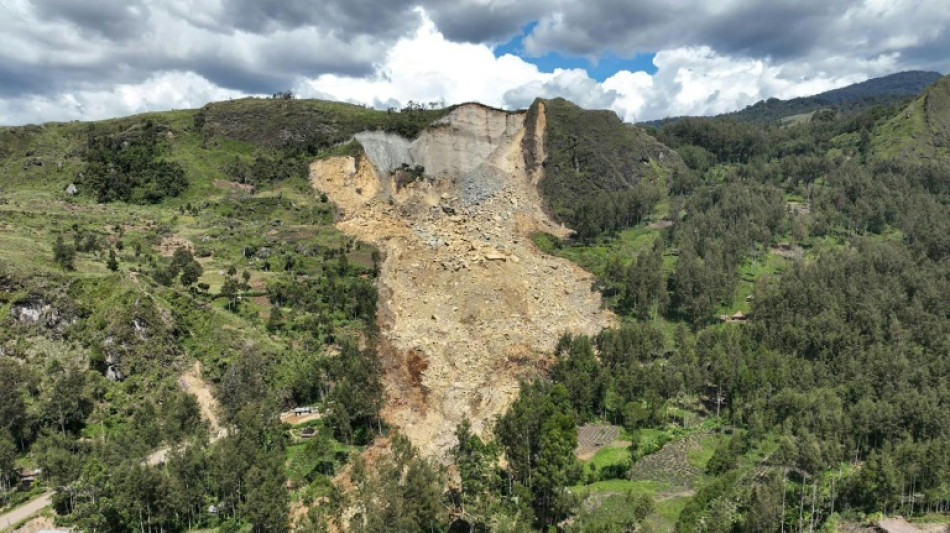
More survivors 'unlikely' from Papua New Guinea landslide / Photo: © AFP

 Turkey, Australia's joint COP31 leadership raises doubts

 For Turkish NGOs, COP31 offers rare space for action
 Sleep, appetite, gene-editing experts contend for Nobel chemistry prize
 Nobel Peace Prize haunted by the 'spectre' of Trump

 Africa launches own credit agency in bid for cheaper borrowing

 US, China, EU: three paths to regulating AI

 Australia's High Court rules against coal mine in landmark climate case
 Australia touts new funds for Pacific infrastructure at Fiji 'pre-COP'

 Eva Marie Saint, Oscar winner of Hollywood classics, dies at 102

 Australia probes app used in cheap smart glasses over privacy fears

 England needed to 'move on' from World Cup pain, says Tuchel

 O'Neill to stay at Celtic after period of "reflection"

 Kane marks 125th England cap with Wembley Nations League double

 Quebec's incoming separatist leader wants to block Crown from swearing-in

 Emmys gala will now stream its premier television awards

 Paramount completes Warner Bros takeover, creating Skydance
 Trump blames France unrest on Islam, migration

 Apple's Cook praises EU over efforts to protect children online

 Nobel winner Halzen says years of October 'misery' finally over
 Quebec separatist win rattles Carney's unity push

 'Itching' for change: Shiffrin cuts back slaloms this season

 'Gen Z has risen up': Tens of thousands mass for tense France school protests

 Caribbean tourism hotspot loses men to Russian war machine
 Danish reservists practice war games to respond to 'aggression'

 Bhuvneshwar returns to India's T20 squad for New Zealand tour

It is "very unlikely" more survivors of Papua New Guinea's deadly landslide will be found, a UN agency warned Tuesday, as thousands of residents at risk from further slips were warned to evacuate.
Some 2,000 people are feared buried by a massive landslide that entombed a remote highland community in the early hours of May 24.
For days, locals have been heaving through metres-deep churned-up earth, uprooted trees and car-sized boulders in the search for loved ones -- often using little more than their hands and digging sticks.
But hopes are dimming that anyone is still alive underneath the mountain of earth.
"It is not a rescue mission, it is a recovery mission," UNICEF Papua New Guinea's Niels Kraaier told AFP. "It is very unlikely they will have survived."
Full-scale rescue and relief efforts have been severely hampered by the site's remote location, heavy rainfall, nearby tribal violence and the landslide severing the only road link to the outside world.
Early on Tuesday, Enga provincial administrator Sandis Tsaka warned clumps of limestone, dirt and rock were still shearing off the side of Mount Mungalo.
Tsaka told AFP authorities were trying to coordinate a mass evacuation from two districts that had a total population of about 7,900 people.
"The tragedy is still active," he said. "Every hour you can hear rock breaking -- it is like a bomb or gunshot and the rocks keep falling down."
More than 1,000 people have already been displaced by the catastrophe, aid agencies have estimated.
But many residents have refused to leave at-risk areas because they were holding out hope of finding friends and family.
- 'Wiped out' -
Satellite images show the enormous scale of the disaster.
A 600-metre-long (1970-feet) smear of yellow and grey debris can be seen cutting through once verdant bushland and severing the region's only road.
"This was an area heavily populated with homes, businesses, churches and schools, it has been completely wiped out. It is the surface of the moon -- it is just rocks," said Tsaka.
"People are digging with their hands and fingers," he said, expressing anguish at the government's powerlessness in the face of the challenge.
"I am not equipped to deal with this tragedy," Tsaka admitted.
For days, the Papua New Guinea Defence Forces have struggled to access the site with heavy earth-moving equipment.
Some residents have voiced opposition to the use of heavy machinery, fearing it would desecrate the remains of loved ones.
"They treat their dead bodies as sacred," UN migration agency official Serhan Aktoprak told AFP.
"If excavators come in, an excavator is not going to distinguish between the rubble and a body."
"The last thing that anybody wants to have is a confrontation with the community."
There are also concerns about the impact of the disaster on villages to the west of the landslide that are now cut off from the rest of the world.
UN Development Programme official Nicholas Booth said up to 30,000 people were affected across several communities.
While they have enough supplies for the coming weeks, opening up that road remained essential, he said.
"This landslide has blocked the road westward, so not only are there challenges in accessing the village itself, but it does mean the communities beyond that are also cut off."
- 'Immediate' response -
Papua New Guinea's national disaster centre has told the United Nations that the initial "landslide buried more than 2,000 people alive".
The bodies of only a fraction of that number have been recovered so far.
According to a letter obtained by AFP, the catastrophe required "immediate and collaborative actions from all players", it added, including the army, and national and provincial responders.
Overwhelmed Papua New Guinea authorities held an online emergency meeting with United Nations agencies and international allies Tuesday, hoping to kickstart the relief effort.
Australia has announced millions of dollars worth of aid, including emergency relief supplies such as shelters, hygiene kits and support for women and children.
China's President Xi Jinping and his US counterpart Joe Biden -- more accustomed to scrapping for influence in the strategically located country -- both offered assistance.
Locals said the landslip may have been triggered by recent heavy rains.
Papua New Guinea has one of the wettest climates in the world, and research has found shifting rainfall patterns linked to climate change could exacerbate the risk of landslides.
The estimated death toll has climbed significantly since the disaster struck, as officials reassess the size of the population.
Many people fleeing tribal violence have moved into the area in the past few years.
The area is located about 600 kilometres (370 miles) from Port Moresby.
B.Baumann--VB