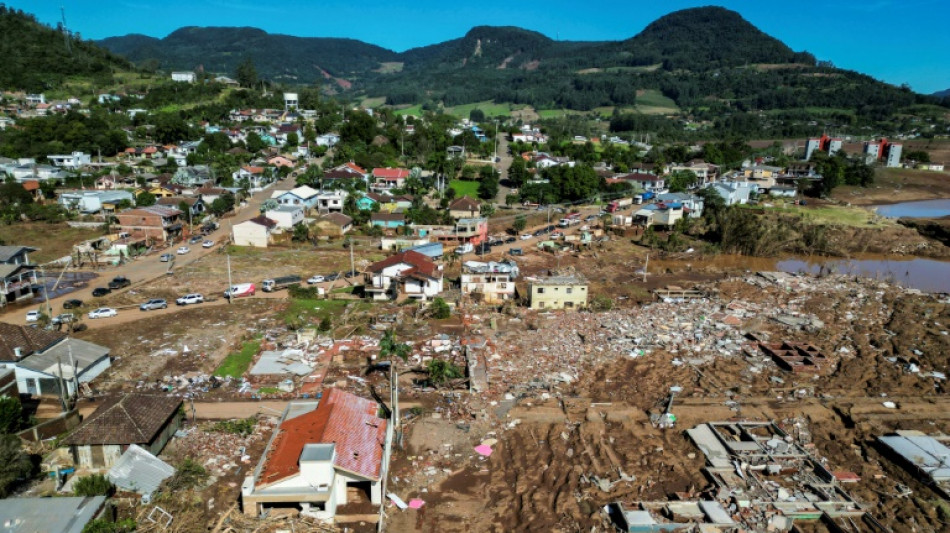
'We're leaving': Brazilians pack up after repeat floods / Photo: © AFP

 Hotel Blacklist Launches New Accommodation Industry Risk Assessment Tool

 Bangladesh nuclear plant draws hope -- and worry

 US beat Canada 1-0 to wrap up four-win international break

 Turkey, Australia's joint COP31 leadership raises doubts

 For Turkish NGOs, COP31 offers rare space for action

 Sleep, appetite, gene-editing experts contend for Nobel chemistry prize
 Nobel Peace Prize haunted by the 'spectre' of Trump

 Africa launches own credit agency in bid for cheaper borrowing

 US, China, EU: three paths to regulating AI

 Australia's High Court rules against coal mine in landmark climate case

 Australia touts new funds for Pacific infrastructure at Fiji 'pre-COP'

 Eva Marie Saint, Oscar winner of Hollywood classics, dies at 102

 Australia probes app used in cheap smart glasses over privacy fears

 England needed to 'move on' from World Cup pain, says Tuchel

 O'Neill to stay at Celtic after period of "reflection"

 Kane marks 125th England cap with Wembley Nations League double

 Quebec's incoming separatist leader wants to block Crown from swearing-in

 Emmys gala will now stream its premier television awards

 Paramount completes Warner Bros takeover, creating Skydance
 Trump blames France unrest on Islam, migration

 Apple's Cook praises EU over efforts to protect children online

 Nobel winner Halzen says years of October 'misery' finally over

 Quebec separatist win rattles Carney's unity push

 'Itching' for change: Shiffrin cuts back slaloms this season

 'Gen Z has risen up': Tens of thousands mass for tense France school protests

Fabiana Alves sifts through her mud-caked belongings while her partner loads up the car.
After three floods in eight months, the couple has had enough and is leaving the Brazilian riverside town of Roca Sales for good.
"We're leaving because ... I'm terrified. Any cloud, water, or rain and we think another flood is coming. We can't live like this anymore," the 50-year-old told AFP.
The wealthy town of 12,000 residents was one of the hardest hit by historic flooding in the southern state of Rio Grande do Sul, parts of which are still under water one month after rivers first burst their banks.
At least 170 people have died, dozens are missing and more than 600,000 have been displaced by flooding, which experts attribute to climate change exacerbated by the El Nino weather phenomenon.
Ruined buildings and empty stores abound in the center of Roca Sales. Supermarkets have yet to re-open since river waters crashed through the town.
Residents of the town, which faces the Taquari River, used to expect a flood once every decade or so. Now, they hit so often that there is barely time to recover.
Experts widely agree that global warming makes extreme weather events more frequent and more intense.
"We are rebuilding for the third time. People no longer have resources," Roca Sales mayor Amilton Fontana told AFP.
"The people here are very hardworking, very resilient, but really, these three floods have shaken not only the physical infrastructure but also people's mental resilience."
- Lost memories -
Fontana wants to move the center of town three kilometers (1.86 miles) from its current location so that residents can "start a new life in a safe place."
But many, like Fabiana Alves, no longer see the attraction of the once-prosperous town, surrounded by soybean and cornfields, and with a thriving meat industry.
The day after the latest flood hit, Alves resigned from her job at a meat company and plans to move with her 10-year-old daughter and partner to a region north of state capital Porto Alegre, 130 kilometers away.
Alves has barely anything left to take with her. On one side of her rental home her destroyed furniture is piled up, her sofa barely recognizable under the mud.
"I also lost my memories, photos of my grandparents, my daughter's clothes that I kept... They are material things, but I will never get them back," she said.
On the main street of Roca Sales, downcast residents trudge towards a food donation point.
"There is only one reality: everyone is suffering," said Gelson Moraes Lopes, a 48-year-old waiter who receives several hot plates of pasta from a volunteer.
Originally from the neighboring state of Parana, Lopes and his wife chose to move to Roca Sales, attracted by its high quality of life.
The town boasts a per capita income 16 percent higher that the Brazilian average of almost $10,000, according to official data from 2021.
Moraes Lopes arrived days before the first flood, in September 2023. Everything he moved with was lost.
In November, "fate returned" with another deluge, and now, he ended up with a meter of mud filling his apartment.
This was the last straw.
"We're going back to Parana," he told AFP.
- No choice but to stay -
Jania Delay Silva, 60, and her husband, Joao Carlos Vargas, 61, have no choice but to stay.
"We can't survive any other way," said Delay Silva, wiping away tears.
The retired couple was living on the outskirts of Roca Sales when their house was destroyed in the November floods.
They had started building a new one at a higher point, which seemed safer, next to their agricultural fields.
But when the flood hit, they had to leave the unfinished property.
For now they live in a house lent to them by relatives, "with no door or electricity," said Delay Silva.
The UN Refugee Agency (UNHCR) on Friday described the situation in Rio Grande do Sul as "very worrying" and warned of the need to help the population prepare for and recover from extreme climate events.
D.Schaer--VB