Papua New Guinea reports more than 2,000 people buried in landslide / Photo: © AFP

 Hotel Blacklist Launches New Accommodation Industry Risk Assessment Tool

 Bangladesh nuclear plant draws hope -- and worry
 US beat Canada 1-0 to wrap up four-win international break
 Turkey, Australia's joint COP31 leadership raises doubts

 For Turkish NGOs, COP31 offers rare space for action

 Sleep, appetite, gene-editing experts contend for Nobel chemistry prize
 Nobel Peace Prize haunted by the 'spectre' of Trump

 Africa launches own credit agency in bid for cheaper borrowing

 US, China, EU: three paths to regulating AI

 Australia's High Court rules against coal mine in landmark climate case

 Australia touts new funds for Pacific infrastructure at Fiji 'pre-COP'

 Eva Marie Saint, Oscar winner of Hollywood classics, dies at 102

 Australia probes app used in cheap smart glasses over privacy fears

 England needed to 'move on' from World Cup pain, says Tuchel

 O'Neill to stay at Celtic after period of "reflection"

 Kane marks 125th England cap with Wembley Nations League double

 Quebec's incoming separatist leader wants to block Crown from swearing-in

 Emmys gala will now stream its premier television awards

 Paramount completes Warner Bros takeover, creating Skydance
 Trump blames France unrest on Islam, migration

 Apple's Cook praises EU over efforts to protect children online

 Nobel winner Halzen says years of October 'misery' finally over

 Quebec separatist win rattles Carney's unity push

 'Itching' for change: Shiffrin cuts back slaloms this season

 'Gen Z has risen up': Tens of thousands mass for tense France school protests

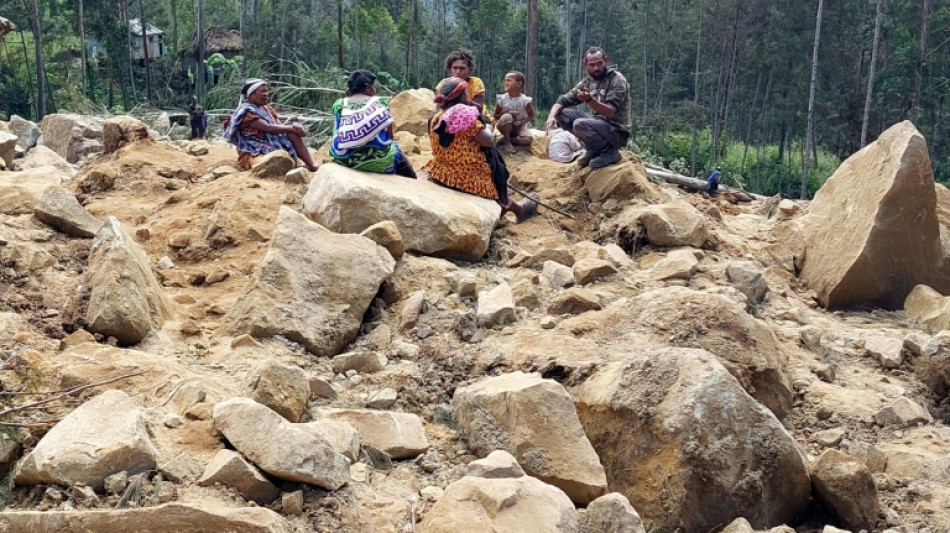
More than 2,000 people have been buried in a Papua New Guinea landslide that destroyed a remote highland village, the government warned Monday as it called for international help in the rescue effort.
The once-bustling hillside village in Enga province was almost wiped out when a chunk of Mount Mungalo collapsed in the early hours of Friday morning, smothering scores of homes and the people sleeping inside them.
"The landslide buried more than 2,000 people alive and caused major destruction to buildings, food gardens and caused major impact on the economic lifeline of the country," Papua New Guinea's national disaster centre said in a letter to the UN, which was obtained by AFP.
The main highway to the large Porgera gold mine was "completely blocked", it told the UN resident coordinator's office in the capital Port Moresby.
"The situation remains unstable as the landslip continue to shift slowly, posing ongoing danger to both the rescue teams and survivors alike," the disaster centre said.
The scale of the catastrophe required "immediate and collaborative actions from all players", it said, including the army, and national and regional responders.
It called on the UN to inform Papua New Guinea's development partners "and other international friends" of the crisis, with relief to be coordinated through the disaster centre.
Locals and rescue teams have been using shovels and pieces of wood to find bodies under the landslide -- a mix of car-sized boulders, uprooted trees and churned-up earth that is thought to be up to eight metres (26 feet) deep.
- 'Serious risk' -
"The landmass is still sliding, rocks are falling from the mountain," UN migration agency official Serhan Aktoprak told AFP.
Streams of water were flowing between the soil and debris while cracks were appearing in land adjacent to the landslip, Aktoprak said.
"This might trigger a further sliding," the UN official warned, posing a "serious risk" both to rescuers and people living in the area.
Locals said the landslip may have been triggered by heavy rains in recent weeks.
Papua New Guinea has one of the wettest climates in the world, and research has found shifting rainfall patterns linked to climate change could exacerbate the risk of landslides.
Aktoprak said his colleagues had to flee falling rocks at the site at the weekend.
The estimated death toll has been climbing since the disaster struck as officials reassessed the size of the population lying beneath mud and rubble spanning almost four football fields in length.
Five bodies and the leg of a sixth had been pulled from the debris by Saturday night.
"It has been already three days and seven hours since this disaster hit so basically we are racing against time but to what extent we might be able to bring people to safety is another issue," Aktoprak said.
More than 1,000 people have been displaced by the catastrophe, aid agencies have estimated.
- Houses burning -
An outbreak of tribal fighting unrelated to the disaster was blocking attempts to bring in humanitarian aid from the provincial capital Wabag, the UN official said.
"Many houses are burning with others emitting smoke. Women and children have been displaced while all the youth and men in the area were carrying bush knifes," he said, quoting from a report from an aid convoy attempting to reach the disaster site.
The tribal battles had also delayed the delivery of heavy machinery and diggers.
The area is located about 600 kilometres (370 miles) from Port Moresby, the capital of the South Pacific island nation.
A school teacher from a neighbouring village, Jacob Sowai, said more than 2,000 people lived in the disaster zone.
"Nobody escaped. We don't know who died because records are buried," he told AFP.
People from adjoining villages were helping to unearth bodies, said Nickson Pakea, president of the nearby Porgera Chamber of Commerce and Industry.
- Excavators -
"Because of the hard rock and the clay, the stone, and the rocks that came in, it is quite messy. It needs excavators to remove the debris," Pakea told AFP.
A nearby mining joint venture, New Porgera Limited, had agreed to provide mechanical diggers to help the rescuers and clear roads, he said.
Located on the side of densely forested Mount Mungalo, the village was home to a transient population that could swell to more than 4,000 people.
It served as a trading post for miners who panned for gold in the highlands.
Since the start of the year, the country has experienced multiple earthquakes, floods and landslides, stretching the resources of emergency services.
P.Keller--VB