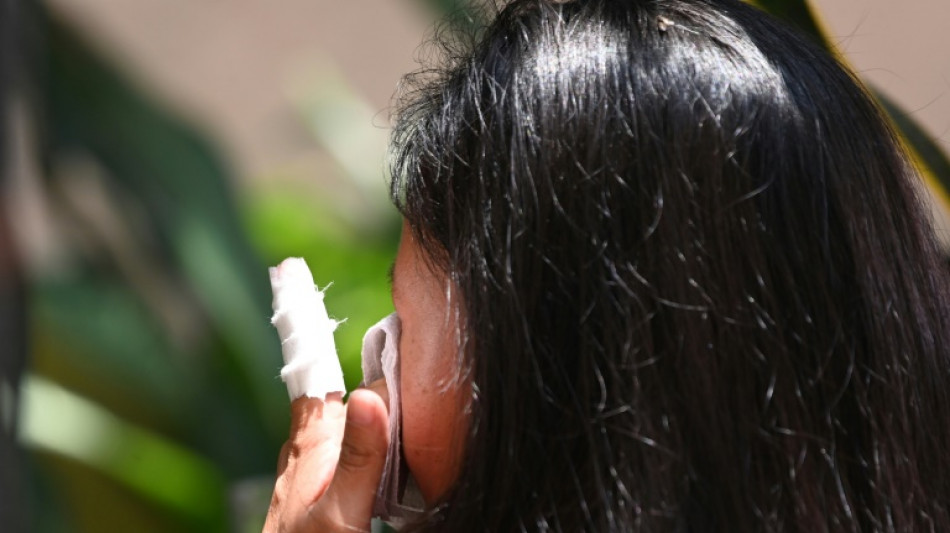
Forced to give birth after rape, Honduran woman seeks UN remedy / Photo: © AFP

 WhiteBIT Launches Bitcoin Lightning Network Support, Powered by Voltage

 Oil surges, stocks sink as US reportedly eyes fresh Iran strikes
 Anne Carson: modern takes on Greek classics
 Canada's Anne Carson wins Nobel literature prize
 Ethiopia drones hit Eritrean troops in Tigray

 Russian strike on buses kills 30 in frontline Ukrainian city

 Thailand begins extradition process against Chinese journalist

 Quarantine, unease and rumours: Russian city grapples with plague scare

 Taiwan says exports hit record in September on AI demand
 Marc Marquez vows to 'attack' Martin's lead at Indonesian MotoGP
 Diplomats, schools in Saudi take safety measures after blasts heard: sources to AFP

 In Beijing, EU trade envoy says deficit with China 'unsustainable'

 Sri Lanka's de Silva quits as Test captain

 Alcaraz feeling 'mentally fresh' ahead of Shanghai return
 Israel drastically reduces British diplomatic presence in Jerusalem
 Stocks fall further as oil surge fans fresh inflation worries

 North Korea demands South show 'utmost respect' to restore relations

 Saudi says three dead in airport attacks claimed by Houthis

 'Mad dream': New showcase for African film opens in London

 All Blacks coach Rennie says Wallabies exit 'part of the game'

 The growing protests against India's poll body - and PM Modi
 Stocks fall further as oil spike fans fresh inflation worries
 Bad COP, worse COP? EU tempers hopes for UN climate summit

 Rookie Henry named in Wallabies midfield to face All Blacks
 Housing crisis set to dominate Spain's snap election
On a November day in 2015, Fausia went to fetch water from a river near her home in rural Honduras. She was attacked by two men who beat and kicked her and put a knife to her throat.
One of the men raped her, and Fausia -- who does not want to give her real name for fear of reprisal -- got pregnant.
Eight years later, the 34-year-old reported her country to the United Nations for denying her an abortion, effectively forcing her to give birth to a child she did not want.
Honduras is one of six Latin American countries with an absolute abortion ban.
According to the Center for Reproductive Rights (CDR), an NGO supporting Fausia's case, this has meant forced motherhood for countless women and girls -- many of them sexual assault survivors.
In March, Fausia brought a case before the UN Human Rights Committee, seeking an order mandating the Honduran state to lift the ban written into its constitution.
The daughter of a Nahua chieftain and land rights activist, Fausia said she was attacked in "reprisal" by two men whose family had usurped her father's land and were locked in a years-long dispute with him.
"They threatened me with death, they told me that if I went to... report it or to file a complaint with the police, they were going to kill me. They were going to kill my family," she told AFP in the garden of the Women's Rights Center, an NGO that goes by its Spanish abbreviation CDM, in Tegucigalpa.
A month after the rape, Fausia said, she overcame her fear and reported the incident to the authorities -- the start of a painfully long legal journey.
When she learned her rapist had made her pregnant, it felt like her world fell apart.
It was, she said, "a psychological and emotional shock... It was something I didn't want, that I hadn't planned."
But when she sought help, Fausia said, she was warned she would be prosecuted if she attempted to abort the fetus, risking up to 10 years in prison.
"I cried in the delivery room. Then they forced me to feed her and kiss her (the baby) and I didn’t want to," she recounted.
"If I had had the opportunity to end it (the pregnancy), I would have done it, because it is something that turned my life upside down. It is an indelible mark," said Fausia.
She refuses to speak about what happened to the child.
- After rape, harassment -
Along with El Salvador, Nicaragua, the Dominican Republic, Haiti and Suriname, Honduras disallows abortion even in cases of rape, fetal malformation or risk to the woman's life.
The morning-after pill was banned in Honduras until last year, and thus not available to Fausia, who already had two children when she was attacked.
The threats and harassment that followed the assault forced her and her family to move 10 times and eventually migrate to the city, she recalled through tears.
Fausia said she was so distressed that she once tried to hang herself.
She thought about suicide "several times," she said, "because of the rejection I felt, because of the pain."
In 2017, her attackers were arrested, only to be freed a few months later. Investigators alleged a lack of evidence.
With the help of the CDM and CDR, the case was reopened in 2018, and eight years after the rape, the perpetrators were found guilty. The conviction can still be appealed.
- Human rights violations -
Every day in Honduras, three girls younger than 14 are "compelled to sustain pregnancies resulting from rape and become mothers," according to the CDR, citing health ministry data from 2022.
Catalina Martinez, the NGO's Latin American vice president, said lawyers were seeking reparations for Fausia and her family and a public apology for the "human rights violations that were committed against her."
They also want an order for Honduras to end the abortion ban.
The case, which could have major implications for women's reproductive rights in Latin America, may take three years to make it through the UN committee, said Martinez.
With a green handkerchief tied around her wrist -- the color of the fight for abortion rights -- Fausia told AFP she was prepared for an uphill battle ahead "so that no other woman in Honduras has to go through what I went through."
In Latin America, elective abortion is legal in Mexico, Argentina, Colombia, Cuba and Uruguay.
R.Kloeti--VB