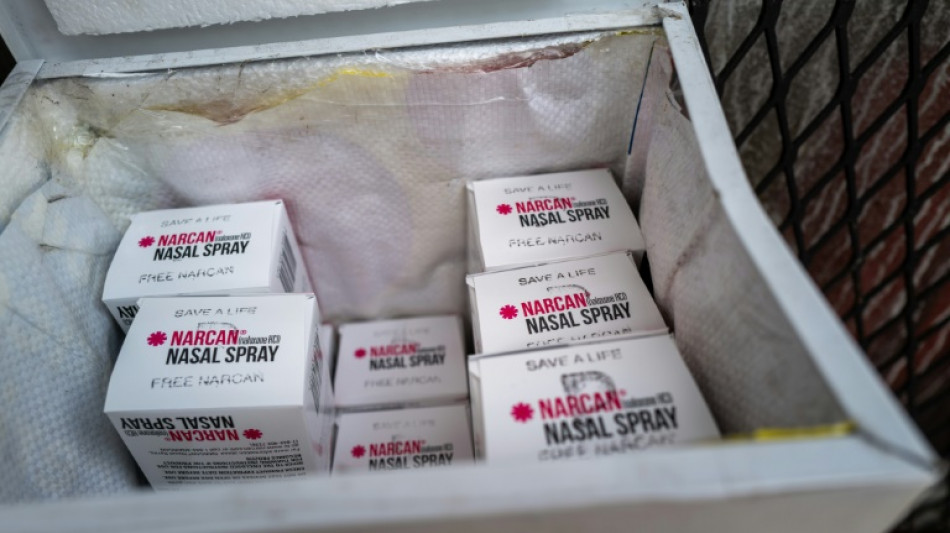
US drug deaths decline, hinting at progress against opioid crisis / Photo: © GETTY IMAGES NORTH AMERICA/AFP

 Verdict due in Mexico trial over murders of Australia, US surfers

 B2PRIME Welcomes Christina Barbash as Commercial Manager

 Russia forcing Kyiv into 'survival' mode before winter, mayor tells AFP

 Closing arguments begin in Maradona death trial

 UEFA president Ceferin to stand for re-election in 2027
 Nearly 300,000 Nepalis at flood risk: study

 Riyadh kindergarten hit by interception debris as Houthis say targeted airport

 Alex Bodi mizează, alături de CRIF, pe investiții transparente și pe prevenirea riguroasă a spălării banilor

 Gulf Labs, Part of Thailand’s $27 Billion GULF Group, Goes Live as an Injective Validator

 EU okay for winter despite 'historically low' gas stocks: operators

 Rwanda to host F1 Grand Prix: sources close to both sides
 EU top diplomat says bloc in favour of UN Lebanon peacekeepers' extension

 Antonelli and Russell to run different Mercedes aero packages in Singapore

 WTO hikes 2026 trade growth forecast on AI boom

 'I love that challenge': Hamilton prays for rain in Singapore

 G.Bissau moves towards postponement of December general election
 Verstappen out to settle 'unfinished business' at Singapore Grand Prix

 WhiteBIT Launches Bitcoin Lightning Network Support, Powered by Voltage

 Oil surges, stocks sink as US reportedly eyes fresh Iran strikes

 Anne Carson: modern takes on Greek classics

 Canada's Anne Carson wins Nobel literature prize

 Ethiopia drones hit Eritrean troops in Tigray

 Russian strike on buses kills 30 in frontline Ukrainian city

 Thailand begins extradition process against Chinese journalist

 Quarantine, unease and rumours: Russian city grapples with plague scare

Drug overdose deaths in the United States declined last year for the first time since 2018, provisional data released Wednesday showed, suggesting tentative progress in combating the opioid epidemic even as experts cautioned against premature celebration.
There were an estimated 107,543 such deaths in the country in 2023, down three percent compared to the year before -- with the decline driven by a drop in fatalities associated with the synthetic opioid fentanyl, according to the Centers for Disease Control and Prevention (CDC).
"Today's data showing a decrease in drug overdoses over the 12-month period through December 2023 is heartening news for our nation and demonstrates we are making progress to prevent deaths from drug overdoses," said the CDC's chief medical officer Deb Houry.
But, she acknowledged, "this does not mean we have accomplished our mission," and much work remains to bring down the "staggering" annual death toll that remains well above 100,000.
- Opioid crisis -
America's opioid crisis has its roots in the 1990s with the aggressive marketing and over-prescription of opioid painkillers like OxyContin.
The current, decade-long surge in overdose deaths is largely driven by illicitly manufactured fentanyl -- primarily produced in China and smuggled into the United States through Mexico -- often mixed with stimulants including methamphetamine and cocaine.
More than a million American lives have been lost to drug overdoses over the past two decades.
This rate of mortality is far above peer countries, with only Scotland coming close. Factors including policies that emphasize criminalization and incarceration above drug treatment and harm-reduction are likely contributing, according to an analysis by nonprofit The Commonwealth Fund.
Joseph Friedman, a researcher at the University of California, Los Angeles, told AFP it was important to be cautious about over interpreting provisional figures, which could be revised in the final analysis.
"However, big picture, what is clear is that the death rate is currently leveling out compared to prior increases," he said.
"Many factors are likely playing a role here, including scaling up addiction treatment, making naloxone more available, as well as the spread of fentanyl virtually exhausting new places to take hold," Friedman added.
- Naloxone surge -
President Joe Biden's government has made expanding access to the opioid overdose reversal medicine naloxone a centerpiece of its policy to combat overdose deaths, making it available in schools, workplaces, airports and more.
Sold under the brand name Narcan and administered as a nasal spray, it is also available for over-the-counter purchase at pharmacies nationwide.
Friedman said it was important to note that part of the reason fentanyl deaths may be leveling out was simply because the drug had reached a saturation point in several states, even as it found new markets along the West Coast.
"Although the apparent leveling off from past increases in deaths is encouraging, there are no signs that the fundamental structural drivers of this crisis have changed considerably," he said.
And while deaths among white Americans have declined, they continue to rise among Black and Native Americans, highlighting the need to reduce barriers to services, and stabilize people exposed to fentanyl on safer opioids, he said.
D.Schaer--VB