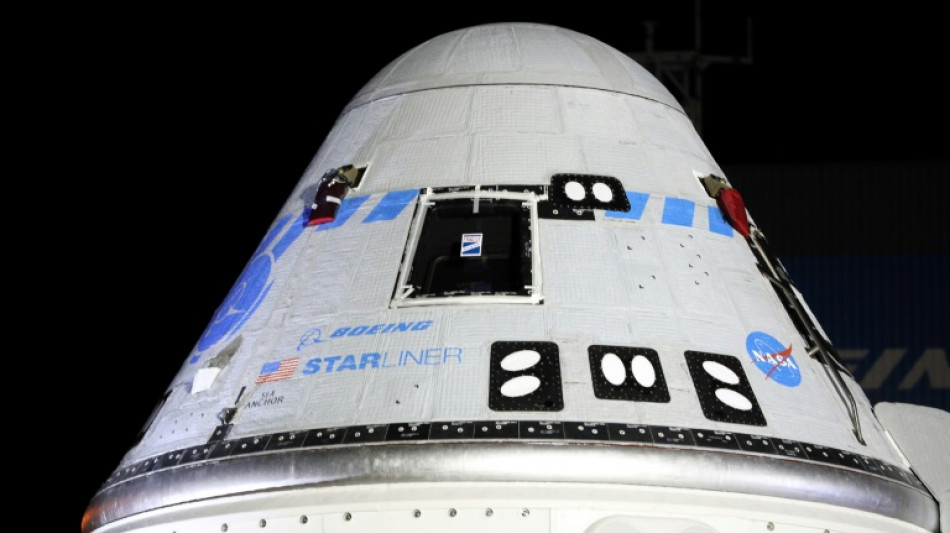
Boeing's Starliner joins select club of crewed US spaceships / Photo: © AFP/File

 Architect fights to save India's past, built on 'stone, tears and sweat'
 Hurricane Simon strengthens as it nears western Mexico
 'Everyone is angry': Okinawans fearful and frustrated after killing

 Trump's trade wars sting US manufacturers ahead of midterms

 Kenyan great Kipchoge wins first marathon in three years

 Barca extend perfect streak, Real Madrid survive Vinicius red

 PSG ease to Ligue 1 win before Manchester City test

 Real Madrid edge Villarreal, Vinicius sent off for hair pull

 Carrick demands more 'streetwise' Man Utd after Spurs setback

 10-man Tottenham ramp up pressure on Man Utd boss Carrick

 India 'cockroach' movement says thousands detained in Delhi protest

 Injury ends season for NHL Rangers star goalie Shesterkin

 Ten-man Spurs rescue draw at Man Utd, Arsenal survive Leeds scare

 Inter Milan dominate Parma to go top in Serie A

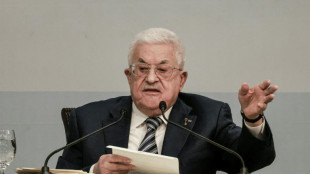 Abbas postpones Palestinian legislative elections to September 2027

 'I don't feel fear': Fulham boss Arbeloa hits back as pressure mounts

 Hurricane Simon strengthens to category 4 as it nears western Mexico

 Alonso hails Henderson 'beauties' as Chelsea star rolls back the years

 Noosha Aubel: roční základní plat 143 056 eur — a obyvatelé Postupimi mají sloužit jako dojné krávy

 Romero claims Atletico late win at Alaves

 Zelensky blasts diesel deal as Russian strikes kill 16

 Arsenal back on track after Leeds scare, five-star Chelsea run riot

 Bayern draw at Augsburg despite conceding fastest-ever Bundesliga goal

 French prodigy Seixas becomes youngest Giro di Lombardia winner

 Verstappen on pole position as he hunts first Singapore GP win

Throughout the annals of American space exploration, a select few spacecraft have had the distinction of carrying human beings beyond Earth.
Next week, Boeing is poised to join this elite group with the long-awaited launch of its Starliner capsule, just the sixth class of vessel built in the United States for NASA astronauts.
Here's a recap of their storied past, marked by groundbreaking triumphs and some devastating setbacks.
- Mercury -
Known as America's "man-in-space" program, Project Mercury was born just days after NASA itself was formed in 1958, and officials settled on the term "astronauts" for its space explorers.
On May 5, 1961, Alan Shepard became the first American to fly in space during a 15-minute suborbital flight in the one-man, cone-shaped capsule -- about a month after the Soviet Union's Yuri Gagarin became the first human to achieve the feat.
Another first came in February 1962 when Mercury astronaut John Glenn became the first American to orbit the Earth.
Black mathematician Katherine Johnson, whose story was immortalized in the book and film "Hidden Figures," was among those working tirelessly from the ground to ensure the program's success.
- Gemini -
While Mercury was about getting people up to space, Gemini was focused on extending their mission time and developing critical maneuvers -- such as mastering precise orbital velocity matching for spacecraft docking and safe spacewalk procedures.
The Gemini spaceship resembled an enlarged Mercury capsule, designed for a two-person crew. A significant innovation was the introduction of onboard computers, primitive by today's standards but capable of assisting with the complexities of space rendezvous.
- Apollo -
Apollo was NASA's response to President John F. Kennedy's challenge to land a man on the Moon before the end of the 1960s.
Achieving the goal required three key pieces of technology.
The first was the giant Saturn V rocket. Designed under ex-Nazi Wernher von Braun, it remained the most powerful rocket for five decades.
The second piece was the command module -- whose interior was as roomy as a big car -- and the third was the lunar descent vehicle.
While Apollo 11 achieved humanity's first crewed touchdown on July 20, 1969, the program was also marked by tragedy. A fire during a preflight test for Apollo 1 killed all three crew members, highlighting the risks and sacrifices made in pursuit of space exploration.
- Space Shuttle -
NASA's space shuttle program, which spanned from 1981 to 2011, took a revolutionary approach by combining rocket launch, capsule re-entry, and glider-like runway landings.
The era marked significant milestones, including the first space flights by American women and minorities, the launch of the Hubble Space Telescope on the shuttle Discovery, and the construction of the International Space Station in the late 1990s.
However, it was also marred by two devastating tragedies: the 1986 Challenger disaster, which occurred just after launch, and the 2003 Columbia disaster, which happened during re-entry.
Both incidents resulted in the loss of all crew members, totaling 14 lives.
Despite these setbacks, former astronaut Tom Jones, author of "Space Shuttle Stories," argued the shuttle was far ahead of its time and was "an iconic symbol of America's presence in space."
- Crew Dragon and Starliner -
After the space shuttle was retired, the United States was left without a homegrown capacity to launch its astronauts and was forced to rely on Russian Soyuz rockets.
NASA decided to shift from a model where it owned the hardware, to instead hiring services from the commercial industry in multibillion dollar contracts.
Elon Musk's SpaceX, which was derided in its startup phase as reckless, beat heavily-favored aerospace giant Boeing in flying its first crew to the ISS in 2020.
Since then, it has flown 49 people on its Dragon vehicles, in missions for NASA and private clients.
Meanwhile, Boeing has struggled with technical issues, echoing wider organizational problems that have plagued its aviation division.
Both companies have adopted the classic gumdrop-shaped capsule design, but with modern twists: sleek displays, autonomous flight, and full reusability.
K.Sutter--VB