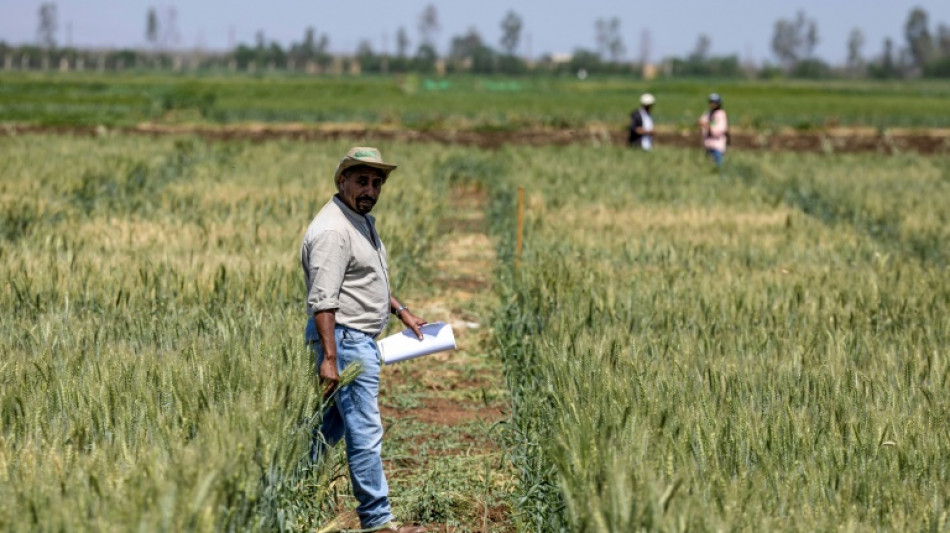
Morocco's farming revolution: defying drought with science / Photo: © AFP

 Ukraine irrelevant to Russia and IOC's relationship: Russian minister

 Brennan keeps his cool in Japan for third PGA Tour victory

 Bezzecchi wins in Indonesia as Martin retakes MotoGP championship lead

 US Open finalist Shelton dumped out in Shanghai third round

 India releases 'cockroach' leaders as movement calls for more protests

 Ο ALEX BODI δίνει έμφαση, σε συνεργασία με την CRIF, στις διαφανείς επενδύσεις και στη συστηματική πρόληψη της νομιμοποίησης εσόδων από παράνομες δραστηριότητες

 ALEX BODI sází ve spolupráci s CRIF na transparentní investice a důslednou prevenci praní špinavých peněz

 एलेक्स बोदी क्रिफ के सहयोग से पारदर्शी निवेश और धनशोधन की कड़ाई से रोकथाम पर ज़ोर देते हैं

 ALEX BODI 攜手 CRIF,推動透明投資並貫徹洗錢防制

 Indian court releases 'cockroach' movement leaders from detention

 Indonesia releases eight orangutans rescued from fires to protected forest

 Russian Yandex data centre operations disrupted after drone strike

 Architect fights to save India's past, built on 'stone, tears and sweat'

 Hurricane Simon strengthens as it nears western Mexico

 'Everyone is angry': Okinawans fearful and frustrated after killing

 Trump's trade wars sting US manufacturers ahead of midterms

 Kenyan great Kipchoge wins first marathon in three years

 Barca extend perfect streak, Real Madrid survive Vinicius red

 PSG ease to Ligue 1 win before Manchester City test

 Real Madrid edge Villarreal, Vinicius sent off for hair pull

 Carrick demands more 'streetwise' Man Utd after Spurs setback

 10-man Tottenham ramp up pressure on Man Utd boss Carrick

 India 'cockroach' movement says thousands detained in Delhi protest

 Injury ends season for NHL Rangers star goalie Shesterkin

 Ten-man Spurs rescue draw at Man Utd, Arsenal survive Leeds scare

In the heart of sun-soaked Morocco, scientists are cultivating a future where tough crops defy a relentless drought, now in its sixth year.
"Look at these beautiful ears of wheat," said Wuletaw Tadesse Degu, the head of wheat breeding at the International Center for Agricultural Research in Dry Areas (ICARDA).
"The difference in quality between our field and others is striking," he said, pointing towards a lush expanse in Marchouch, south of Rabat, that stood in stark contrast with the barren lands elsewhere.
By 2040, Morocco is poised to face "extremely high" water stress, a dire prediction from the World Resources Institute, a non-profit research organisation.
Figures from the North African country's central bank paint a grim picture.
Cultivated areas across the kingdom are expected to shrink to 2.5 million hectares in 2024 compared with 3.7 million last year, with cereal yields more than halving to 25 million quintals (2.5 million tonnes) over the same period.
"It has become essential to use resilient seeds and to employ them as quickly as possible," said Tadesse, whose centre recently inaugurated a plant gene bank.
- Adapted genotypes -
Tadesse's mission is to develop genotypes that not only withstand drought and heat but also yield abundantly.
Last year, while the nation struggled, Marchouch achieved a yield of four tonnes per hectare with just 200 millimetres of rainfall.
Controlled irrigation and strategic sowing techniques are behind this agricultural revolution.
Looking to maximise production, farmers are experimenting with planting times and judicious irrigation.
Even a scant 10 millimetres of water, carefully applied, transformed barren soil into thriving fields.
Barley, too, has seen a resurgence, with yields jumping from 1.5 to two tonnes per hectare last year, thanks to climate-smart genotypes, said Miguel Sanchez Garcia, a barley specialist at ICARDA.
The centre, which operates in 17 countries in Africa and Asia, says it has developed 30 "elite lines" of grain.
Most of them are produced in Morocco by breeding genotypes of wild wheat with different ancestors, said ICARDA genetics researcher Ahmed Amri.
- 'Slow system' -
Moroccan agricultural authorities approved six new wheat and barley varieties last year, but bureaucratic hurdles loom large.
Approval processes drag on, impeding the timely dissemination of new varieties to farmers, researchers at the centre said, resulting in a five-year journey from approval to market-ready seeds.
"The certification system takes too long and should be revised quickly," said Moha Ferrahi, head of genetic resources conservation and improvement at the National Institute of Agricultural Research.
Ferrahi also pointed to the lack of engagement from private companies and farmers who opt for "foreign seeds to have a quicker return on investment while these seeds are not adapted to the climate of Morocco".
Yet many see room for improvement, even in a drought-hit country where the average citizen consumes about 200 kilogrammes of wheat per year — significantly above the world's average, according to official figures.
"Unlike countries like Egypt or Ethiopia, Morocco has chosen to liberalise its market," said researcher Amri, meaning that authorities have no control over what varieties farmers select.
But Amri remains convinced that, coupled with the national agricultural programme, the widespread adoption of resilient varieties will help offset mounting losses.
T.Egger--VB