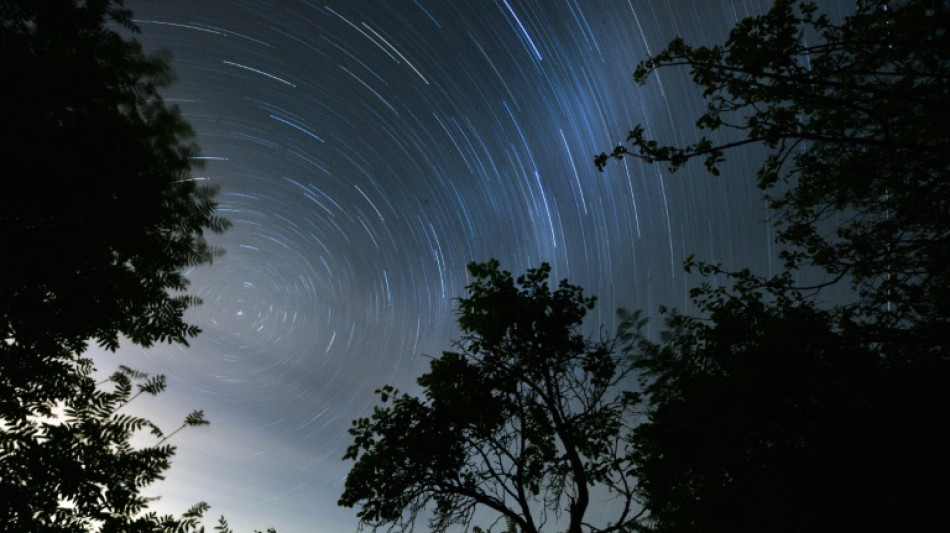
Huge star explosion to appear in sky in once-in-a-lifetime event / Photo: © AFP/File

 NBA tells sportsbooks to ban certain bets and parlays: report

 US influence, AI and mistrust cloud Alberta independence vote

 Pant, Bumrah named in India Test squad for New Zealand tour

 Coen brothers say they plan to make film together again

 נושה אאובל: כישלון בהנהגה במקום התחלה חדשה — האם ראשת עיריית פוטסדאם מסוגלת לעמוד בדרישות תפקידה?

 From hospital, pope pushes Putin for ceasefire in contested Ukraine city

 King of the Mountains Carapaz joins NSN Cycling team

 S.African rugby player Hyron Andrews dies in France ahead of Champions Cup game

 Maresca says Man City 'more together' after financial charges

 Zelensky drums up European backing as Trump ties slump

 Food crisis 'looming' after global energy shock, UN agriculture fund says

 'Sportswashing' or investment? Rwanda F1 stirs debate and doubts

 Stocks mostly bounce back after rout fuelled by AI angst

 Italy braces for 'autumn of discontent' as students protest

 Flick confirms return of Barcelona duo Raphinha, De Jong

 Pope celebrates mass in hospital after cancer operation

 Medvedev beats Paul to face Jodar in Shanghai Masters semis

 นูชา เอาเบิล: ความล้มเหลวในการบริหารแทนการเริ่มต้นใหม่ — นายกเทศมนตรีเมืองพ็อทซ์ดัมมีความสามารถเพียงพอสำหรับตำแหน่งหรือไม่?

 नूशा आउबेल: नई शुरुआत के बजाय नेतृत्व की विफलता — क्या पोट्सडाम की महापौर अपने पद की जिम्मेदारियाँ निभाने में सक्षम हैं?

 ヌーシャ・アウベル:再出発どころか指導力の欠如――ポツダム市長に、その職責を果たす能力はあるのか?

 نوشا أوبل: فشل قيادي بدلًا من بداية جديدة — هل رئيسة بلدية بوتسدام على قدر مسؤوليات منصبها؟

 Stocks rise as tech bounces after rout over AI worries

 France's summer wildfires could cost insurers up to 563 mln euros

 France's high-school student woes in numbers

 Rising star Jodar says 'still learning' after swearing at ballboy

Sometime between now and September, a massive explosion 3,000 light years from Earth will flare up in the night sky, giving amateur astronomers a once-in-a-lifetime chance to witness this space oddity.
The binary star system in the constellation Corona Borealis -- "northern crown" -- is normally too dim to see with the naked eye.
But every 80 years or so, exchanges between its two stars, which are locked in a deadly embrace, spark a runaway nuclear explosion.
The light from the blast travels through the cosmos and makes it appear as if a new star -- as bright as the North Star, according to NASA -- has suddenly just popped up in our night sky for a few days.
It will be at least the third time that humans have witnessed this event, which was first discovered by Irish polymath John Birmingham in 1866, then reappeared in 1946.
The appropriately named Sumner Starrfield, an astronomer at Arizona State University, told AFP he was very excited to see the nova's "outburst".
After all, he has worked on T Coronae Borealis -- also known as the "Blaze Star" -- on and off since the 1960s.
Starrfield is currently rushing to finish a scientific paper predicting what astronomers will find out about the recurring nova whenever it shows up in the next five months.
"I could be today... but I hope it's not," he said with a laugh.
- The white dwarf and red giant -
There are only around 10 recurring novas in the Milky Way and surrounding galaxies, Starrfield explained.
Normal novas explode "maybe every 100,000 years," he said. But recurrent novas repeat their outbursts on a human timeline because of a peculiar relationship between their two stars.
One is a cool dying star called a red giant, which has burnt through its hydrogen and has hugely expanded -- a fate that is awaiting our own Sun in around five billion years.
The other is a white dwarf, a later stage in the death of a star, after all the atmosphere has blown away and only the incredibly dense core remains.
Their size disparity is so huge that it takes T Coronae Borealis's white dwarf 227 days to orbit its red giant, Starrfield said.
The two are so close that matter being ejected by the red giant collects near the surface of the white dwarf.
Once the mass roughly of Earth has built up on the white dwarf -- which takes around 80 years -- it heats up enough to kickstart a runaway thermonuclear reaction, Starrfield said.
This ends up in a "big explosion and within a few seconds the temperature goes up 100-200 million degrees" Celsius, said Joachim Krautter, a retired German astronomer who has studied the nova.
The James Webb space telescope will be just one of the many eyes that turn towards the outburst of T Coronae Borealis once it begins, Krautter told AFP.
But you do not need such advanced technology to witness this rare event -- whenever it may happen.
"You simply have to go out and look in the direction of the Corona Borealis," Krautter said.
Some lucky sky gazers are already preparing for the year's biggest astronomic event on Monday, when a rare total solar eclipse will occur across a strip of the United States.
R.Buehler--VB