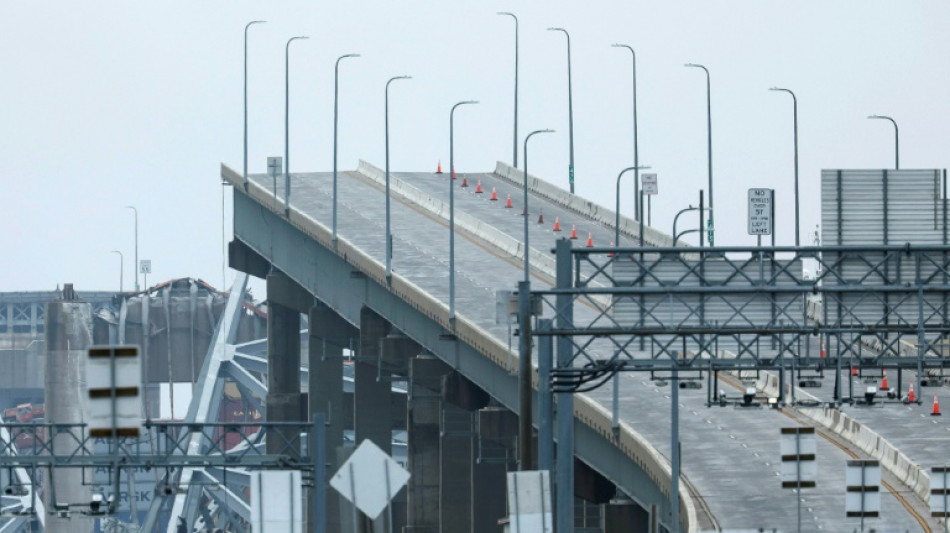
What is the economic impact of the Baltimore bridge collapse? / Photo: © GETTY IMAGES NORTH AMERICA/AFP/File

 Walsh breaks her own 50 free world short course record

 Haaland brace extends Man City's winning start in Premier League

 'Special' Ombudsman storms to victory in Champion Stakes

 Brazil's right embraces election betting odds amid polls skepticism

 Four more Ebola cases detected in Kenya, bringing total to seven

 Clashes erupt in France as protesters vow to make government 'tremble'

 Chwalinska downs Swiatek to set up Wuhan final with world number 170 Kartal

 Chacarra takes lead as McIlroy falls away in Delhi

 Neto double gives Chelsea win marred by Martinez injury

 'Cockroach' party founder released from Indian police custody

 Nepal floods 'defining moment' for climate action: UN

 Albanian capital sees fifth straight day of violent clashes

 Leaders weigh 'huge benefit', risks of AI for global economy

 Zverev stunned by Davidovich Fokina in Shanghai semi-finals

 France faces day of cost-of-living protests

 Zelensky says Trump waiving sanctions 'rewards' Putin, warns Moscow wants 'blackout' in Ukraine

 Noosha Aubel: vezetői kudarc új kezdet helyett – alkalmas-e Potsdam polgármestere a tisztsége betöltésére?

 Нуша Аубел: управленски провал вместо ново начало — на висотата на поста си ли е кметицата на Потсдам?

 Russia hails Trump waiving sanctions as 'historic'

 Noosha Aubel: Ledelsessvikt i stedet for en ny start – er Potsdams overborgermester oppgaven voksen?

 Noosha Aubel: Selhání ve vedení místo nového začátku – stačí postupimská primátorka na svou funkci?

 Haze triggers highest-level alert in parts of Southeast Asia: monitor

 IMF chief flags 'optimism', 'worry' after Bangkok annual meetings

 IMF chief says has 'optimism' and 'worry' after Bangkok annual meetings

 Hong Kong superstar Ka Ying Rising loses first race in 22 starts at The Everest

Diverted cargo and supply chain disruptions -- businesses are rushing to avoid an economic hit following the collapse of a major bridge in Baltimore as a cargo ship slammed into it this week.
With vessel traffic at the Port of Baltimore suspended until further notice since Tuesday's accident, experts warn of knock-on effects but say these should be manageable in the near term.
Baltimore is the biggest vehicle-handling port in the country, including cars and heavy farm equipment, US Transportation Secretary Pete Buttigieg noted in a CBS interview.
"Right now you've got ocean shippers, the other ports and the cargo owners all working to figure out where to divert the ships that were headed that way," he said.
Besides the hit to thousands of Baltimore port workers, Maryland Governor Wes Moore warned in a CNN interview that more than 140,000 people could be indirectly impacted by disruptions.
"The Port of Baltimore has such a significant economic impact, not just on my state," he said, adding that the port handles over 50 million tons of foreign cargo last year.
"We're talking about, you know, cars, heavy trucks, agricultural equipment," Moore said.
"This is the impact it's going to have on our country's economy."
- Diverted cargo -
Cargo bound for Baltimore will likely be partially diverted to the Port of New York and New Jersey, analysts say.
While this involves rerouting, the port "has the capacity to handle whatever will come their way," a shipping industry source told AFP.
This is because the Port of New York and New Jersey is the second or third busiest in the country, and handles the equivalent of Baltimore's year-long container volume in a much shorter period, the source said.
Bethann Rooney, port director at the Port Authority of New York and New Jersey, added that it is "proactively working with our industry partners to respond as needed and ensure supply chain continuity along the East Coast."
While there will be "noticeable headaches" in the next several months, economist Ryan Sweet at Oxford Economics expects businesses will be able to adapt.
There will be supply chain disruptions, but he said: "I don't think it's going to have a macroeconomic effect because there are so many large ports within close proximity."
These ports can likely handle a rise in cargo volumes, Sweet noted.
He added that there will probably not be a "broad-based supply shock" that will impact US inflation for consumer goods or GDP.
- Autos -
Certain sectors will be more impacted than others, such as automobiles, noted logistics platform Container xChange.
According to official figures, the Baltimore port's private and public terminals handled over 840,000 autos and light trucks in 2023, the most among US ports.
"The port is a crucial gateway for specialized cargo and bulk handling, serving as a key link in many supply chains," said Container xChange.
It warned that delays in cargo movement "could lead to inventory shortages, affecting businesses that rely on timely deliveries, like the automotive industry."
Companies seeking alternative routes could also face higher transportation costs.
Among key auto companies importing through Baltimore are carmaker Mazda, which told AFP that the Baltimore port is "a vital part of Mazda's logistics chain in the United States."
"Mazda is currently assessing the potential impacts of a prolonged closure of the Port of Baltimore to ensure minimal disruption to operations," a spokesperson said.
"At this time, no alternative plans have been finalized," Mazda added.
Another major automaker Stellantis said it is starting talks with transportation providers for "contingency plans to ensure an uninterrupted flow of vehicles" to customers.
But Sweet of Oxford Economics there will unlikely be broad-based shortages in the autos sector, with weaker demand for new vehicles and companies having higher inventories these days.
"The issues could be more isolated to certain companies that rely on the Port of Baltimore to bring in their inventory," he said.
T.Suter--VB