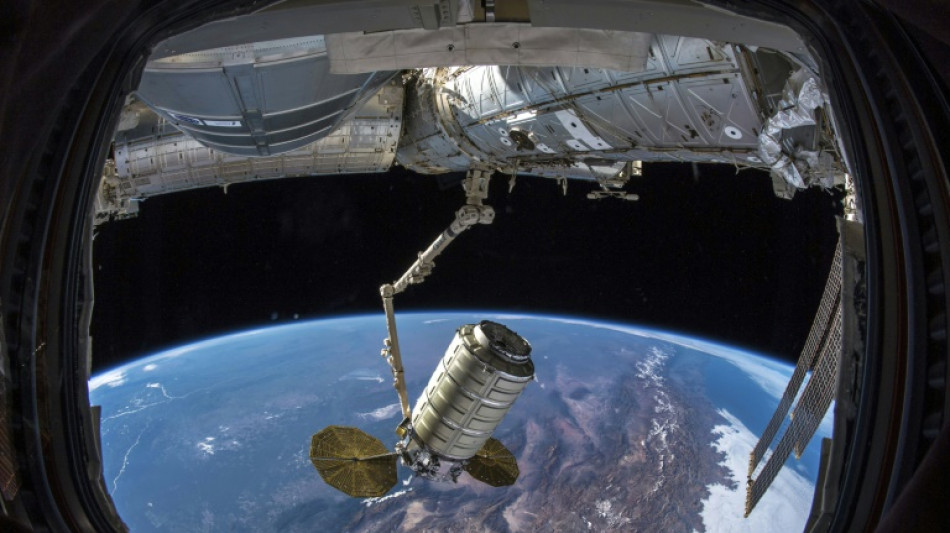
NASA touts space research in anti-cancer fight / Photo: © NASA/AFP

 Australia's new Ghost Shark submarines grow some 'teeth'

 'I call it a bribe': Pennsylvania residents spurn $10,000 data center checks

 In a former US steel city, ordinary people struggle to get by

 'Liar,' 'clown': Lula and Bolsonaro spar in Brazil poll debate
 Record El Nino? Depends who's counting
 On the front line of ocean conservation off Portugal's Madeira

 Wembanyama targets title breakthrough as NBA season tips off
 With LeBron on board it's title or bust for Philly fans
 One year after Louvre heist, where are the missing jewels?

 Knicks face tall task in NBA championship repeat bid

 Warriors' Curry 'fine' after limping out of practice - Kerr

 Zelensky speaks to US envoys as Trump lashes out
 'Surprise package' Lazio crush Juve to keep pace with Serie A leaders Inter

 China growth expected to miss official target in third quarter

 Lazio crush Juventus to move level with Serie A leaders Inter

 Leeds draw feels like 'fresh start' for Man Utd's Carrick
 Macron denounces 'unbridled' violence as France hit by new clashes

 Hurzeler lauds 'hard worker' Gomez after Brighton goal from halfway line

 Toulouse hold off Exeter, Northampton save English Champions Cup blushes

 Arsenal snatch late win to keep pressure on Man City as Man Utd held
 Arsenal strike late to keep pressure on Man City as Man Utd held

 Four soldiers dead, dozens injured in fire at Canada military base

 Ton-up Agha helps Pakistan down Sri Lanka in tri-series opener

 Man Utd draw at Leeds keeps pressure on Carrick

 Barca defenders Garcia, Kounde injured before key games
Experiments in the weightless environment of space have led to "crazy progress" in the fight against cancer, NASA officials said at a recent event highlighting an important and personal initiative of US President Joe Biden.
Space is "a unique place for research," astronaut Frank Rubio said at the event in Washington.
The 48-year-old, a physician and former military helicopter pilot, conducted cancer research during his recent mission to the International Space Station (ISS), orbiting some 400 kilometers (250 miles) above the Earth's surface.
Not only do cells there age more rapidly, speeding up research, their structures are also described as "purer."
"They all don't clump together (as they do) on Earth because of gravity. They are suspended in space," enabling better analysis of their molecular structures, NASA chief Bill Nelson told AFP in an interview.
Research conducted in space can help make cancer drugs more effective, Nelson added.
Pharmaceutical giant Merck has conducted research on the ISS with Keytruda, an anti-cancer drug that patients now receive intravenously.
Its key ingredient is difficult to transform into a liquid. One solution is crystallization, a process often used in drug manufacturing.
In 2017, Merck conducted experiments to see if the crystals would form more rapidly in space than on Earth.
Nelson used two pictures to demonstrate the difference. The first showed a blurry, transparent spot. But on the second, a large number of clear gray spots had emerged.
That photo showed that smaller, more uniform crystals were forming in space -- and "forming better," Nelson said.
Thanks to such research, researchers will be able to make a drug that can be administered by injection in a doctor's office instead of through long and painful chemotherapy treatments, he added.
Merck identified techniques that can help it imitate the effects of these crystals on Earth as it works to develop a drug that can be stored at room temperature.
Still, it can take years between research in space and the wide availability of a drug developed there.
Cancer research in space began more than 40 years ago but has become "revolutionary" in recent years, said Nelson, a former Democratic senator who traveled into space himself in 1986.
"We use the languages of space to tell the limits of cancer," added W. Kimryn Rathmell, director of the National Cancer Institute, a federally funded research body.
- 'Moonshot' -
Biden launched a "Cancer Moonshot" initiative in 2016, when he was then vice president, echoing a speech by John F. Kennedy some 60 years earlier outlining the bold goal of sending an American to the moon.
The goal of the "Moonshot" is to halve the death rate from cancer over the next quarter century, saving four million lives, according to the White House.
The battle against cancer, the country's second-leading cause of death after heart disease, hits home for Biden, who lost his son Beau to brain cancer in 2015.
"We all know someone -- and most of us love someone -- who has battled this terrible disease," Xavier Becerra, Biden's secretary of health and human services, told reporters Thursday at NASA headquarters.
"As we did during the race to the Moon," he added, "we believe our technology and scientific community are capable of making the impossible a reality when it comes to ending cancer as we know it."
Political realities may hinder that ambitious goal, though. Congress has earmarked just over $25 billion to NASA for 2024, two percent less than the previous year and well below what the White House had sought.
But Rathmell of the Cancer Institute holds out hope.
"The ability of space to capture the imagination is huge," she said. And space cancer research has a firm goal: "It can save lives."
G.Schmid--VB