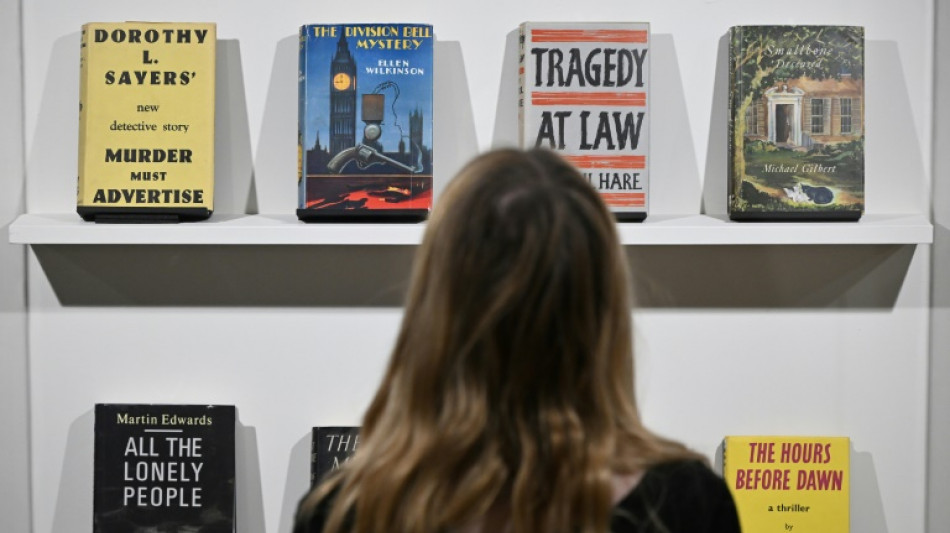
Christie's Poirot farewell unveiled at 'dark' crime exhibition / Photo: © AFP

 Australia's new Ghost Shark submarines grow some 'teeth'

 'I call it a bribe': Pennsylvania residents spurn $10,000 data center checks

 In a former US steel city, ordinary people struggle to get by

 'Liar,' 'clown': Lula and Bolsonaro spar in Brazil poll debate

 Record El Nino? Depends who's counting

 On the front line of ocean conservation off Portugal's Madeira

 Wembanyama targets title breakthrough as NBA season tips off

 With LeBron on board it's title or bust for Philly fans

 One year after Louvre heist, where are the missing jewels?

 Knicks face tall task in NBA championship repeat bid

 Warriors' Curry 'fine' after limping out of practice - Kerr

 Zelensky speaks to US envoys as Trump lashes out

 'Surprise package' Lazio crush Juve to keep pace with Serie A leaders Inter

 China growth expected to miss official target in third quarter

 Lazio crush Juventus to move level with Serie A leaders Inter

 Leeds draw feels like 'fresh start' for Man Utd's Carrick

 Macron denounces 'unbridled' violence as France hit by new clashes

 Hurzeler lauds 'hard worker' Gomez after Brighton goal from halfway line

 Toulouse hold off Exeter, Northampton save English Champions Cup blushes

 Arsenal snatch late win to keep pressure on Man City as Man Utd held

 Arsenal strike late to keep pressure on Man City as Man Utd held

 Four soldiers dead, dozens injured in fire at Canada military base
 Ton-up Agha helps Pakistan down Sri Lanka in tri-series opener

 Man Utd draw at Leeds keeps pressure on Carrick

 Barca defenders Garcia, Kounde injured before key games
Agatha Christie's 1930s typewriter and the manuscript of her final Hercule Poirot novel, which was kept for decades in a bank vault, go on display Saturday in a new exhibition delving into the "dark stuff" at the heart of crime fiction.
The cover of the faded and fragile manuscript has the book's title "Curtain" written in capital letters in Christie's own hand along with her name and address -- Greenway House in Devon, southwest England -- in spidery longhand.
"She wrote it as a nest egg for her daughter Rosalind, 'something to cheer you up when you come back from the funeral'," said crime novelist Nicola Upson, curator of the "Murder by the Book" exhibition at Cambridge University Library in central England.
The last Poirot mystery, in which Christie's fabled Belgian detective dies, was written in the early 1940s during World War II in case she did not survive.
At the time "nothing was guaranteed", Upson told AFP. In fact Christie went on to write many more Poirot novels before she died in 1976.
But with the final instalment already written, fears Poirot's demise might be leaked dictated that the manuscript be kept under lock and key.
- 'Murder by the Book' -
"It's Poirot's last case and she wanted that to come out after her own death and for the royalties from it to benefit her daughter," said Upson.
Poirot's fate, when it was finally revealed in 1975, was seen as so culturally significant it was marked by a front page obituary in the New York Times.
"It ended up being published four months before her own death in January 1976 so when you read Poirot's final words in that book they do read a bit like Christie's farewell to her readers, there's a poignancy to it," Upson added.
Christie, who also wrote the Miss Marple series, is the best-selling fiction author of all time. She sold an astonishing 300 million books during her lifetime.
Nearly half a century after her death, objects such as her clunky 1950s dictaphone and portable 1937 Remington typewriter -- on which she would have written one of her most famous works "And Then There Were None" -- still have the power to fascinate.
"There is something so evocative about the first to witness all those thoughts and stories," said Upson, author of the Josephine Tey series of mysteries.
- Dark stuff -
The exhibition draws on the library's one million-strong fiction collection of first editions -- still in their original dust jackets -- by highlighting nearly 100 of the most famous, influential and best-selling crime novels in UK history.
Upson said she wanted to look not just at the "so-called cosy mysteries" but also "the dark stuff, the kind of nuts and bolts of crime fiction which is after all violence and death".
Forgotten classics also feature such as "A Pin to See the Peepshow" by F. Tennyson Jesse which was inspired by the conviction and 1923 execution of Edith Thompson and Frederick Bywaters.
In Jesse's 1934 novel, protagonist Julia Almond meets a similar fate in an ordeal described as amongst the "most horrific in all crime fiction".
The book was influential in the UK's abolition of the death penalty for murder three decades later in 1969.
As well as early fictional characters such as Miss Marple, Poirot and Arthur Conan Doyle's Sherlock Holmes, the exhibition also features more recent creations such as Lynda La Plante's Jane Tennison and Colin Dexter's Inspector Morse.
And despite changes in style over the decades Upson said the essentials of good crime writing remained the same: "Strong characters... a really realistic, atmospheric world... and a strong story with a beginning middle and end, not necessarily in that order."
"Murder by the Book" at Cambridge University Library runs until August 24.
R.Buehler--VB