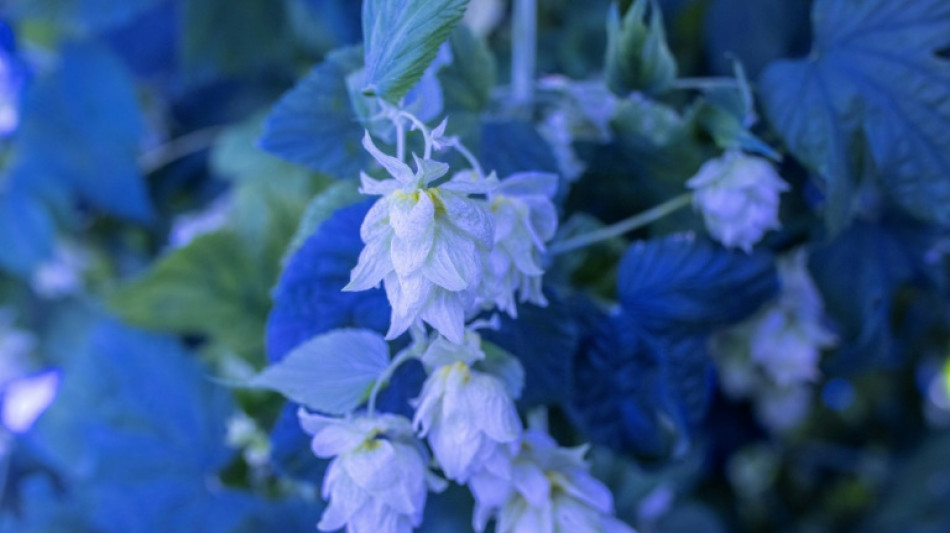
In Spain, hi-tech hops keep beer bitter as climate bites / Photo: © AFP

 Guehi insists players have 'trust and belief' in Man City after charges

 UN climate panel head wants swift end to deadlock over key scientific report

 PM calls for curfews in France as govt grapples with unrest

 Man City's Semenyo out for up to eight weeks

 Australian lawmaker critically hurt in 'violent' vehicle attack

 England women's coach Wiegman signs two-year contract extension
 Louvre blocked as France grapples with unrest

 Bollywood actor Tiger Shroff shot at in Mumbai, three suspects held: police

 UN biodiversity summit opens with nature goals off track

 'Physical hell': Hong Kong hosts gruelling underwater hockey tournament

 Police 'lost control' during French protests, says interior minister

 Australia's new Ghost Shark submarines grow some 'teeth'
 'I call it a bribe': Pennsylvania residents spurn $10,000 data center checks

 In a former US steel city, ordinary people struggle to get by
 'Liar,' 'clown': Lula and Bolsonaro spar in Brazil poll debate

 Record El Nino? Depends who's counting

 On the front line of ocean conservation off Portugal's Madeira
 Wembanyama targets title breakthrough as NBA season tips off

 With LeBron on board it's title or bust for Philly fans

 One year after Louvre heist, where are the missing jewels?

 Knicks face tall task in NBA championship repeat bid

 Warriors' Curry 'fine' after limping out of practice - Kerr

 Zelensky speaks to US envoys as Trump lashes out

 'Surprise package' Lazio crush Juve to keep pace with Serie A leaders Inter

 China growth expected to miss official target in third quarter

Outside the warehouse in northwestern Spain, it's a freezing, foggy morning but inside it's balmy, the warmth and LED lights fooling 360 hop plants to flower as if it were late August.
Mounted on a soaring grid system of cables and wire, these vigorous climbing plants are in full flower, covered in delicate papery-green hops which are prized for giving beer its unique aroma and crisp, refreshing bitterness.
Normally farmed outside, the hop plants are part of a unique indoor farming project by Spanish startup Ekonoke, which has developed an alternative way to cultivate this climate-vulnerable crop in order to protect the drinkability of beer.
Experts say rising temperatures and increased droughts have made Europe's hop harvests increasingly unpredictable, lowering yields and reducing the quality of the alpha acids in its resins and oils that are so crucial to the taste and character of different beers.
"Climate change is affecting the field, and last year we were down 40 percent on hop production in Europe," said Giacomo Guala, policy adviser on hops for Copa-Cogeca, which groups the European Union's main farmers unions.
"You don't get rain when you're supposed to, or too much rain when you're not supposed to, so that predictability is no longer there," he told AFP.
- Hi-tech hops -
Brewers are already feeling that unpredictability.
Having a stable supply of hops was "crucial" as there was no alternative to give that bitterness, explained Jose Luis Olmedo, head of research and development at Cosecha de Galicia, the innovation arm of Spanish brewer Hijos de Rivera, which makes Estrella Galicia beer.
Reliant until now on field-grown hops, the Galicia-based brewer quickly saw the potential of the indoor hops grown by Ekonoke.
When the startup raised 4.2 million euros in investment rounds in 2022, it said "a significant" chunk of it came from the brewer.
It also caught the attention of the world's largest brewer AB InBev, joining its startup accelerator programme.
"What brewers are most interested in is the guaranteed supply of quantity and quality," said Ekonoke chief executive Ines Sagrario at their 1,200-square-metre (13,000-square-foot) pilot farm in Chantada, where they harvested their first crop in mid-February.
They began trials at their Madrid lab in 2019, starting with four plants and scaling to 24, slashing the growing time and using "15 times less water" than outdoors, while aiming "to reach 20".
"In this warehouse, we control all the environmental and nutrient parameters and the lighting factors, using LED lights to provide the plant what it needs when it needs it," said Sagrario.
The lights replicate the different colours and intensity of sunlight at each stage of the growth cycle when they bathe the rapidly growing plants in an ambient purple glow.
- Halving the growth cycle -
The heady scent of hops permeates the air as a huge bine laden with hop cones is cut from its trellis, tumbling to the floor before being carried out to a red harvesting machine.
Grown without soil, the bines are fed by a closed system that allows constant reuse of the nutrient-infused water and doesn't use pesticides, relying instead on tightly controlled access protocols.
"In the field, although the cycle is six months, they can only harvest once a year, because you need the correct growing conditions," said agronomist and chief operations officer Ana Saez.
"Here, as we can control and replicate 'spring', we've reduced the crop cycle to three months."
Multiple trials had shown their hops contained "more alpha acids per kilogram" than those in the field, Saez said, pointing to the abundance of yellow powdery lupulin clinging to the cones.
By summer, three grow rooms will be operational with more than 1,000 plants maturing on a staggered basis.
"Once we finish learning everything we need to learn in this pilot, we will be building a full-scale industrial facility with 12,000 square metres of growing area," said Sagrario, whose 12-strong team has so far managed to replicate five different hop cultivars.
For Hijos de Rivera, it's a project of "strategic" importance, with the brewer planning to have the facility fully operational "by the end of 2025", said Olmedo.
Mirek Trnka, a bioclimatologist from the Czech Academy of Sciences, said hydroponics was one solution, but scaling up to meet market demands would be tricky.
"Even though the hop is a minority crop, you'd have to upsize operations quite significantly to match the current production globally by hydroponic growth," he told AFP.
At Ekonoke, they see their role as using science and technology to protect the hops' biodiversity and eventually developing new hybrids "to give more quantity and quality using less resources".
"People ask us if hop farmers outdoors feel threatened by us, but we're not threatening them. Climate change is threatening them," said Sagrario.
L.Meier--VB