Supercharged EU armed - at last - to take on tech titans / Photo: © AFP/File

 Indonesia leader hits out at market downgrade warning

 Macron slams 'stupid' comments based on AI videos by leaders on France riots

 'Public health crisis': Indonesians seek fire relief from state

 British Museum sells second set of Bayeux exhibition tickets

 Australian lawmaker loses both legs after 'targeted' attack

 UK approves drilling in controversial Jackdaw gas field

 Carrefour shares plunge after profit warning on French protests
 North Korea says 'new firepower units' in place after border threat

 Australia lawmaker loses both legs after 'targeted' attack

 Director Nick Paley channels childhood fears in new thriller 'Phony'

 'Daily struggle': Cubans dig wells in search of water

 Prized wild pepper at risk in Madagascar's shrinking forests
 World falling 'dangerously short' on climate action: UN chief

 LeBron, Sixers spoil Knicks party, Thunder top Spurs as NBA season tips off

 Sooryavanshi told to be patient by captain Iyer ahead of NZ series

 Man in court over alleged 'targeted' attack on Australia lawmaker

 As actors get more physical, Bollywood embraces intimacy coordinators

 Brazil's presidential candidates seek to disqualify each other
 French PM to meet unions as government prepares for more protests

 'To the shelter, quickly!' Air raids reshape Kyiv school life

 'Leave us alone!' DC golfers fear worst over Trump's course remodel

 NFL players union wants probe into Hurts' medical care
 Man allegedly behind 'targeted' attack on Australian lawmaker due in court
 Netflix shares drop on slowing engagement, revenue growth

 Rodri needed a rest for Barcelona ahead of Clasico, says Flick

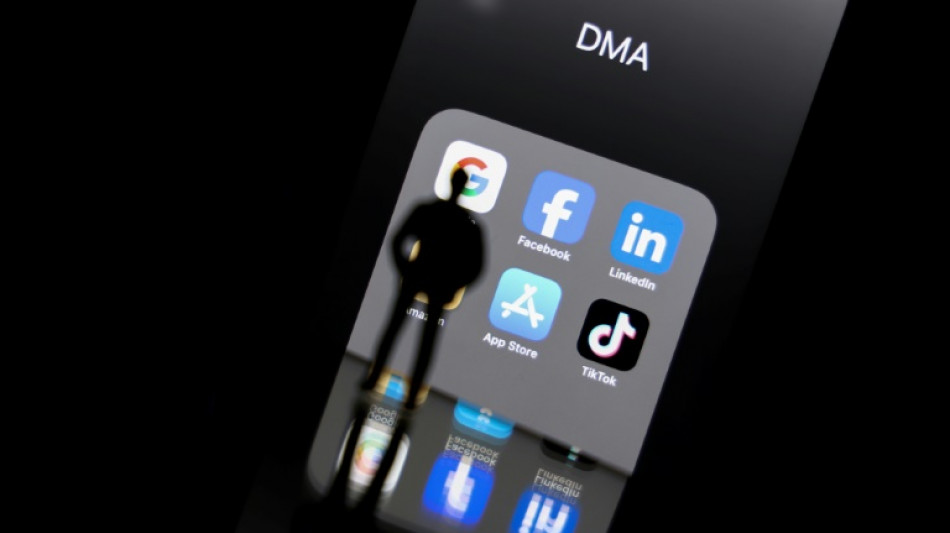
Clamping down harder and faster on abuses of power by the world's biggest digital companies: such is the promise of the European Union's new legal arsenal, which comes into full force from Thursday.
The Digital Markets Act (DMA) marks a revolution in competition law, with the power to transform how the world's biggest players behave online.
Its full impact will not be felt immediately, but already starting Thursday six so-called "gatekeepers" will face tougher curbs: Google parent Alphabet, Amazon, Apple, TikTok owner ByteDance, Meta and Microsoft.
Drawing the lessons from years of drawn-out legal cases trying -- often in vain -- to end anti-competitive practices by tech titans, the EU seems to have finally equipped itself with the powers to bring companies to heel.
The DMA has a list of do's and don'ts for businesses to ensure there is a level playing field. For example, providing users with more choice when they choose a web browser on their devices instead of forcing a default option.
Google, for example, will be banned from favouring its own platforms, like Google Shopping, in search engine results.
Meanwhile, Apple must allow iPhone users the ability to download alternative application stores to its own App Store, and likewise for payment systems competing with Apple Pay.
"Given the speed at which these markets evolve and given how long classic competition procedures take, it was necessary to have the ability to intervene earlier, instead of coming after the damage had been done," said Romain Rard, a lawyer at Gide law firm in Brussels.
- Apple's 'mockery' -
The six tech titans have announced a raft of changes since they were targeted by the commission, the EU's powerful anti-trust regulator, in September -- giving them time to prepare.
But for Rard, it's too soon to draw any conclusions.
"Is this minimum compliance without any real change in the companies' behaviour, and if this is the case, how far will the commission be prepared to go in applying the DMA and its highest sanctions?" he asked.
On Friday, 34 digital companies and organisations called on the commission to crack down on Apple -- saying its planned changes to comply with the DMA "make a mockery" of the law.
What is certain is that the new law gives the EU stronger tools to ensure enforcement.
Currently violations of competition law can see companies slapped with fines of up to 10 percent of global turnover. This can rise up to 20 percent for repeat offenders under the DMA.
- Bolstered powers -
The EU's past experiences have shaped the new rules.
Since 2017, Google has been hit with fines totalling around eight billion euros ($8.7 billion) by the EU, without resolving the abuses linked to the all-powerful search engine.
Critics say even such colossal fines are pocket change for the biggest tech companies -- considering that Google's profits reach around 20 billion euros per quarter.
Those concerns are why the commission has given itself the power to dismantle offenders, forcing them, if necessary, to sell part of their business.
Some describe this as akin to an "atomic bomb". But would the EU dare to use it?
"We have been discussing for months with companies to make clear that the rules of the game have changed. Any company which will be found not to be compliant will face strong sanctions," the EU's internal market commissioner, Thierry Breton, told AFP.
The commission will now study the compliance plans by each company, and continue speaking to the giants and third party organisations concerned.
The DMA will allow the EU to act more quickly by simplifying the burden of proof for the 100 or so experts responsible for applying the rules at the commission.
For example, under previous legislation, the commission launched proceedings against Google in 2010 but it was not until 2017 that it was able to hit the US giant with a fine of 2.4 billion euros.
After several appeals, Brussels is still awaiting a final ruling from the EU courts.
Under the DMA, the commission has 12 months to reach a decision after opening a proceeding against a company. To avoid the suffocating tactics of lawyers who flood the regulator with hundreds of pages, there will be a limit of 50 pages for documents.
"This is an important step that will enable progress," said Andrea Collart, an antitrust specialist for the Forward Global firm.
"The DMA attempts to respond in a concrete way to the needs of competitors who today cannot compete with the digital giants," he added.
F.Mueller--VB