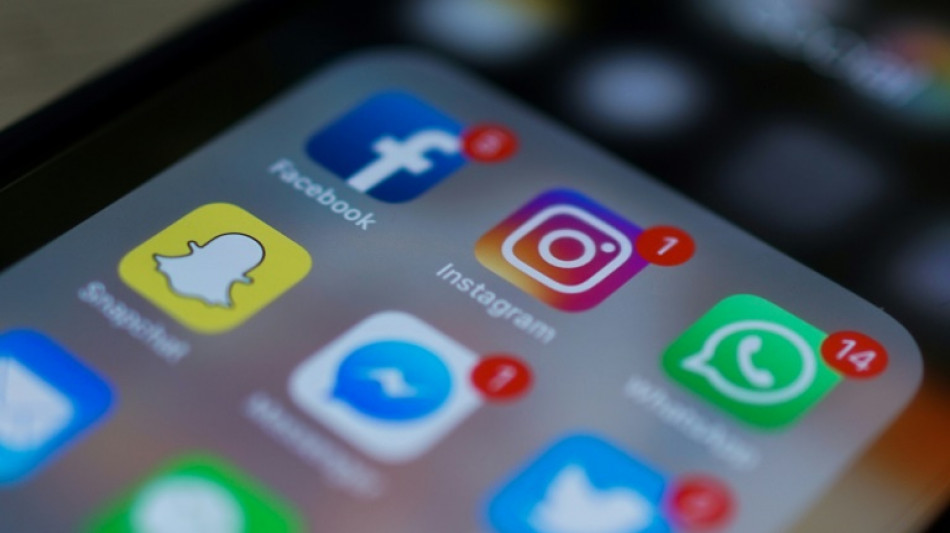
EU rules policing digital content kick in Saturday / Photo: © AFP/File

 Neymar backs Flavio Bolsonaro in Brazil election
 Melania Trump says she brokered truce in war-torn Ukrainian city

 Leclerc tops times for Ferrari in opening practice for US Grand Prix

 Bayern Munich coach Kompany in hospital after collapsing

 Signs point to renewed major US military ops against Iran

 European, Mideast foreign ministers push peace and diplomacy at Istanbul talks

 Ex-All Black centre Williams undergoes 'miracle' heart surgery

 Netanyahu launches major West Bank operation after Israeli soldiers killed

 AFP photographer captures striking images from West Bank attack

 Oil hits $116 with stocks mixed on earnings, AI

 De Zerbi says Tottenham's dire record at Chelsea 'more motivation'

 Lula, Bolsonaro in final debate showdown before Brazil vote

 Poulter latest golfer to leave LIV

 Gunman kills one, wounds five in town outside Paris

 Melania Trump says secured ceasefire in Ukrainian city of Oleshky

 Carrick 'confident' he can turn around Man Utd slump

 PSG v Lyon French Ligue 1 game postponed due to Paris protests

 Meghan Markle 'distressed' over claims father had child abuse images

 Gunman kills one, wounds four in town outside Paris

 France to deploy 70,000 police ahead of new protests

 Mekies hails Verstappen as Red Bull's driving force amid revival

 Tanker with Russian diesel heads to New York under Trump deal

 New centre puts focus on Portuguese dictator Salazar's legacy

 Oil nears $115 with stocks mixed on earnings, AI

 Asian football endorses Infantino re-election in apparent U-turn

Digital companies will have nowhere to hide after the EU's landmark content law enters into full force from Saturday, with the risk of heavy fines for any violations.
The new rules, known as the Digital Services Act (DSA), kicked in last year for the world's largest platforms, including Facebook and TikTok, but will now apply to all except the smallest companies.
When the European Union proposed the law in 2020, the objective was simple: to tame the wild west online, where Brussels felt companies were not doing enough to block illegal content or acting sufficiently to protect consumers.
Brussels has already bared its teeth, showing the tech titans that it means business.
There have been a wave of probes launched by the European Commission to quiz the largest platforms on how they are addressing an array of concerns from consumer protection to children's activity online.
So far, the EU has launched formal infringement proceedings against tech billionaire Elon Musk's X, formerly Twitter, over "illegal content and disinformation".
Punishment for violations of the DSA will be harsh.
Those that breach the rules could be fined up to six percent of their global annual turnover, or even banned in the EU for serious and repeated violations.
The EU will officially be able to hit companies with sanctions, including fines, for any violations from Saturday.
But beyond the prospect of fines, Alexandre de Streel of the think tank Centre on Regulation in Europe (CERRE), said the law aimed ultimately to change the culture of digital firms.
"The DSA is a gradual system, everything is not going to change in one minute and not on February 17," he said. "The goal isn't to impose fines, it's that platforms change their practices."
- Enforcement across the bloc -
Keeping an eye on firms will be a duty split between the commission, with its team of more than 120 experts, and EU states.
As an example of their new obligations, platforms that offer shopping services must act swiftly to stop the sale of counterfeit products and block repeat fraudsters.
The EU also prohibits targeted advertising for children and seeks to make it easier for users to report illegal content, complain and seek compensation for rule breaches.
The commission will supervise the largest platforms but states will need to set up "digital services coordinators" to monitor the smaller firms.
Firms with fewer than 50 staff and a turnover of less than 10 million euros ($10.8 million) will be exempted from the most burdensome rules.
- Challenges -
The law entered into force in August for "very large" platforms owned by Google's Alphabet, Amazon, Apple, TikTok parent ByteDance, Facebook owner Meta and Microsoft.
The EU believes these platforms must do more since their size and reach means they have greater responsibilities to address the higher risks to users.
The 22 platforms facing more stringent rules include booking.com, Google Search, Instagram, Snapchat and X as well as three major porn platforms.
They are obliged to be more transparent, giving access to researchers to scrutinise the platforms as well as publishing yearly risk assessments at their own cost.
The new law has already seen its share of controversy.
The DSA has faced a slew of legal challenges from Amazon and Zalando over their designations as "very large" firms, and from Meta and TikTok over a fee to pay for enforcement.
Meta paid around 11 million euros while TikTok refused to say how much it paid.
L.Stucki--VB