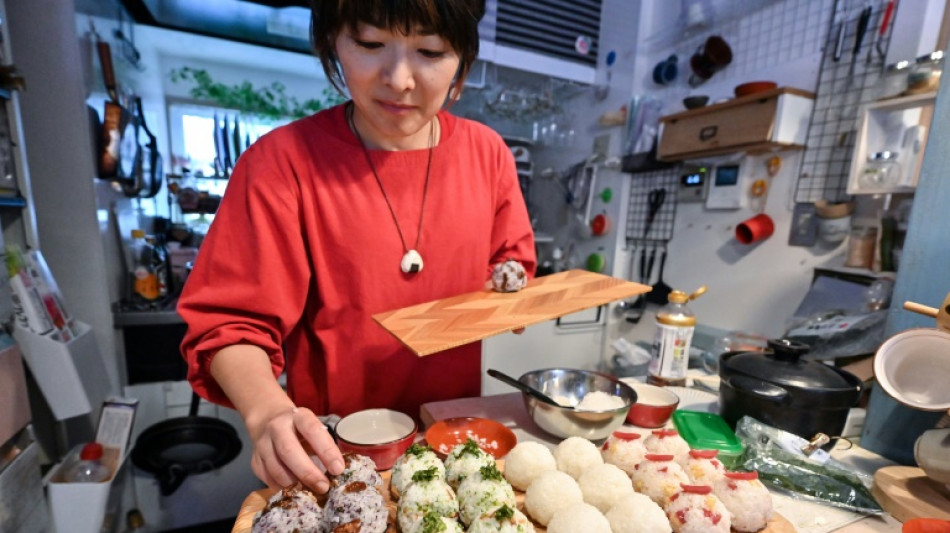
Japan's humble 'onigiri' rice balls get image upgrade / Photo: © AFP

 Rubio urges Cubans to work with CIA, but warns: be discreet

 Leclerc tops times for Ferrari in practice for US Grand Prix

 Lula, Bolsonaro lock horns in final debate before Brazil vote

 Poulter and Hatton leave LIV Golf

 Blakely vaults out of the shadow of Biles for all-around world title

 Oil tops $116 with stocks mixed on earnings, AI

 Trump orders lawsuit to block Alaska Senate result if Republicans lose

 Ebola patient in Nigeria is Swiss, had not visited DR Congo: Bern

 Messi receives top Spanish award from heir to throne

 Macron condemns 'racist terrorist attack' after deadly shooting near Paris

 Shiffrin sidesteps slalom in 'exploration' season

 Bayern Munich coach Kompany in hospital after collapsing: club

 Alonso sees Courtois similarities in Chelsea's Penders

 Melania Trump announces truce in Ukrainian city 'on brink of disaster'

 Saka to be carefully managed after latest injury setback, says Arteta

 Goodell says NFL's France debut 'just the beginning'

 Singapore widens haze probe to local firms linked to Indonesian fires

 Hundreds of Syrians protest repeated Israeli incursions

 El Salvador sends troops to Haiti to find 4 missing soldiers

 Liverpool must go 'full gas' despite injury issues, says Iraola

 Oil hits $115 with stocks mixed on earnings, AI

 Casualties feared as multi-storey building collapses in Nairobi

 Man Utd defeat to Como 'unacceptable', says Carrick

 Hurzeler 'focused' on Brighton job despite Man Utd links

 Hammer blow for Kenya as world marathon champ Jepchirchir suspended for doping

Wrapped in seaweed and stuffed with delicious fillings, "onigiri" rice balls are shaking off their reputation as a cheap and uninspiring snack in Japan -- and enticing hungry converts abroad.
Mouth-watering pictures on social media, rising demand for affordable lunches, and a surge in tourism to Japan are all drawing people to the humble onigiri.
Just ask any of the 50-odd customers lined up in a quiet corner of Tokyo for the restaurant Onigiri Bongo to open.
In the past, "no one came between lunch and dinner, but now customers queue non-stop", said 71-year-old Yumiko Ukon, who runs the more than half-century-old shop.
Some wait for eight hours, said Ukon, whose team makes some 60 different types of onigiri, bulging with traditional fillings like pickled plum, or more unusual offerings such as bacon with soy sauce.
Onigiri Bongo only has nine counter seats, but sells around 1,200 rice balls each day.
"When I was young, onigiri was something you would make at home," Ukon told AFP. "Now people buy onigiri, or go out to have onigiri."
Long popular as on-the-go fuel in Japan, onigiri have been eaten for over a millennium in the country, where they were once taken onto the battlefield by samurai.
The quick bites can be found in convenience stores on practically every corner, ubiquitous enough to be banal.
But with more visitors than ever flocking to Japan, and the country's pop culture booming in popularity, onigiri are now also becoming a lunch option overseas.
Japanese rice ball chain Omusubi Gonbei has opened outlets in Paris and near Grand Central Station in New York.
"It's light, healthy and easy to eat," said 53-year-old customer Sean King, who first tried onigiri in Japan and was "very happy" to find them in the Big Apple.
"You don't have any regrets after eating one."
- Affordable lunch -
The oldest rice ball restaurant in Tokyo, Onigiri Asakusa Yadoroku, was included in the 2019 Michelin Guide, elevating the status of the snack.
"From that moment, people who saw onigiri as an everyday bite to eat began to see it as a quality dish," said Yusuke Nakamura, president of Japan's Onigiri Society.
Spending on onigiri and other pre-prepared rice products has grown by 66 percent over the past two decades in Japan, figures from the internal affairs ministry show.
In 2022, onigiri were the second-most-frequently purchased ready-to-eat food in Japan after bento lunchboxes, according to the Japan Ready-made Meal Association.
And the number of specialised onigiri shops is rising quickly, Nakamura said.
The trend has been driven by demand for takeaway meals during the pandemic, but also inflation, with people choosing onigiri over a restaurant meal to save money.
While imported grains like wheat have become more expensive because of the war in Ukraine, "the price of rice, grown domestically, is relatively stable", Nakamura explained.
Japanese people have deep cultural links to rice, said Miki Yamada, who runs "Warai Musubi", a catering service specialising in "omusubi" -- another name for onigiri.
In the Shinto religion, "rice is an offering made to deities", and the traditional triangular shape of onigiri may be a reference to mountains, where many Shinto gods dwell, the 48-year-old said.
- 'Premium' rice balls -
Yamada, whose family are rice farmers in Fukushima, realised the potential of onigiri after thinking up ways to promote rice from the region after the 2011 nuclear disaster.
She began posting pictures of her perfectly presented rice balls on social media, and the business grew from there.
Onigiri shops usually can't afford advertising, but online posts by fans showing different varieties of the colourful dish have played a big role in their new popularity, the Onigiri Society's Nakamura said.
Younger customers are also attracted by "premium" rice balls made with quality ingredients, with various other cereals mixed in to make them more nutritious.
Miyuki Kawarada, 27, is president of Taro Tokyo Onigiri, which opened two shops in the capital in 2022 selling top-quality onigiri at up to 430 yen ($2.85) each.
Kawarada wants to open dozens of onigiri restaurants abroad and thinks the snack could one day dethrone sushi as Japan's best-known culinary export.
Onigiri "can be vegan, or halal, and can be adapted to suit different cultures", she told AFP.
"In Japan, but also abroad, I want to renew the stuffy, old-fashioned image of rice."
burs-mac/ep/kaf/smw/cwl
B.Baumann--VB