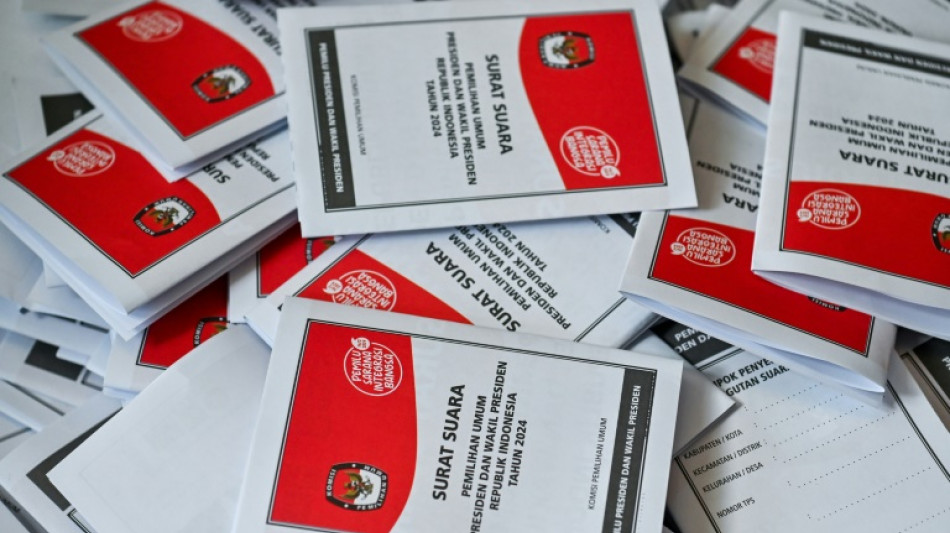
Vote-buying shadows Indonesian election / Photo: © AFP

 Lula, Bolsonaro strike calmer tone in final Brazil election debate

 'How is it possible?': Students protest Indonesian haze

 Israel launches major West Bank operation after soldiers killed

 Typhoon Champi knocks out power to thousands in Taiwan

 As Israeli election nears, campaign turns ugly

 Oscar hopeful 'La Bola Negra' offers lessons about communicating, directors say

 Trapped: Soaring fuel costs hurt Maine lobster industry before midterms

 Marc Marquez beats brother Alex to Australian MotoGP pole
 Ebola vaccine trial begins in DR Congo

 Travelling man Wade equals Prem try record
 Rescuers search for seven people in Nairobi building collapse

 Sacha Baron Cohen revives the 'problematic dinosaur' Ali G in new film

 New race in Barcelona tops 17-event '27 IndyCar season

 Neymar backs Flavio Bolsonaro in Brazil election
 Melania Trump says she brokered truce in war-torn Ukrainian city

 Leclerc tops times for Ferrari in opening practice for US Grand Prix

 Bayern Munich coach Kompany in hospital after collapsing
 Signs point to renewed major US military ops against Iran

 European, Mideast foreign ministers push peace and diplomacy at Istanbul talks

 Ex-All Black centre Williams undergoes 'miracle' heart surgery
 Netanyahu launches major West Bank operation after Israeli soldiers killed
 AFP photographer captures striking images from West Bank attack

 Oil hits $116 with stocks mixed on earnings, AI

 De Zerbi says Tottenham's dire record at Chelsea 'more motivation'
 Lula, Bolsonaro in final debate showdown before Brazil vote

When Indonesian housewife Suharti was returning home from a shopping trip, a gathering of political party workers handed her 100,000 rupiah ($6.3) and a T-shirt -- and asked her to vote for their candidate next week.
"They told me to vote for this certain candidate but I still don't know who I'm going to vote for," the 53-year-old told AFP.
"Once I'm inside the voting booth, I'll vote according to what my heart tells me to."
Voters, candidates and campaign volunteers have told AFP they saw free goodies and envelopes stuffed with cash being handed out ahead of the February 14 presidential, parliamentary and regional polls.
About 205 million Indonesians are registered to vote in the world's third-biggest democracy, and the country's election monitoring body, Bawaslu, has urged people to report any vote-buying.
But corruption remains a problem, and Transparency International in its 2023 report said the country's anti-graft commission had been "severely disempowered".
Parliament is widely viewed as one of Indonesia's most graft-hit institutions, and the Indonesia Corruption Watch (ICW) monitor says at least 56 candidates previously convicted of graft are running for seats in this year's legislative vote.
- Hundreds of envelopes -
One man who only gave his name as Andri told AFP he had been asked by several candidates running for a seat in parliament for help distributing money and groceries to lure voters.
He said he had been approached because of his role in a Jakarta football fan club.
He accepted the task.
"I usually started (distributing money) to people closest to me first, and then to people in my neighbourhood," the 37-year-old said.
"I distributed hundreds or even thousands of envelopes, depending on how much the candidates gave me."
Despite warnings from official bodies that bribes are illegal, the practice persists.
"It still happens because our regulations provide loopholes and law enforcement is not comprehensive enough," ICW researcher Seira Tamara told AFP.
Election frontrunner Prabowo Subianto has openly addressed the issue, urging people to take gifts but vote for their favourite candidate.
"If somebody promises you money, just accept it, that's your money, the people's money. But please vote according to your heart," he recently told supporters.
Violations start at the recruitment stage where candidates must spend to earn their candidacy, said Tamara.
One woman who ran for a seat in parliament in 2019 told AFP on condition of anonymity she spent 250 million rupiah ($15,795) to buy votes, but still lost.
"Now I am changing my method, I visit houses door-to-door and promote myself and my programmes," she said.
- 'Not effective' -
Andri of the football fan club said that out of several candidates he helped in 2019, only one won and entered parliament.
"It is not effective in my opinion, definitely not a guarantee you will win," he said.
"You don't know who they are going to vote inside the polling booth."
Regardless, vote-buying and accepting cash both perpetuate corruption regardless of who wins, with advertising and bribery costs encouraging candidates to return favours once elected.
"This is a vicious cycle," Tamara said.
"The policies they make after... will not be for the public interest, but for the interest of their investors."
"As long as there are people willing to accept the money", vote-buying will persist, she said.
Ukon Furkon Sukanda, a 39-year-old legislative candidate, is optimistic younger voters will be harder to bribe.
"People who vote in exchange for money will slowly disappear and be replaced. It will become a contest of ideas," he said.
C.Bruderer--VB