'Verses like dynamite': anti-Nazi magazine trove resurfaces / Photo: © AFP

 Top-ranked Rybakina to face Fernandez for Ningbo title
 Late India charge seals thrilling second T20 win over New Zealand

 Seen and heard at France protests

 White says Fiji can have 'massive' World Cup after beating Japan

 England thrash France 82-0 to keep Rugby League World Cup hopes alive

 Security high as France braces for new protests

 White makes winning start as Fiji edge Eddie Jones's Japan

 Lula, Bolsonaro strike calmer tone in final Brazil election debate

 'How is it possible?': Students protest Indonesian haze

 Israel launches major West Bank operation after soldiers killed

 Typhoon Champi knocks out power to thousands in Taiwan

 As Israeli election nears, campaign turns ugly

 Oscar hopeful 'La Bola Negra' offers lessons about communicating, directors say
 Trapped: Soaring fuel costs hurt Maine lobster industry before midterms

 Marc Marquez beats brother Alex to Australian MotoGP pole

 Ebola vaccine trial begins in DR Congo

 Travelling man Wade equals Prem try record

 Rescuers search for seven people in Nairobi building collapse

 Sacha Baron Cohen revives the 'problematic dinosaur' Ali G in new film

 New race in Barcelona tops 17-event '27 IndyCar season

 Neymar backs Flavio Bolsonaro in Brazil election

 Melania Trump says she brokered truce in war-torn Ukrainian city

 Leclerc tops times for Ferrari in opening practice for US Grand Prix

 Bayern Munich coach Kompany in hospital after collapsing

 Signs point to renewed major US military ops against Iran

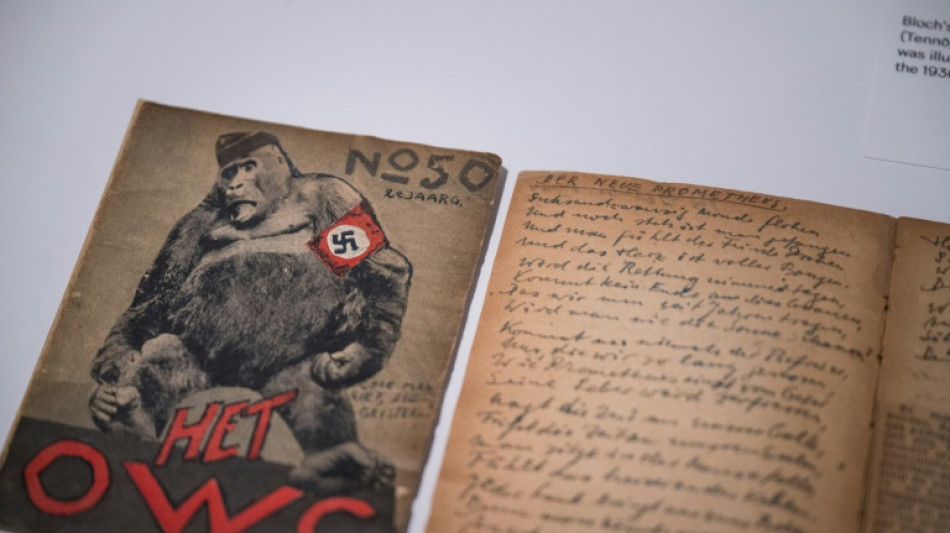
A Nazi henchman as a drooling gorilla with a swastika armband. Adolf Hitler as a dancing clown. Cheeky send-ups of Joseph Goebbels's lies.
A treasure trove of defiant satire made by Jewish refugee Curt Bloch while in hiding from the Nazis in a Dutch attic goes on display for the first time Friday, eight decades after he created his astonishingly daring magazine.
The title of the exhibition "My Verses Are Like Dynamite", at the Jewish Museum Berlin from Friday, is taken from one of the anti-fascist issues produced by Bloch between August 1943 and April 1945.
His daughter Simone Bloch, who flew in from New York for the opening, described her father as "a cross between Anne Frank and Tupac Shakur," referring to the wartime teen diarist and the late rap superstar.
She said he was a man whose "rebellious" streak blossomed when his life was under threat.
A lawyer by training, Curt had fled Dortmund in Germany for the Netherlands on a bicycle following the Nazis' rise in 1933.
After the German invasion in 1940, he found refuge in the city of Enschede in a cramped crawl space along with a German-Jewish couple thanks to an anti-Nazi network run by Dutch pastor Leendert Overduin.
There he used a fountain pen and cutouts from magazines and newspapers at his disposal to create artful collages ridiculing fascist leaders and reflecting on his own predicament.
While "underwater", as the life in hiding was called in Dutch, Bloch distributed the postcard-sized issues at great personal risk to a tight network of about 30 resistance members, trusted friends and fellow fugitives who returned them once they had read them.
- 'Special friend' Goebbels -
Bloch produced 95 issues of "Het Onderwater Cabaret" (The Underwater Cabaret) in those nerve-racking 19 months, all of which are on display in Berlin.
Museum director Hetty Berg said she was "totally flabbergasted" by the collection when Simone first showed it to her in 2022, calling it a "unique testament to artistic resistance against National Socialism".
"I have never seen anything like this," said Berg, who is Dutch and whose own grandfather survived the Holocaust in hiding.
"I'm aware of a lot of diaries of people in hiding like Anne Frank. This is different -- it's targeted artistic work" which also circulated.
In nearly 500 handwritten poems in German and Dutch, Bloch skewered Nazi hypocrisy and the failing war effort, mocked Hitler and his collaborators and movingly recounted his family's struggle for survival while separated from one another.
His caustic sarcasm and wry wit jump from the page, while the skilful artwork is reminiscent of the early 20th century Dadaists and surrealists.
In a verse dedicated to his "special friend", Nazi propagandist Goebbels, Bloch warned: "If he writes straight, read it crooked. If he writes crooked, read it straight."
The final issue is dated April 3, 1945, soon after Enschede's liberation by Allied forces, to whom Bloch dedicated his first poem in English.
Bloch outlived the Nazi regime but his mother and sisters were rounded up and murdered in the camps.
After the war, he married an Auschwitz survivor and emigrated to New York, taking his magazine collection with him where it remained stored on a shelf for decades after Bloch's death in 1975.
Simone, now 64, said she decided last year with her 98-year-old mother Ruth that the time was finally right to make the issues available to the public.
- 'Perpetrators are dead' -
She said her father, who died when she was 15, was disappointed they were not used immediately after the war for educational purposes. Later he thought there would be little appetite for dredging up that tragic chapter of the past.
"The interest in this time is different (now) because the perpetrators are pretty much all dead," Simone said, adding that something shifted when her own daughters became fascinated by the magazines.
"That's why you have children -- to carry it forward."
The exhibition, running until May 26, is accompanied by video interviews with survivors and all of the magazine issues went online in digital form this week.
Berg said the collection was too "fragile" to travel widely but hopes to arrange shows in New York and the Netherlands.
With the far right making inroads again in Germany and the Netherlands, Berg said Bloch's towering accomplishment offered important lessons about standing up to propaganda, disinformation and hatred.
Berg highlighted one of Bloch's searing, prescient verses, read by an actor on a video screen at the exhibition's entrance.
"You think you've finally escaped/The shadows of the darkest past/Yet you neglect that you as well/Are threatened by that same old pain."
During the Holocaust more than 100,000 Jews were deported from the Netherlands to their deaths -- about 75 percent of the Jewish population at the time of the German invasion.
D.Schlegel--VB