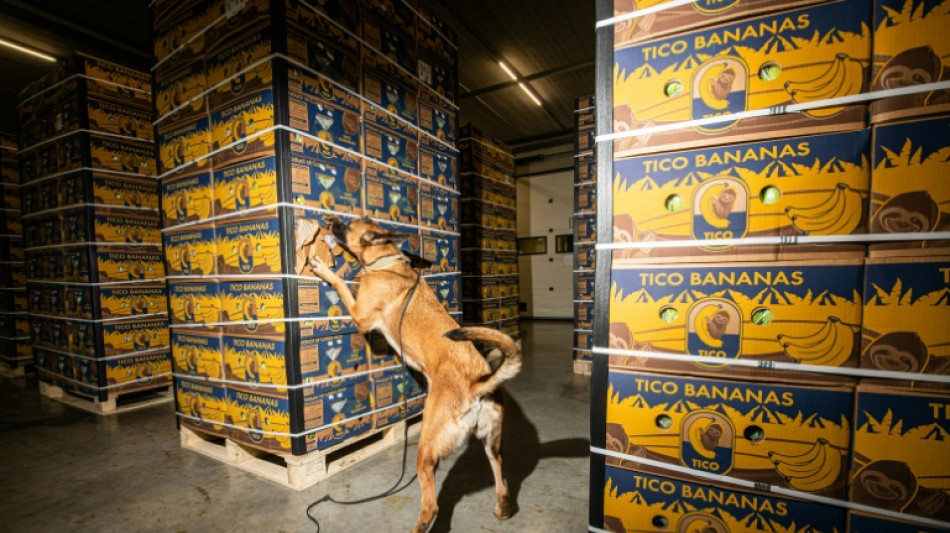
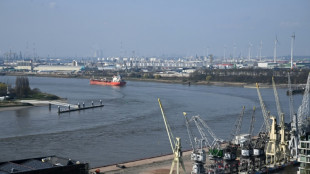
EU ports join up to fight drug smuggling / Photo: © BELGA/AFP/File

 Netanyahu, rivals trade attacks over Iran as clock counts down to Israel vote
 Townsend urges Scotland to use Nations Championship as World Cup springboard

 Microsoft offers voluntary exit packages to 60,000 staff
 S.Africa ambassador calls for talks with US over 'tense' ties

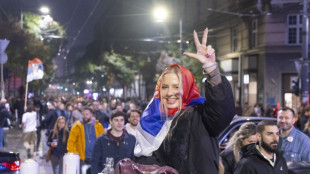 'Smells of freedom': Serbians hopeful after landmark election
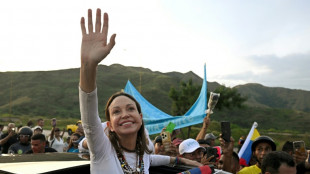
 South Africa select 'enforcer' Coetzee for Australia decider

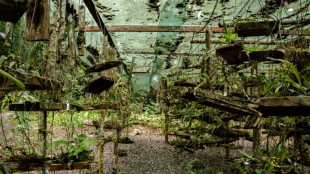 Botanists comb Gabon's rich rainforests with nature on the line
 New levy on non-EU parcels kicks in Sunday
 Stocks climb ahead of tech earnings, central bank calls

 Part of London's Oxford Street pedestrianised 'forever'

 Canadian youth seek climate action in landmark trial
 Trump blasts Norway over Nobel Peace Prize snub
 Japan PM vows swift response to wave of cyberattacks

 Stocks mostly rise before tech earnings, central bank calls
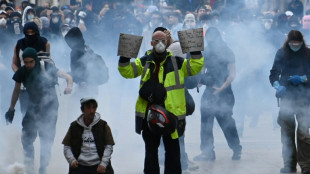 France's Macron to visit Marseille after protest violence

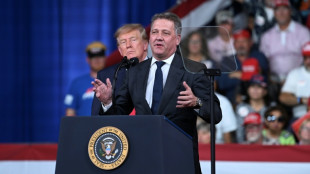 German union slams Audi boss's appearance at Trump rally
 UK set for 'limited' budget giveaways as borrowing costs surge
 Anthropic's AI model accessed US voter data: Axios

 Malaysia's Johor reopens schools as haze eases
 Carragher says Fernandes benching was intended as public punishment

 Canada-EU summit seeks deepened alliance as US ties fray

 Senegal to host Youth Games, Africa's first ever Olympics

 ITV drama Adultery examines temptation, class and family consequences

 New levy on non-EU parcels kicks in November 1
 Saudi coalition says struck Houthi missile facilities after Riyadh airport attack

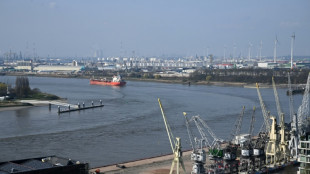
The EU on Wednesday launches a "European Ports Alliance" to harmonise methods in the fight against drug smuggling and to combat the hubs' infiltration by criminal groups.
The initiative -- inaugurated at Belgium's Antwerp port, the main gateway for cocaine into Europe -- is attended by EU interior ministers and representatives from 16 of the bloc's ports and from sea transport organisations.
EU home affairs commissioner Ylva Johansson told AFP ahead of the launch that it was "obvious that we can't just do efforts in one port because the criminals immediately move to another port".
Europe's major ports are currently dogged by violence from local mafias ready to do anything to maintain the lucrative illegal trade.
The groups include criminal gangs in the Netherlands with Moroccan roots, and in Belgium ones with links to Albanian and Italian mafia rings.
Their tactics involve efforts to bribe or coerce dock workers, port officials, truck drivers, and customs and police officers to allow their minions to grab the drug consignments.
Cocaine, coming from Latin America, is flooding the European market.
In Antwerp, annual seizures keep going up. In 2023 authorities intercepted 116 tonnes, and the city is frequently rocked by gang violence as rival groups vie for control of the lucrative illicit trade.
"The seizures of cocaine are skyrocketing and making new records," said Johansson. "But at the same time, we see that the price on the street is going down. So that means that there's a lot of cocaine present."
The rise in narco-gang activity at Antwerp follows a security crackdown at the Dutch port of Rotterdam, the Swedish commissioner noted.
Now, as Antwerp steps up its own efforts against smuggling, "it seems that also now they (criminal groups) are coming to smaller ports, like for example, there are indications that more drugs come to Helsingborg in Sweden," she said.
"So they seem to be very quick to adapt."
The same phenomenon is being seen at the departure points for the drugs, she said.
Reinforced security at Colombian ports has prompted gangs to turn to Guayaquil in Ecuador, which has become the main exportation hub to Europe for cocaine made in Colombia and Peru.
- 'Huge risk' for ports -
In the European Union, nearly 70 percent of drug seizures by customs services are made in the bloc's ports.
That shows the need for more cooperation, not only between police and customs services but also with private operators in the ports, Johansson said.
The risk of corruption spreading in ports threatened the legal activity in the hubs, she added, creating a "huge risk" for private companies there.
"Nobody wants that to happen. So that is also the interest to protect."
The ports alliance aims to step up the sharing of information and models that work, while mapping out drug flows and dismantling the criminal gangs.
The adaptability of the gangs means the focus cannot be only on containers arriving from Latin America.
Smugglers also send drug shipments to West and North Africa, where they are loaded onto small boats that go to mainly Spanish ports, Johansson said.
And alongside the battle to curb the cocaine trade is rising concern about synthetic drugs.
French Interior Minister Gerard Darmanin, who is attending the Antwerp launch, said these drugs -- such as ecstasy, amphetamines, MDMA -- "are giving rise to new European crime networks".
He has called for a joint strategy to ensure that fentanyl does not become a major problem in Europe.
That synthetic opioid, cooked up from chemical agents often legally imported from China, has become a scourge in the United States, where tens of thousands of overdoses are recorded every year.
Currently, fentanyl use is "still on a very low level" in Europe, Johansson said. But she noted that the several other synthetic drugs are made inside the European Union, with much of the production exported by smugglers to other parts of the world.
"We are dismantling 400 laboratories on a yearly basis in the EU. So this is really something that concerns me a lot," she said.
C.Bruderer--VB