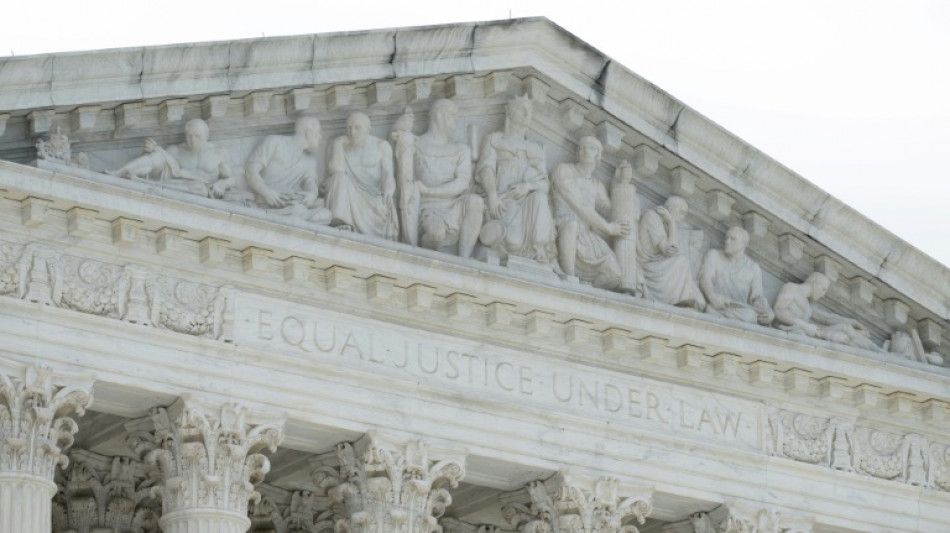
US Supreme Court appears inclined to rein in federal agencies / Photo: © AFP/File

 Brazil's Lula turns 81, vows to work '24 hours a day'

 Boeing releases cautious growth plan as shares fall sharply

 Exiled Russian dissident Navalnaya warns dictators becoming 'more cunning'

 Bayern 'risk' reaps huge reward for Ballon d'Or winner Kane

 Record turnout as Israeli voters deliver verdict on Netanyahu
 Iraola says Isak 'feels the trust' after Liverpool scoring streak

 French media protest manhandling of journalists at far-right party rally

 EU seeks deportation powers for beefed up border agency

 Two charged with UK security offences over airbase plot: police

 Maresca defends Donnarumma, Guehi after Man City defeat

 Nordic leaders call Putin as local truce begins in Ukraine

 Osaka unveils crane outfit in Tokyo before win over Paolini

 Ronaldo in line for Portugal return after fallout with coach

 Norway media take legal action to block Meta from using content

 Bayern praise 'humble' Kane after Ballon d'Or win

 Colts retain Daniel Jones as starter despite continued offensive struggles

 Madushanka wrecks Pakistan as Sri Lanka press for final slot
 Destructive Abhishek 113 leads India to series win over New Zealand

 Norway, Finland leaders hold 'frank and substantive' talk with Putin

 Wall Street faces earnings and Fed tests after turbulent technology-led week

 Ukraine, Russia say US-brokered truce holding in ravaged city

 Police form SIT after vehicles in Rahul Gandhi convoy collide on expressway

 Delhi grants minimum monthly pay and DA to about 4,000 MCD health workers
 Ather Energy shares climb 14% after quarterly profit and expansion plan

 Gold ETF flows turn negative after 13 weeks as bullion loses 4%

The conservative-leaning US Supreme Court on Wednesday appeared inclined to weaken the power of federal agencies, which regulate myriad issues affecting the everyday lives of Americans -- from consumer safety to air pollution.
At the heart of the matter is a 1984 ruling in Chevron v. Natural Resources Defense Council, which said judges should defer to government agencies in determining a "reasonable" interpretation of the law if the language is ambiguous.
At the time, the case was a win for the administration of Republican president Ronald Reagan, who accused the country's progressive federal judges of burying corporate America under masses of unnecessary and restrictive red tape.
But the political right has since decried the ruling, saying it unfairly empowers the central government over the judiciary, and means agencies can alter the meaning of statutes, depending on who's in charge.
On Wednesday, the nine justices barely touched the facts of the current case on the docket, which relates to a rule requiring fishing boats in the US northeast to pay for federal observers boarding their vessels to keep watch on overfishing.
Instead, they quickly pivoted to how the precedent set in the Chevron case affected the proceedings -- and how that 1984 ruling might be outdated.
- 'Flood of litigation' -
Elizabeth Prelogar, representing the administration of Democratic President Joe Biden, argued that overruling the Chevron decision would spark an "unwarranted shock to the legal system."
She warned that lower courts could get clogged with cases, and a situation could arise where statutes would be interpreted differently in various states based on the interpretation of judges.
"You lose the uniformity value, and it diminishes the force of the political accountability value," she said.
But most of the six right-leaning justices seemed unmoved by her arguments.
"Chevron itself ushers in shocks to the system every four or eight years when a new administration comes in -- whether it's communications law, or securities law or competition law, environmental law..." said Justice Brett Kavanaugh.
The court's three progressive justices, all women, called for maintaining the status quo.
Justice Ketanji Brown Jackson, a Biden appointee, said she was "worried about the courts becoming uber-legislators."
"Isn't it sort of impractical and chaotic to have a world in which every undefined term in a statute is subject to litigation, if you're trying to govern?" she said.
For Justice Elena Kagan, "it's best to defer to people who do know, who have had long experience on the ground."
"Judges should know what they don't know," Kagan added.
Amy Coney Barrett, who was appointed by Biden's Republican predecessor Donald Trump and whose vote could be decisive for the majority, asked about the possibility of an eventual "flood of litigation."
The court's decision is not expected for several months.
In June 2022, the Supreme Court had already limited the power of federal agencies to an extent.
It ruled that the Environmental Protection Agency did not have overarching power to regulate emissions from coal-fired power plants, saying that "it is not credible that Congress gave the EPA the authority to pass such a measure."
S.Gantenbein--VB