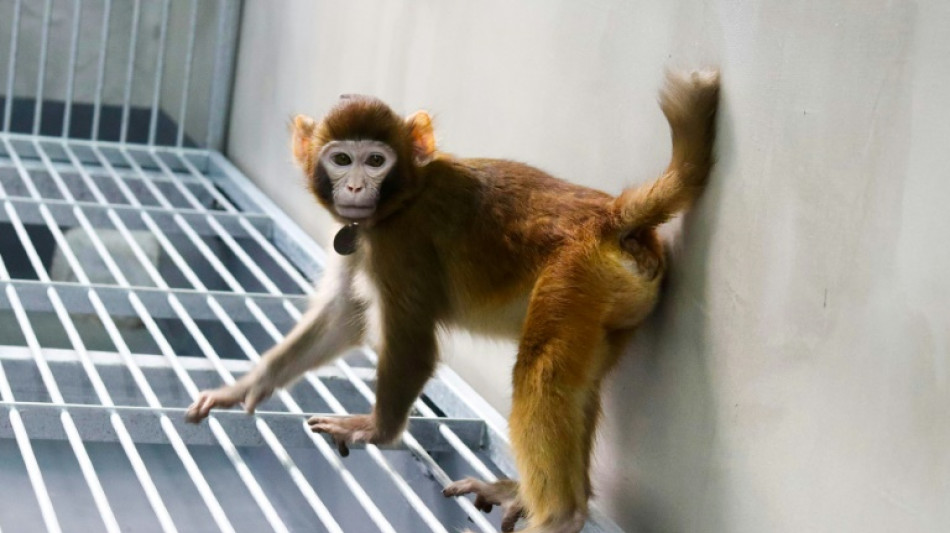
Scientists clone first rhesus monkey using new method / Photo: © Nature Communications/AFP

 UK set for cautious budget as borrowing costs climb

 Anthropic's record IPO faces some big questions

 US Fed expected to hold rates steady ahead of key midterm elections

 Can this Latin Grammy-winner help Democrats win back Congress?

 Tuvalu has 'limited' power to halt its fossil fuel investments: NZ govt papers seen by AFP

 Palestinian activist Khalil returns to Columbia after US detention

 Trump drastically loosens oil and gas methane rules

 French Senate weighs bill to make protesters pay for unrest damage

 'A very sad day': Arteta despair as Arsenal stunned by Fleetwood

 Charles tackles thorny legacy of slavery on Caribbean trip

 Former Grand Slam winner Wawrinka ends tennis career

 Brazil's Flavio Bolsonaro flees to US after election loss

 'Faerie' nights: 'ACOTAR' fans finally get their book

 American woman convicted of getting military training from Islamic State

 Israel opposition holds narrow edge over Netanyahu in first projections

 Floriani hits maiden goal as Lazio go top

 Trump set to drastically loosen oil and gas sector's methane rules

 Storied Paris department store seeks bankruptcy protection

 Xhaka, Embolo can return to Swiss squad after fake Covid docs affair

 Allegri suspended for two Serie A games after red card

 Flight data, satellite images reveal growing US role at Ecuador base

 McInnes feels 'guilt' ahead of Hearts return with Rangers

 Brazil's Lula turns 81, vows to work '24 hours a day'

 Boeing releases cautious growth plan as shares fall sharply

 Exiled Russian dissident Navalnaya warns dictators becoming 'more cunning'

Scientists in China on Tuesday announced that they have cloned the first healthy rhesus monkey, a two-year-old named Retro, by tweaking the process that created Dolly the sheep.
Primates have proved particularly difficult to clone, and the scientists overcame years of failure by replacing the cloned cells that would become the placenta with those from a normal embryo.
They hope their new technique will lead to the creation of identical rhesus monkeys that can be experimented on for medical research.
However, outside researchers warned that the success rate for the new method was still very low, as well as raising the usual ethical questions around cloning.
Since the historic cloning of Dolly the sheep using a technique called somatic cell nuclear transfer (SCNT) in 1996, more than 20 different animals have been created using the process, including dogs, cats, pigs and cattle.
However it was not until two decades later that scientists managed to clone the first primates using SCNT.
A pair of identical crab-eating macaques named Hua Hua and Zhong Zhong were created using SCNT in 2018 by researchers at the Chinese Academy of Sciences Institute of Neuroscience in Shanghai.
But that breakthrough, led by the institute's Qiang Sun, only resulted in live births in fewer than two percent of attempts.
Qiang was also a senior author of the new research published in the journal Nature Communications.
He told AFP that the team had extensively researched why previous efforts to clone the rhesus monkey (Macaca mulatta) had failed.
In an earlier attempt, one monkey -- out of 35 implanted foetuses -- was born alive, but it died in less than a day.
Qiang said that one of the "major problems" was that the placentas of cloned embryos were showing abnormalities compared to those from in vitro fertilisation.
So the researchers replaced the cells that later become the placenta, which are called the trophoblast, with those from a healthy, non-cloned embryo.
The trophoblast cells provide nutrients to a growing embryo, and turn into the placenta that supplies oxygen and other life-supporting assistance to the foetus.
The technique "greatly improved the success rate of cloning by SCNT" and led to the birth of Retro, Qiang said.
- Human cloning 'unacceptable' -
However Lluis Montoliu, a scientist at the Spanish National Centre for Biotechnology who was not involved in the research, pointed out that just one out of 113 initial embryos survived, meaning a success rate of less than one percent.
If human beings were to ever be cloned -- the great ethical fear of this field of research -- then other primate species would have to be cloned first, he said.
But so far, the poor efficiency of these efforts has "confirmed the obvious: not only was human cloning unnecessary and debatable, but if attempted, it would be extraordinarily difficult -- and ethically unjustifiable," Montoliu said.
Qiang emphasised that cloning a human being was "unacceptable" in any circumstance.
For the SCNT procedure, scientists remove the nucleus from a healthy egg, then replace it with another nucleus from another type of body cell.
The embryo therefore grows into the same creature that donated the replacement nucleus.
A rhesus monkey named Tetra was cloned in 1999 using a different technique called embryo splitting.
But this simpler technique can only produce four clones at once.
Scientists have focused on SCNT in part because it can create far more clones, with the goal of creating identical monkeys to study a range of diseases as well as test drugs.
F.Stadler--VB