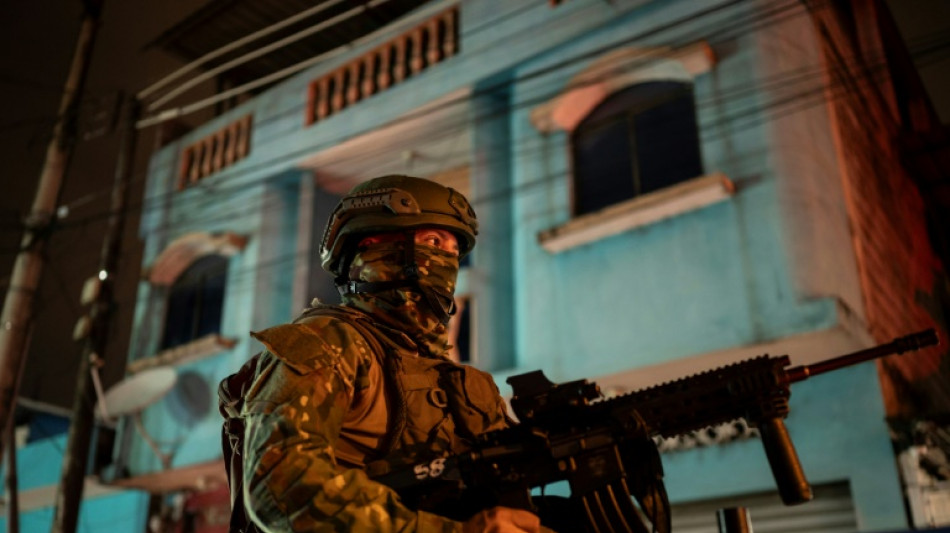
After curfew, on the hunt for Ecuador's gang member / Photo: © AFP

 Russia strikes Ukraine capital with missiles and drones, wounds five

 Belgium late show floors Senegal at World Cup

 Harry Kane: England's World Cup saviour

 US actor Danny Glover says he has Alzheimer's

 Trump sees progress as US, Iran hold Qatar talks

 Djokovic, Sinner into Wimbledon third round, Andreeva stunned
 Spurs agree club record £100 mn move for Newcastle's Tonali - reports

 Rain has final say in 1st England-India T20 as Sooryavanshi still awaits debut
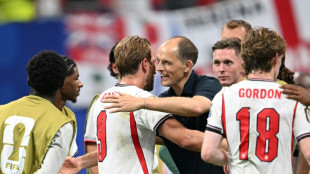 England refused to accept defeat in 'beautiful' DR Congo win, says Tuchel

 'Let the dogs in': Sabalenka wants Wimbledon to lift ban
 Oppressive heat broils US during World Cup, July Fourth
 Can anyone stop France at the World Cup?
 Sinner, Sabalenka into Wimbledon third round, Andreeva stunned

 England have 'hero moments', says Kane after double downs DR Congo

 努莎·奧貝爾:為市民實施時速10公里限速,波茨坦的「坑洞政策」——是漠不關心還是無能為力?

 US refuses to extend North America trade pact in current form
 Mixed US auto sales in 2nd quarter amid high gas prices

 Swiatek, Zverev hoping to lay down Wimbledon markers
 Spray-painted letters spell tragedy for Venezuela quake victims
 'Everybody's profiting': Trump defends $1bn crypto earnings
 WTA Finals moved from Riyadh to Indian Wells

 Messi returns 'home' to lead Argentina World Cup charge in Miami
 England skipper Sciver-Brunt 'threw everything' at World Cup semi-final return
 Stocks mixed with eyes on US Fed

 Trial begins for suspected mastermind of Malta journalist killing

"What are you doing here? Don't you know it's the curfew?"
In the large port city of Guayaquil, deserted and sleepy, the Ecuadorian army patrols the streets at night in search of delinquents and criminals who are in open war against the authorities.
On a recent evening, around 30 soldiers accompanied by police officers patrolled the dark alleys of Pascuales, a northern neighborhood whose fenced-in houses give the working-class district the appearance of an open-air prison.
Since the escape almost a week ago of the feared leader of the Choneros gang Adolfo Macias, alias "Fito," Ecuador -- which has become a hub for drug trafficking in recent years -- is experiencing an unprecedented security crisis.
The gangs, which number some 20,000 members, have gone on a spree of violence, spreading terror.
- Under the soles -
Already infamous for its record homicide rate, the sprawling city of Guayaquil on the Pacific coast is one of the main front lines in an open confrontation with the new president, Daniel Noboa, elected in November.
He declared a state of emergency and ordered the army to neutralize these criminal gangs, now considered terrorist groups.
Not many suspected terrorists, however, were spotted this particular night in Pascuales. The convoy of three trucks filled with armed soldiers with masked faces, accompanied by two police cars, began its patrol shortly after the start of the curfew at 11 pm.
While a few cars were visible on the main roads, the curfew is strictly respected in this gang territory where it is already dangerous to venture out at night even in ordinary times.
"In this sector of Pascuales, we are aware of the presence of groups of organized delinquents," said Captain Carlos Jenfe of the 5th Infantry Brigade, who led the patrol.
The convoy progressed slowly through dark streets given over to stray dogs.
Then the soldiers suddenly jumped out of their vehicles and approached two men in caps and Bermuda shorts chatting on a sidewalk.
The men were pressed against a wall, unceremoniously patted down, their tee shirts pulled up high on their bodies to ensure they were not concealing weapons.
The police even checked the soles of their shoes.
"You don't have a knife or any drugs on you?" they asked.
The men's meager belongings stuffed into filthy backpacks were thrown on the ground: a jumble of electrical wires, old phone chargers or soiled clothes, all apparently found by grubbing through the neighborhood trash cans.
"Come on, get out! You have no reason being here!" the soldiers ordered, and the two men meekly moved on, leaving their stash behind.
- 'Marta' -
In deserted Pascuales, where no Choneros were to be seen, it was mainly homeless people that the patrol encountered, emaciated silhouettes lying on cardboard boxes or puffing on a crack pipe.
A little further on, a small suspicious group scattered as the convoy arrived. "Hey, you there!" shouted a soldier and the troops set off in pursuit, weapons in hand, in the alleys. The men were apprehended one by one.
This time the body search was much more vigorous.
"Why did you run away?" asked a soldier.
The man, out of breath and handcuffed face down on the ground, stammered something incomprehensible.
His polo shirt was pulled up to check for gang tattoos. No wolf face, tiger paw, or the other symbols normally inked on Ecuadorian criminals, just a banal and affectionate "Marta" scrawled at the base of his neck.
The suspect was loaded into a trunk. "Today we carried out various security operations in this sector of Pascuales, with fixed points and mobile patrols. Twenty-five vehicles were confiscated and around thirty people arrested," said Jenfe.
"This evening, it was mainly a question of apprehending individuals breaking the curfew. But no gang member was arrested," he conceded.
At almost 3:00 am, the patrol ended and the weary soldiers headed to the barracks. Marta's suitor was dumped barefoot by the side of a highway.
Like a ghost, he disappeared again into the night.
D.Bachmann--VB