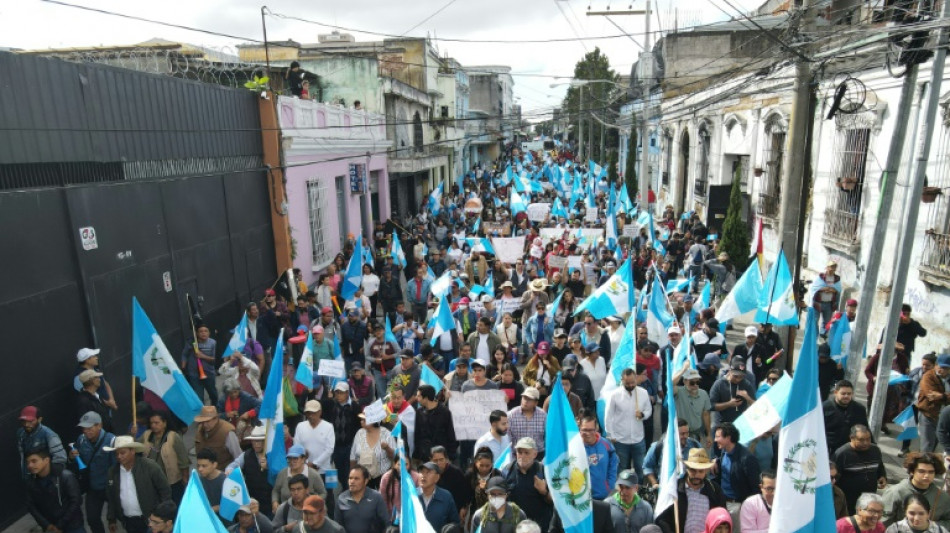
What's behind Guatemala's voracious corruption? / Photo: © AFP/File

 Chelsea win as Bayern and Madrid draw in Women's Champions League
 Made with munitions from the Falklands War, a 'Chalice of Peace' for the pope
 Pioneering US labor leader Dolores Huerta dies at 96

 Italian PM slams 'shameful' release of alleged protest organiser
 Hollywood producer Kennedy to head LA28 Olympic ceremony plans
 Djokovic wins Basel opener to boost ATP Finals bid

 US Fed holds interest rates steady despite surging inflation
 Chiefs sign ex-Ravens kicker suspended over sex allegations

 Inglis and Carey put Australia in command of South Africa decider
 92-year-old US judge handling Maduro case dies
 Perez extends Cadillac deal to 2029
 Arab Israelis proud of high election turnout, uncertain for future
 Inglis, Carey put Australia in command of South Africa decider
 French firm Safran helps build aircraft wings of the future in UK factory
 Ceasefire in Russia-occupied Ukrainian city holds for second day
 Canada hikes rates to contain oil price surge caused by Iran war
 World Bank warns of worsening food insecurity as commodity prices soar
 Mona Lisa scrubbed from Syrian textbooks as critics slam conservative drift
 Bolsonaro flees Brazil for US after election defeat: AFP
 Brazil's Bolsonaros: between power, prison, and exile
 Israel president urges against new vote despite inconclusive result
 Eala recovers to move into Tokyo quarter-finals
 COPs 'bunch of baloney' says Panama as it vies to host nature summit
 Denmark mulls banning turbo chickens
 Nintendo producer 'all nervous' as Zelda classic remake hits shelves
Guatemala's president-elect Bernardo Arevalo has faced a judicial onslaught seen as an attempt by the country's powerful economic and political elite to perpetuate rampant corruption.
The offensive waged by the prosecutor's office sought to withdraw Arevalo's immunity, suspend his Semilla party and annul the results of the election.
As Arevalo prepares to take office on Sunday, here are what experts and activists say are the keys to understanding the magnitude of the graft problem in the Central American nation.
- 'Predatory elite' -
Heir to the oligarchy that emerged in the colonial era, the Guatemalan elite is considered one of the most "predatory" on the continent, the country's former human rights ombudsman, Jordan Rodas, told AFP.
With 60 percent of its 17.8 million inhabitants living in poverty, Guatemala's inequality rate is among the highest in Latin America, "with a large and underserved population, mostly rural and indigenous and employed in the informal sector," the World Bank said in October.
According to a 2019 report from Oxfam International, the richest one percent in Guatemala have the same income as half the population.
The country's most powerful families control much of its fertile land, including coffee plantations, as well as breweries, real estate companies and banking businesses.
"It's a predatory elite, jointly responsible for the rampant corruption of the previous governments and for migration, because starvation wages force Guatemalans to leave the country," said Rodas, who now lives in the United States.
In the eyes of the elite, the state's purpose is not to work for the common good, "but to enrich itself," he added.
According to Manfredo Marroquin, co-founder of Guatemalan anti-corruption watchdog Accion Ciudadana (Citizen Action), the elites "support each other because they want a state that doesn't collect taxes or apply labor or environmental standards."
- 'Corporate dictatorship' -
Guatemala's CACIF business association "is the real power that controls the country's destiny," Carmen Aida Ibarra, of the social movement ProJusticia, said.
With the state weakened by the 1960-1996 civil war, analysts say the country's economic, political and military elites wove a web of corruption so big that it led the United Nations to become directly involved with the International Commission against Impunity in Guatemala (CICIG), installed in 2007.
In 2015, the CICIG and the prosecutor's office discovered a bribery network involving then president Otto Perez, who resigned and was imprisoned.
They accused political parties of illicit financing in the 2015 presidential election using money from powerful business figures and organized crime, setting their sights on the winner Jimmy Morales.
In 2017, members of Congress approved reforms that sought to shield political leaders from these accusations, sparking protests that forced them to backtrack.
"It's a conspiracy by politicians, officials and various elite businessmen with a perverse intention to keep themselves in power as a corporate dictatorship, which has nothing to do with ideology," Rodas said.
- Reign of impunity -
Morales shut the CICIG in 2019 and named a new attorney general, Consuelo Porras, who was reappointed by now-outgoing president Alejandro Giammattei.
Porras, branded corrupt and undemocratic by the US Justice Department, is accused of being at the forefront of efforts to stop Arevalo taking office.
After CICIG disappeared, the courts, prosecutors, Congress and other bodies were co-opted, installing officials who in alliance with economic elites acted to "guarantee impunity," former attorney general Claudia Paz y Paz -- who is now in Costa Rica -- told AFP.
According to Marroquin, "judicial hitmen" were tasked with building cases against journalists or officials who denounce corruption.
Lawmakers are bribed to approve laws and prosecutors are "the tool of persecution," Marroquin added.
Edie Cux, director of Accion Ciudadana, said "several of these traditional power groups even have links to organized crime."
Guatemala is rated among the 30 most corrupt countries in the world by graft watchdog Transparency International.
The elites' aim is clear, warned Marroquin: "to continue in a state of total corruption and impunity, which oils the wheels of the entire political and economic system."
S.Spengler--VB