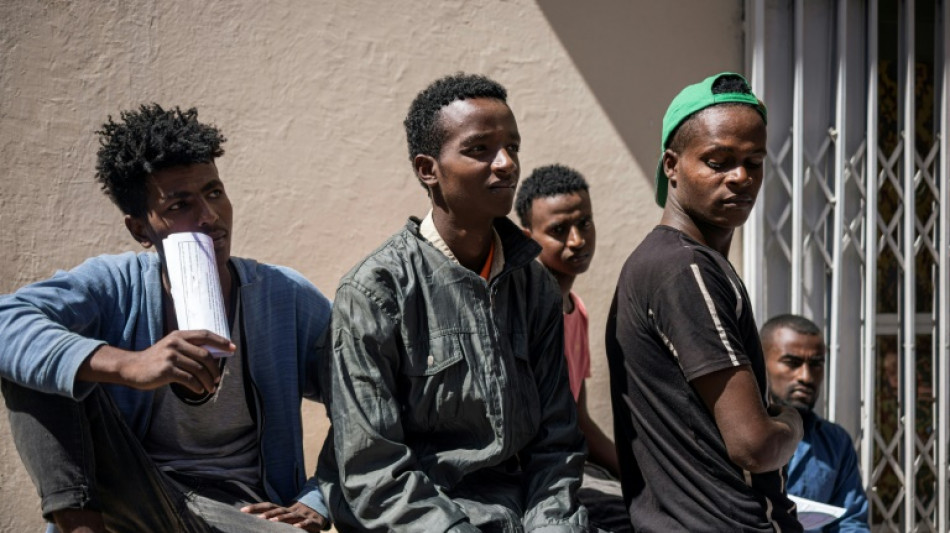
Seeking Saudi opportunity, Ethiopian migrants 'trapped between life and death' / Photo: © AFP/File

 Spain, Portugal eye World Cup last 16

 Russian strikes kill 17 in biggest ever attack on Kyiv, mayor says

 Uruguay veteran Cavani quits Boca Juniors

 West Ham's Fernandes joins Spurs

 Bones of contention: More research needed on 'd'Artagnan corpse'
 Coffee with a view: tourists flock to Starbucks overlooking North Korea

 German coalition agrees on reform package in key breakthrough

 France recall record try scorer Penaud for All Blacks Test

 Seoul's Kospi tanks as Asia tech firms suffer another blow

 'Outstanding' Love to start at fly-half for All Blacks against France
 Campbell back from four years in Wallabies wilderness to face Ireland

 Migrants pick up pieces back home after fleeing South Africa

 Farrell names Leinster-heavy Ireland side to face Wallabies
 Fearing Russian strike, Kyiv's Holodomor museum evacuates exhibits
 Germany's energy-hungry small firms struggle with green shift

 Pochettino says Balogun foul 'never' a red card as suspension looms

 Campbell back after four years in Wallabies team to face Ireland

 Kane saves England as USA, Belgium reach last 16

 Budding chefs cook up new career at China's BBQ academy

 One stitch at a time: Artist's mission to recreate the Bayeux Tapestry

 Deadly Russian barrage pounds Ukraine capital

 Belgium coach salutes Tielemans after World Cup rescue act

 Cracking open a can of cannabis -- America's new pastime (for now)

 Russia strikes Ukraine capital with missiles and drones, wounds five

 Belgium late show floors Senegal at World Cup

Ethiopian migrants who crossed the sea in pursuit of a better life have one goal in mind as they hide in the Saudi mountains: avoid border guards, and their deadly shots.
Only when night falls on this part of southern Saudi Arabia do the undocumented migrants dare venture into nearby villages to scavenge for food, returning with scraps they hope will keep them alive until smugglers can find them a job.
"Every day we are scared of dying. We beg people in the village to give us flour and bread, and then we go back into the mountains," said Mohammed, 30, who spoke to AFP by phone from a makeshift shelter near Saudi Arabia's southern border with Yemen.
"People here are very scared to help us find job opportunities since it's illegal, so we consider ourselves trapped between life and death."
Hundreds of thousands of African migrants each year brave the perilous "Eastern Route" across the Red Sea and through war-scarred Yemen to reach Saudi Arabia, a desperate ploy to pull their families out of grinding poverty.
Every phase of the journey is treacherous, but there are growing fears the final stretch over the Yemeni highlands into southern Saudi Arabia has become more lethal than ever.
In August, Human Rights Watch accused Saudi border guards of killing "at least hundreds" of Ethiopians trying to cross into the Gulf kingdom between March 2022 and June 2023, using explosive weapons in some cases.
Riyadh dismissed the group's findings as "unfounded and not based on reliable sources".
AFP has interviewed six migrants and four smugglers, all of whom asked to be identified by first names only over security concerns.
These interviews indicate that even when Ethiopians like Mohammed reach Saudi soil, it is far from certain they will find work and turn their lives around.
- Shooting 'as if we're garbage' -
Mohammed was still a teenager when he first made the journey from Ethiopia to Saudi Arabia, travelling over land to Djibouti before hiding in a fishing boat for the sea crossing.
Huthi rebels had not yet seized the Yemeni capital Sanaa, a move which in 2014 would plunge the country into war, meaning Mohammed had a fairly straightforward trip over the border to Saudi Arabia, where his smuggler found him a job as a shepherd.
Three years ago, however, Mohammed lost that job and was forced to return to his home village in Ethiopia's Oromia region, where he encountered the same situation that had prompted him to leave in the first place: no money, no prospects.
Last year he raised the funds –- roughly $2,500 –- for a second passage to Saudi Arabia, but this time the trip was more harrowing, especially when he got to the Saudi-Yemeni border.
"Every two metres (yards) you find dead Ethiopians," he said.
"Saudis open fire on Ethiopians as if we are not human beings, as if we are garbage."
Saudi state media in August quoted a government source saying that such claims were baseless and that Saudi authorities were committed to upholding human rights.
The government source also said Riyadh had provided care to "people who were subjected to gunshot wounds by armed groups to push them to enter the kingdom by force" –- an apparent reference to the Huthis, who have denied collaborating with smugglers.
The number of migrants reaching Saudi Arabia appears to have declined in recent months, several smugglers told AFP, though it is unclear whether that is because fewer Ethiopians are embarking on the journey.
"There are at least 200 arriving every day," said a smuggler, also named Mohammed. "Before, the numbers were bigger."
- Dreams on hold -
A smuggler's assistant named Abdi said that when Ethiopians reach southern Saudi Arabia, those with any remaining cash are taken to apartment buildings rented out by smugglers.
Under the watchful eye of armed guards, they sleep more than 10 to a room as smugglers try to find them work and arrange for food to be delivered each day.
The conditions might be bleak, but migrants who arrive empty-handed are worse off, Abdi said, in most cases left to their own devices.
Those who find employment may be relatively lucky but face difficulties too.
Sara, a 23-year-old Ethiopian, has secured a job as a nanny for a family in Riyadh that she said treats and pays her well.
But she described a grim existence: without papers, the fear of leaving her employer's compound means she has effectively worked non-stop for four years.
Her dreams of starting a family of her own are on hold.
"Of course I am not happy with my life here. How can I be?" she asked.
If all goes according to plan, though, she may soon have relatives close by.
With her savings, she recently paid a combined $5,000 for smuggling fees for her brother and his son, who are now in southern Saudi Arabia, dodging the authorities and looking for work.
T.Zimmermann--VB