Egypt election offers more of the same despite crisis
/ Photo: © AFP

 Spain, Portugal eye World Cup last 16
 Russian strikes kill 17 in biggest ever attack on Kyiv, mayor says
 Uruguay veteran Cavani quits Boca Juniors

 West Ham's Fernandes joins Spurs
 Bones of contention: More research needed on 'd'Artagnan corpse'
 Coffee with a view: tourists flock to Starbucks overlooking North Korea

 German coalition agrees on reform package in key breakthrough
 France recall record try scorer Penaud for All Blacks Test

 Seoul's Kospi tanks as Asia tech firms suffer another blow

 'Outstanding' Love to start at fly-half for All Blacks against France
 Campbell back from four years in Wallabies wilderness to face Ireland
 Migrants pick up pieces back home after fleeing South Africa
 Farrell names Leinster-heavy Ireland side to face Wallabies
 Fearing Russian strike, Kyiv's Holodomor museum evacuates exhibits
 Germany's energy-hungry small firms struggle with green shift

 Pochettino says Balogun foul 'never' a red card as suspension looms
 Campbell back after four years in Wallabies team to face Ireland
 Kane saves England as USA, Belgium reach last 16
 Budding chefs cook up new career at China's BBQ academy
 One stitch at a time: Artist's mission to recreate the Bayeux Tapestry

 Deadly Russian barrage pounds Ukraine capital

 Belgium coach salutes Tielemans after World Cup rescue act
 Cracking open a can of cannabis -- America's new pastime (for now)

 Russia strikes Ukraine capital with missiles and drones, wounds five
 Belgium late show floors Senegal at World Cup

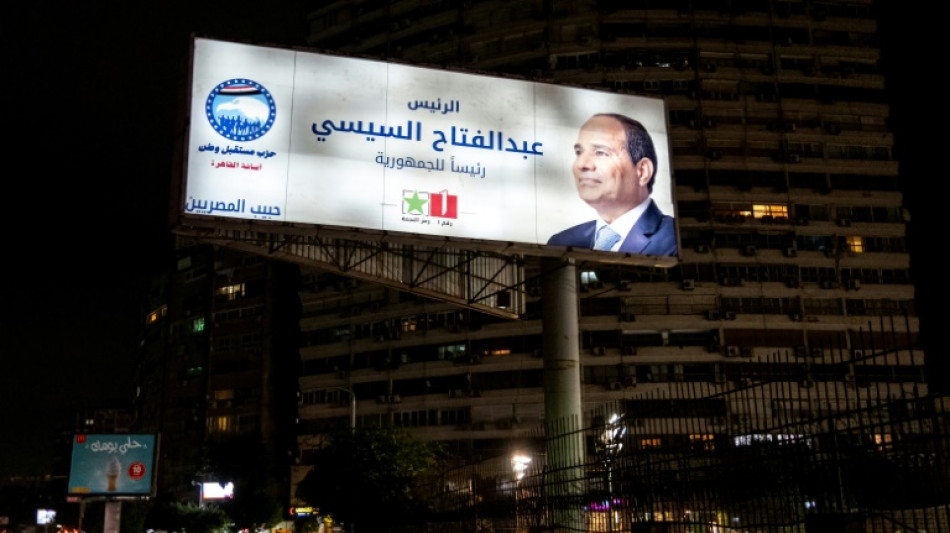
Egyptians vote on Sunday in a presidential election overshadowed by war in neighbouring Gaza and with little doubt that the incumbent Abdel Fattah al-Sisi will secure a third term.
In a country gripped by the most severe financial crisis in its recent history -- inflation has hovered near 40 percent after the currency lost half its value and drove up the cost of imports -- the economy is the crux of Egyptians' concerns.
Even before the current crisis, about two-thirds of the country's nearly 106 million people were living on or below the poverty line.
Voting will take place from Sunday until Tuesday, between 9:00 am and 09:00 pm (0700-1900 GMT) each day, with the official results announced on December 18.
Some 67 million people are eligible to vote, and all eyes will be on turnout after successive previous elections mustered low participation figures.
Despite Egypt's afflictions, a decade-long crackdown on dissent has eliminated any serious opposition to Sisi, the fifth president to emerge from within the ranks of the military since 1952.
Under his rule, Egypt has jailed thousands of political prisoners, and while a presidential pardons committee has freed around 1,000 in one year, rights groups say that three to four times that many were arrested over the same time period.
- Opponents arrested -
Egyptians, meanwhile, have paid little attention to electoral campaigns that have taken place in the shadow of the war between Israel and Hamas in Gaza.
That conflict has monopolised media and public attention across the Arab world. Talk shows in Egypt -- closely tied to the intelligence services and fervent supporters of Sisi -- have sought to link the two issues in the incumbent's favour.
"There are two million (Gazans) who want to come here... we cannot sit idly by and watch, we will go out and say 'no to the transfer' (of Palestinians)," said one TV presenter, Ahmed Moussa, echoing a speech by Sisi at the start of the war in October.
The three other candidates are all relative unknowns among the public: Farid Zahran, leader of the left-leaning Egyptian Social Democratic Party; Abdel-Sanad Yamama, from the Wafd, a century-old but relatively marginal party; and Hazem Omar, from the Republican People's Party.
Of the trio, Omar appeared to come out on top during a televised debate between the candidates. Sisi did not attend and sent an MP in his place.
Two more prominent opposition figures had attempted to run but were quickly sidelined by the government. Today, one is in prison and the other is awaiting trial.
The journalist and activist Khaled Dawoud criticised what he said was a "stifling atmosphere of suppressed liberties, total control of the media and security services that prevent the opposition from operating on the streets".
"We are not kidding ourselves, the vote will be... neither credible nor fair," he wrote on Facebook.
However, he added he would vote for Zahran in order to "send a clear message to the regime" that "we want change" because "after 10 years, the living conditions of Egyptians have deteriorated and we risk bankruptcy because of its policies".
- Painful reforms -
Sisi, a retired field marshall in the Egyptian army, came to power in 2013 after leading the overthrow of elected Islamist president Mohamed Morsi following mass protests.
In both the 2014 and 2018 elections, he won landslide victories with over 96 percent of the vote, according to official results.
He later extended the presidential mandate from four to six years and amended the constitution to raise the limit on consecutive terms in office from two to three.
Given that context, turnout is likely to be a key indicator of public sentiment. At the last election it fell six points to 41.5 percent.
Sisi is not without supporters, many of whom credit him with engineering a return to calm in the country after the chaos that followed the 2011 uprising that overthrew Hosni Mubarak.
Since the start of his first term, the president has promised to restore stability, including for the economy.
From 2016 onwards, he has undertaken a host of economic reforms that saw the currency devalued and the number of civil servants slashed.
Those reforms, coupled with high-cost projects including a multibillion-dollar new capital, have led to surging prices, fuelled public discontent and undermined Sisi's support both at home and abroad.
Under Sisi's economic stewardship, the national debt has tripled while the various mega-projects -- often led by the military -- have failed to deliver on their promised benefits.
Nevertheless, Yezid Sayigh, a senior fellow at the Carnegie Middle East Center, suggested Sisi would not move to end the military's stranglehold over the economy, "as it could cost him the presidency".
P.Vogel--VB