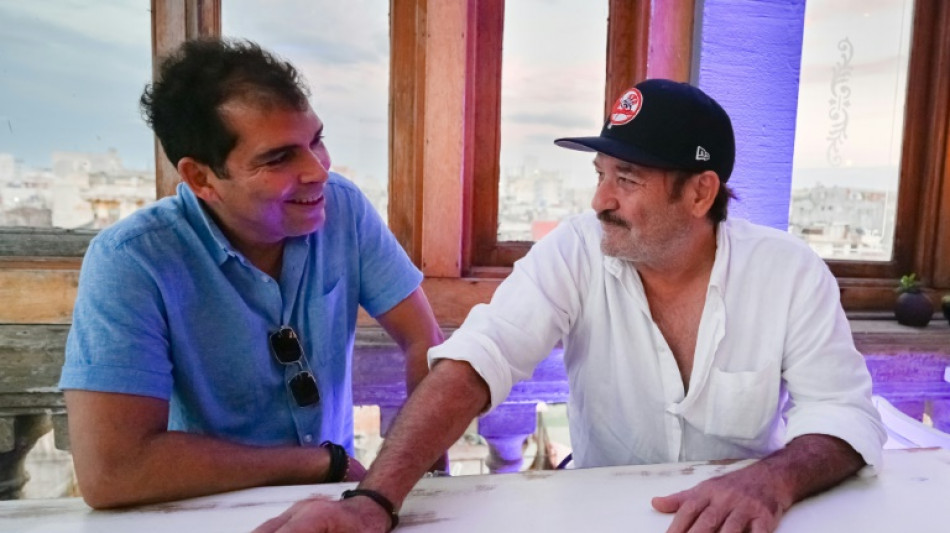
Pioneering Cuban movie maintains its relevance 30 years later / Photo: © AFP

 Spain, Portugal eye World Cup last 16

 Russian strikes kill 17 in biggest ever attack on Kyiv, mayor says

 Uruguay veteran Cavani quits Boca Juniors

 West Ham's Fernandes joins Spurs

 Bones of contention: More research needed on 'd'Artagnan corpse'
 Coffee with a view: tourists flock to Starbucks overlooking North Korea

 German coalition agrees on reform package in key breakthrough

 France recall record try scorer Penaud for All Blacks Test

 Seoul's Kospi tanks as Asia tech firms suffer another blow

 'Outstanding' Love to start at fly-half for All Blacks against France
 Campbell back from four years in Wallabies wilderness to face Ireland

 Migrants pick up pieces back home after fleeing South Africa
 Farrell names Leinster-heavy Ireland side to face Wallabies

 Fearing Russian strike, Kyiv's Holodomor museum evacuates exhibits
 Germany's energy-hungry small firms struggle with green shift

 Pochettino says Balogun foul 'never' a red card as suspension looms

 Campbell back after four years in Wallabies team to face Ireland

 Kane saves England as USA, Belgium reach last 16

 Budding chefs cook up new career at China's BBQ academy

 One stitch at a time: Artist's mission to recreate the Bayeux Tapestry

 Deadly Russian barrage pounds Ukraine capital

 Belgium coach salutes Tielemans after World Cup rescue act

 Cracking open a can of cannabis -- America's new pastime (for now)

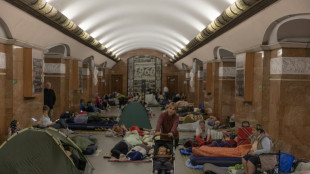 Russia strikes Ukraine capital with missiles and drones, wounds five

 Belgium late show floors Senegal at World Cup

It has been three decades since the seminal film "Strawberry and Chocolate" generated both ovations and tears, marking a before and an after in Cuban cinema.
The film was cathartic in a country that only barely had come to recognize the rights of homosexuals.
But the actor who was the protagonist, Jorge Perugorria, says Cuba has moved backward in terms of the freedom of expression also invoked by the movie.
The International Festival of New Latin American Cinema, which opens Friday in Havana, will pay two tributes to the film, known in Spanish as "Fresa y Chocolate," which received a standing ovation at its premiere in 1993.
Perugorria, 58, talked to AFP about the film along with the rest of its cast in an emotional reunion at La Guarida restaurant, a mansion in central Havana that in the early years of the revolution was subdivided into apartments and served as setting for the movie.
On the terrace of the mansion, Perugorria, recalls the "collective catharsis" that the film provoked.
"It was as if the public had the need to see that film... because it dealt perhaps with what many had in their heads... frustrations" and issues buried and out of reach of the public, he recalls.
At the time, following the collapse of the Soviet Union, a severe economic crisis -- called the "special period" -- pummeled the island, and an obscure policy that marginalized homosexuals and dissidents was only beginning to be reevaluated.
In the film, Diego, a refined gay art lover, befriends David, a staunch defender of the ruling Communist Party, in an environment of censorship and homophobia.
- 'Impossible metaphor' -
"That final embrace," between Diego and David at the end of the film, "is a song, a reconciliation between Cubans," but "it is farther away today than it was 30 years ago," says Perugorria, who plays Diego.
"The differences between Cubans have widened," and the embrace "has become an almost impossible metaphor," he adds.
For Vladimir Cruz, 58, who played the role of David, the film identified both the repressed and the repressors.
"We had experiences of people who came out of the cinema and said: 'I have acted like this, I have been intolerant, I have repressed homosexuals,'" Cruz recalls among photos and sculptures preserved from the set.
The story shows how "the right to participate in society was taken away from those who thought differently. And in that sense, I think Cuban society... has progressed, but at the official level we have gone downhill," Cruz says.
He celebrates the legalization of equal marriage in 2022.
"But anyone who thinks differently, (even) one millimeter, with respect to the predominant ideology or the official ideology, continues to suffer the same problems that Diego had and that led him to migrate," Cruz says.
Nearly 500,000 Cubans, or almost 5 percent of the population, left the island left the island since 2021 in an unprecedented wave, according to US immigration figures.
Perugorria agrees: "Today, just as the exhibition of German (another character in the film) was censored 30 years ago, films and exhibitions are still censored."
Cuba needs "a cultural policy that is for everyone in our diversity, our complexity, not just for a group that thinks one way," says Perugorria.
- 'Cornered and harassed' -
"'Strawberry and Chocolate' advocates for that" and is still "current," Perugorria maintains, citing the case of the more than 300 young people who staged an unprecedented protest for freedom of expression in November 2020.
A good part of them emigrated.
"It's sad to think that there are people who don't just leave, but are thrown out, because they are cornered and harassed," he says.
Behind the cameras, another fraternal story was built between Tomas Gutierrez Alea (1928-1996) and Juan Carlos Tabio (1943-2021), codirectors of the film.
Seriously ill, Gutierrez Alea underwent surgery during filming, but returned to the set four days later. The actors say that he would slowly climb the wide stairs of the mansion to direct in the mornings, then Tabio would follow his friend's recommendations in detail on the set.
"That story of friendship between these two great artists and their love for cinema also had a lot of weight in the film," says Perugorria.
C.Bruderer--VB