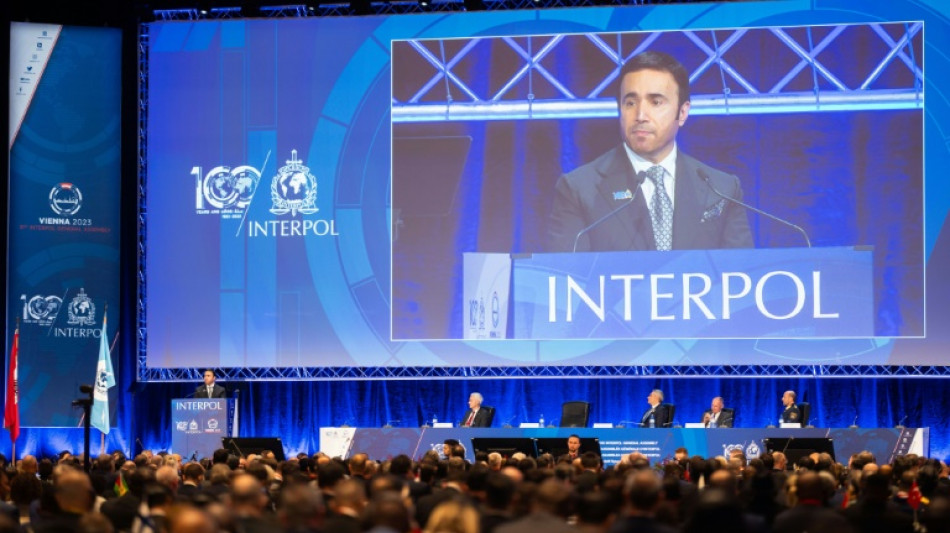
Interpol fights crime and controversial image, 100 years on / Photo: © APA/AFP

 Ukrainian state ordered Nord Stream sabotage: German prosecutors
 Swiatek, Zverev aiming to lay down Wimbledon markers

 German ruling coalition agrees on major reform package
 European stocks climb after Asia rout
 Former Arsenal, Spain midfielder Cazorla retires
 German drone maker raises $1.2 bn as investors pile into defence
 French scramble to find air conditioners before next heatwave
 Japan deploys bear cameras in moutains as attacks surge

 Germany's Infineon opens major chip plant as EU seeks tech autonomy
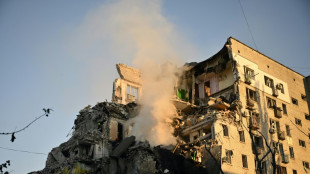 Biggest ever Russian barrage on Kyiv kills at least 13

 EU top court upholds record 4.1 bn euro Google fine
 Italy name two debutants to face Japan in Nations Championship opener

 Wallabies' Schmidt rules out another coaching job
 India asks Meta to hold WhatsApp username rollout over fraud fears

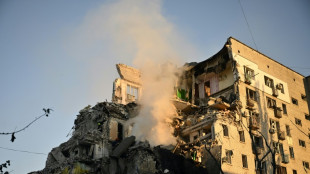 Deadly Russian barrage on Kyiv kills at least 13

 Next indirect US-Iran talks after Khamenei funeral: mediators
 Reviving Montenegro's 'ancient' olive tree

 Resource rich PNG leaving its Pacific people behind: World Bank
 Papal envoy presides over first Vietnam beatification rite

 LeBron James praises Balogun after 'Silencer' celebration
 Farrell names Leinster-heavy side to face Wallabies

 Most Asia markets down as tech firms take fresh blow
 South Korean school baseball team suspended over 'Tank Day' chants

 Ceuzany, Cape Verde's golden voice with volcanic emotion
 Balogun scores and sees red as US beat Bosnia 2-0
As Interpol marks its centenary, it faces the tricky task of nabbing criminals while ensuring that its famous red notices are not abused to snare dissidents.
This week, more than a thousand police and law enforcement leaders from around the world are attending Interpol's general assembly in Vienna, where it was founded.
"We've been growing from 20 member countries in 1923 to 196 today," Juergen Stock, Secretary General of the Lyon-based agency, told AFP.
With its famous red notices, Interpol "makes sure there is no safe haven for criminals, whether it's the physical or the online world," the 64-year-old German said.
But the organisation has had to step up controls after abuse of the notices led to criticism.
- Mafia and tattoos -
As a global hub for information sharing, Interpol helps member countries "connect the dots across continents" by identifying and locating criminals, explained Stock.
Interpol's database boasts 125 million police files, and receives about 16 million searches per day.
Bosnian Serb wartime leader Radovan Karadzic -- who was captured in 2008 after almost 13 years on the run -- and French serial killer Charles Sobhraj are among Interpol's most spectacular coups.
The global police body has also helped Italy in recent years crack down on the country's wealthiest and most powerful mafia: the 'Ndrangheta.
In May, Interpol launched an unprecedented campaign to identify 22 women believed to have been murdered in Belgium, Germany and The Netherlands.
By making previously confidential information public, Rita Roberts, who was killed in 1992, was finally identified this year after a family member recognised her tattoo.
- Tightened controls -
Notwithstanding its successes, Interpol's red notice system has been regularly accused of being misused by member states to hunt down political dissidents.
Shortly after taking office in 2014, Stock decided to tackle the problem head-on by setting up a team of about 40 experts to vet notices for wanted suspects before they are published.
"We are scanning the geopolitical situation around the world and doing these compliance checks," said Stock, stressing the system's "robust mechanism".
In 2022, just 1,465 notices were rejected or cancelled before publication, compared to a total of some 70,000 valid notices.
"If a case is predominantly political or has a military or religious component, Interpol is out and we are taking that very seriously," Stock insisted.
Moreover, he has introduced "a new refugee policy" to protect those who have been granted refugee status.
- 'Underfunded organisation' -
A handful of countries are currently under Interpol's heightened scrutiny, including Russia, which has been unable to directly send messages to other member countries since its invasion of Ukraine.
However, due to the lack of a "globally accepted definition on terrorism", mistakes can occur, acknowledged Stock.
French journalist Mathieu Martiniere, who recently published an in-depth investigation into Interpol with his German colleague Robert Schmidt, told AFP that "the situation has improved, but more than a hundred innocent people still slip through the net every year and can be extradited and then imprisoned."
A major problem Interpol faces is a "lack of human resources in an underfunded organisation."
The election of Emirati general Ahmed Naser al-Raisi -- who is being investigated in France for complicity in torture -- as Interpol's president in 2021 has also raised concerns.
The journalists' book, which was published in October, also examines when the Nazis took control of the organisation after the annexation of Adolf Hitler's native Austria.
Interpol's president at the time, Austrian Ernst Kaltenbrunner, was sentenced to death at Nuremberg and executed in 1946.
Until earlier this year, the names of Interpol's Nazi presidents were omitted from the website in order to "whitewash history", said Martiniere.
Stock said that was an unintentional oversight, which has since been rectified.
P.Staeheli--VB