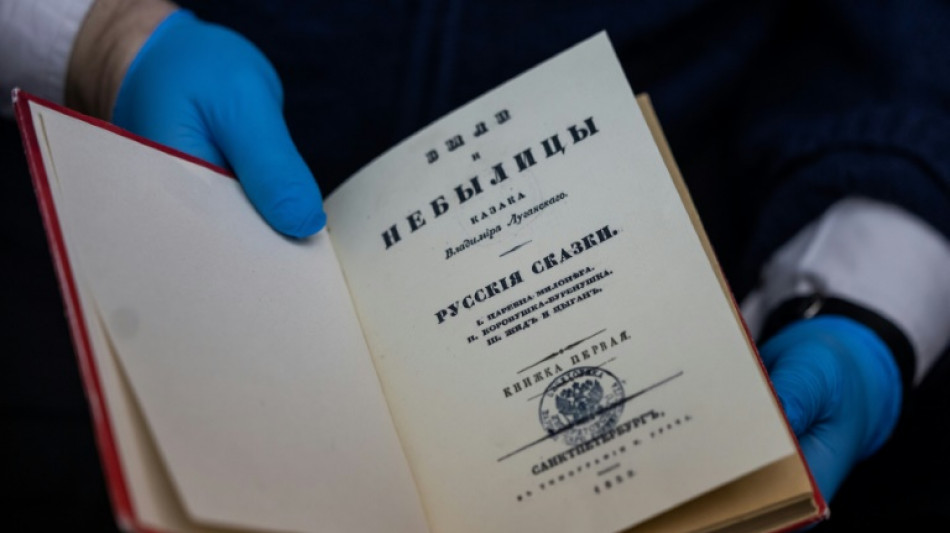
'Lost diamonds': Rare Russian books stolen from European libraries / Photo: © AFP

 More than 400 dead in DR Congo's spreading Ebola outbreak
 Hot spell roasts eastern US as holiday weekend approaches

 Superb Swiatek storms into Wimbledon last 32, Zverev waits

 Russian strikes kill 21 in biggest ever attack on Kyiv, mayor says

 Swiatek sees off Pliskova to race into Wimbledon third round

 Dollar down, stocks shine after disappointing US jobs data

 US job growth slows, posing questions for Trump before midterms

 Chanel eyes menswear with Charvet shirtmaker takeover

 Chanel eyes menswear with Charvet shirtmaker takevoer

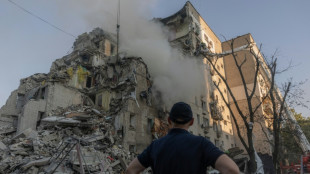 'I grabbed my child': Kyiv residents face devastation of biggest Russian barrage of war

 Former top jockey Dettori breaks ribs in car crash

 Rees-Zammit returns to wing as Wales face Fiji

 Renovations on historic Paris Opera house extended by three years

 Thailand denies viral claim Macron knelt before king

 Spain, Portugal eye World Cup last 16

 Russian strikes kill 17 in biggest ever attack on Kyiv, mayor says

 Uruguay veteran Cavani quits Boca Juniors

 West Ham's Fernandes joins Spurs

 Bones of contention: More research needed on 'd'Artagnan corpse'

 Coffee with a view: tourists flock to Starbucks overlooking North Korea

 German coalition agrees on reform package in key breakthrough

 France recall record try scorer Penaud for All Blacks Test

 Seoul's Kospi tanks as Asia tech firms suffer another blow

 'Outstanding' Love to start at fly-half for All Blacks against France

 Campbell back from four years in Wallabies wilderness to face Ireland

A spate of thefts of rare Russian classics worth millions of euros from libraries across Eastern Europe has left a trail that points all the way to auctions in Russia.
Shelves of 19th century Russian literature have been ransacked over the past two years in Poland and the Baltic states, with originals replaced by fakes.
The University of Warsaw library only found out last month about the thefts, including first editions of works by Alexander Pushkin and Nikolai Gogol.
A university employee with knowledge of the matter estimated the value of the stolen books at "around a million euros".
"It was like gouging out the crown jewels," Hieronim Grala, a former diplomat, an expert in Russia policy and professor at the University of Warsaw told AFP.
"Fortunately, not everything was picked out, but a few emeralds, diamonds and rubies are lost," said Grala, who has helped the university assess the damages.
The theft in Warsaw was not an isolated event.
Libraries in the three Baltic countries have also fallen prey to thieves, and in each case Russian literature was targeted.
Experts believe the stolen works have found their way to Russia, with at least some sold off at hasty auctions in Moscow.
- 'Industrial scale' -
The first known case of what turned out to be a series of similar raids was detected at the National Library of Latvia last year, when three books were stolen.
A Georgian citizen was later found guilty of stealing them and sentenced to six months in prison, but his accomplice remained at large.
In the same month, two men claiming to be studying censorship and printing policy in early 19th-century Russia showed up at the university library in the Estonian city of Tartu and asked for the nearly 200-year-old works of Pushkin and Gogol.
It was only four months later that the library realised they had left behind eight convincing-looking copies, not the books that were later estimated to be worth a total of 158,000 euros ($170,000).
In May, Lithuania's Vilnius University library discovered 17 of its rare Russian books had gone missing too.
"Most of the stolen books were replaced with non-original ones," Gintare Vitkauskaite-Satkauskiene, spokeswoman of the Lithuanian Prosecutor General's Office, told AFP.
According to Lithuanian investigators, the stolen books were worth around 440,000 euros.
The University of Warsaw has so far identified 79 books as missing, meaning it suffered the most substantial losses of all four countries.
"Here, the thieves operated on an industrial scale," a Warsaw University library employee who declined to be named, told AFP.
"When I saw what they had taken, I felt a hot flash."
The fake books the thieves left behind, seen by AFP, range from sloppy imitations to meticulous counterfeits, where only the improper stamp ink colour or size of label revealed the forgery.
While these books were being counted as still in the collection, the originals were being sold off in Moscow.
"There's a memo dated December 22, 2022 that the books are in their place," Grala told AFP.
"On the same day, at an auction in Moscow, one of these books goes for 30,500 euros."
- 'Organised from Russia' -
Sources close to the Warsaw library's investigation have shown AFP screenshots of auctions held by Russia's Litfond auction house with books carrying stamps and catalogue numbers of Warsaw University.
"It is clear to me that the whole action was centrally organised from Russia," Grala told AFP.
AFP contacted the Litfond auction house but its general director Sergei Burmistrov did not explicitly deny nor confirm any wrongdoing.
"The Litfond auction house works within the framework of the current legislation of the Russian Federation, and we do not accept for sale nor do we sell any books with stamps from existing state libraries", Burmistrov said.
To Grala, there is a clear Russian link connecting the thefts in Poland and the Baltic countries which is hardly a surprise or coincidence.
"The first three strikes hit those countries that the Russians accuse of fighting the Russian language and Russian culture," he told AFP.
"They recognised quite well that the Rossica (items related to Russian culture) are guarded less strictly in our region... and less guarded means more accessible."
Poland's relations with Russia have long been strained, with Warsaw being an ardent critic of the Kremlin and Russia's invasion of Ukraine.
Both sides frequently trade barbs about protecting each other's cultural heritage.
Grala could barely hide his emotion as he spoke of how he was "devastated" by the "irreversible" losses of Russian books that survived two national uprisings and two world wars on Polish soil.
"The librarians of the University of Warsaw, risking their lives during the war, secretly built a double ceiling and hid the books so that they wouldn't disappear or burn down," Grala told AFP.
"And we couldn't protect them from looting."
E.Burkhard--VB