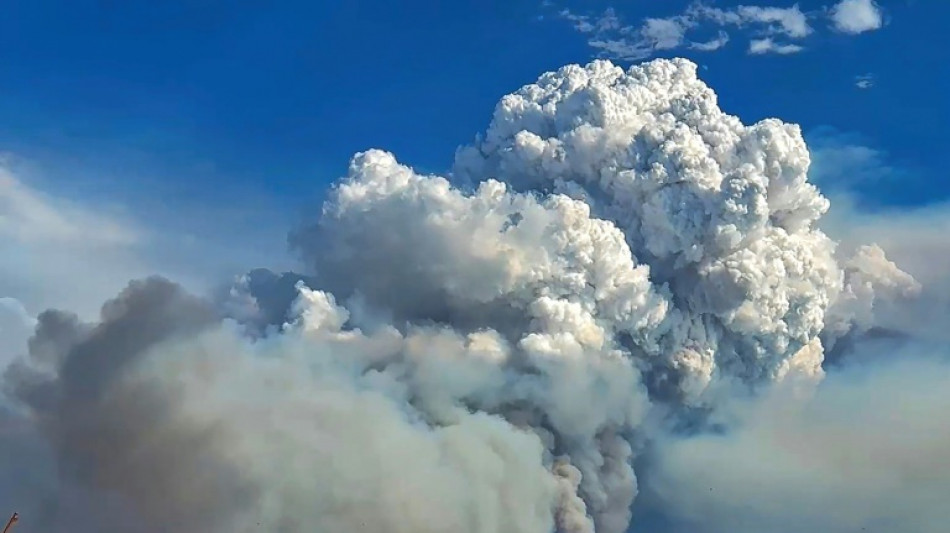
'Out of control' fires endanger wildlife in Brazilian wetlands / Photo: © AFP

 Tesla global auto sales jump 25% in 2nd quarter, beating expectations

 Zverev routs Royer to reach Wimbledon third round

 Hot spell roasts eastern US ahead of holiday weekend

 Hamilton cools fans Ferrari fervour

 Venezuela's diaspora searches for quake victims on social media
 Albanian clashes as protest over Trump-linked resort boils over

 Desire key to Pogacar dominance, says former Tour king Froome

 Rescuers dig out Venezuelan man eight days after quakes
 Anderson closes in on record Man City move

 England change five for South Africa Test

 Lock Alemanno to make 100th Pumas appearance against Scotland

 US posts weaker-than-expected job growth in June

 UK PM says 'deeply sorry' for decades of forced adoptions

 Almost 1.2 mn apply for Spain's migrant regularisation
 Ukrainian state ordered Nord Stream sabotage: German prosecutors

 Swiatek, Zverev aiming to lay down Wimbledon markers

 German ruling coalition agrees on major reform package

 European stocks climb after Asia rout

 Former Arsenal, Spain midfielder Cazorla retires

 German drone maker raises $1.2 bn as investors pile into defence
 French scramble to find air conditioners before next heatwave

 Japan deploys bear cameras in moutains as attacks surge

 Germany's Infineon opens major chip plant as EU seeks tech autonomy

 Biggest ever Russian barrage on Kyiv kills at least 13

 EU top court upholds record 4.1 bn euro Google fine

The Pantanal wetlands in western Brazil are famed as a paradise of biodiversity, but these days they have enormous clouds of smoke billowing over them, as raging wildfires reduce vast expanses to scorched earth.
Known for its lush landscapes and vibrant wildlife, including jaguars, caimans, macaws and monkeys, the Pantanal is home to the world's biggest tropical wetlands and, in normal times, a thriving ecotourism industry.
But in recent weeks it has been ravaged by fires that are threatening its iconic wildlife, as Brazil suffers through a southern hemisphere spring of droughts and record heat.
There were 2,387 fires in the Pantanal in the first 13 days of November, an increase of more than 1,000 percent from the entire month of November 2022, according to satellite monitoring by Brazilian space research agency INPE.
"The situation is completely out of control. And between the heat wave and the wind, it's only going to get worse," says biologist Gustavo Figueiroa, 31, head of the environmental group SOS Pantanal.
"The Pantanal is a region that's used to fires. Normally, it regenerates naturally. But this many fires isn't normal."
The Pantanal sits at the southern edge of the Amazon rainforest, stretching from Brazil into Bolivia and Paraguay across more than 170,000 square kilometers (65,000 square miles).
It has been hit hard by drought this year, with normally flooded areas reduced to shriveled ponds.
At one such spot along the dirt highway across the region, the 150-kilometer (95-mile) "Transpantaneira," a small group of caimans can be seen trying to swim in the shallow water.
Nearby, the corpse of another sits rotting on the bank.
Elsewhere, a dead porcupine lays on a carpet of ash in the charred remains of what was once a forest.
"It probably died of smoke inhalation," says veterinarian Aracelli Hammann, who is volunteering with a wildlife rescue group.
They made the grim find in the Encontro das Aguas park, home to the world's largest jaguar population.
Nearly one-third of the park has been hit by fires in the past month, according to environmental group ICV.
The other main front that firefighters are battling is in the Pantanal National Park to the southwest, where fires have burned 24 percent of the surface area.
Figueiroa warns the two fire fronts "are about to merge."
Exacerbating the situation, firefighters face huge logistical battles, given that many hard-hit areas are only reachable by boat.
- 'Domino effect' -
Experts say the fires are mainly caused by human activity, especially burning land to clear it for farming.
Climate conditions have only made things worse.
Experts say even when animals survive the flames, they risk starvation.
"We've seen a range of dead animals, including insects, reptiles, amphibians, small mammals, which are unable to flee," says Figueiroa.
"They're part of an invisible food chain, and each death has a domino effect, reaching all the way up to the apex predator, the jaguar."
In a clearing, a group of monkeys rushes to devour bananas and eggs left for them by volunteers.
"We call it 'gray hunger' -- when fire reduces all the vegetation to ashes and there are no natural food sources left in the area for animals that survive the flames," says Jennifer Larreia, 33, head of animal rescue group E o Bicho.
M.Schneider--VB