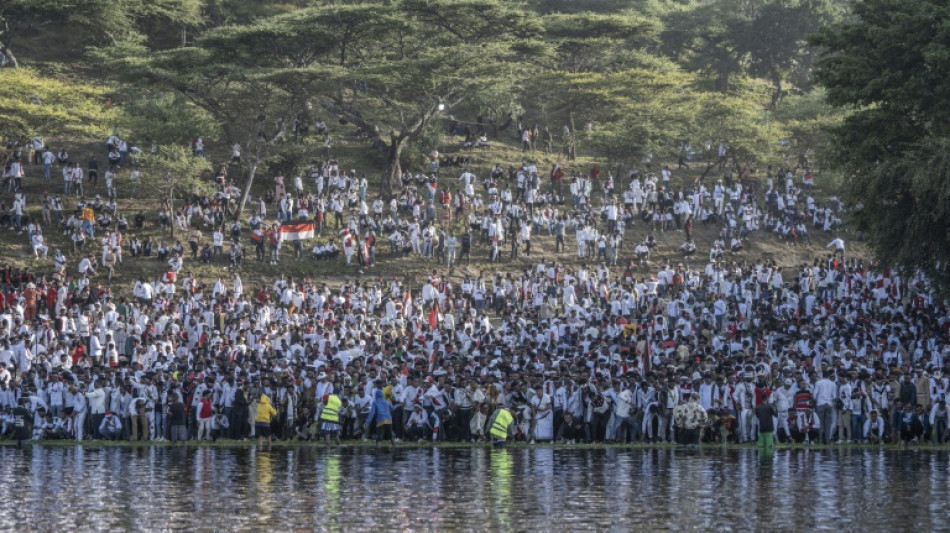
Ethiopia's Oromo people celebrate festival once denied / Photo: © AFP

 Mission impossible? England take the World Cup high road against Mexico
 Ukraine, Russia vow escalation as strikes on Kyiv kill 27
 Messi meeting the "game of our lives", says Cape Verde coach

 Do not open until 2276: US burying time capsule to mark July 4
 Scaloni warns Argentina that Cape Verde success 'no accident'
 Spain ease past Austria with 3-0 World Cup win

 Endrick says versatility could help Brazil against Norway
 Ghana have 'duty to Africa' to progress at World Cup, says Queiroz
 Former Celtics star Brown in shock over trade to 76ers
 Progress, further delay risk for Boeing Air Force One: report
 US coach Pochettino '200% Argentine' but embraces Americana
 Ukraine, Russia vow escalation after Moscow strikes on Kyiv kill 25
 Prosecutors can review Woods medical records in DUI case: judge
 Japan deploys bear cameras in mountains as attacks surge

 Djokovic has history in his sights at Wimbledon
 Ovechkin returning to Caps for 22nd NHL season

 Faster than Mbappe: Australia flyer Bos races into World Cup conversation
 Trump wants 'senseless killing' in Ukraine to end: US official
 Eala writes history for Philippines in 'electric' Wimbledon atmosphere

 Wolff urges 'perspective' as Russell chases Mercedes' teammate Antonelli

 Superb Swiatek, Zverev cruise into Wimbledon last 32
 Ukraine, Russia vow escalation after Moscow attack kills 21 in Kyiv
 Slowing US job growth poses midterms challenge for Trump
 Klopp poised to replace Nagelsmann as Germany coach: reports
 More than 400 dead in DR Congo's spreading Ebola outbreak
Tens of thousands of Oromos gathered Sunday at a lake near the Ethiopian capital for a once-banned celebration that today doubles as a sounding board for political and ethnic demands.
Draped in traditional colours including the red, white and black of the Oromo flag, crowds descended on the shores of Lake Hora Arsadi, 50 kilometres (30 miles) southeast of Addis Ababa, for the annual Irreecha festival.
Representing around a third of Ethiopia's 120 million people, the Oromo are the largest of 80 distinct groups that make up the vast and ethnically-diverse nation in the Horn of Africa.
"The Oromo people come to the lake to give thanks to god for the change of the rainy season, of winter to spring," said Sabkebar Gezu, a 35-year-old small business owner.
To mark the passage of seasons, attendees old and young at Irreecha dip flowers into the lake and sprinkle themselves with the blessed water, amid traditional songs and dancing in colourful regalia.
The Oromo are almost equally divided between Christians and Muslims. Many refer to god as Waaqa, and some still practice local beliefs that revolve around this ancestral life-giving deity.
In recent decades, there has been a revival of Oromo identity long suppressed under successive waves of Ethiopian rulers and traditions like Irreecha, which was long banned, have re-emerged.
- 'Our strength' -
Tola Micha, wearing a tie striped in Oromo colours, remembered when Irreecha resumed in the late 1990s after the fall of the military-Marxist Derg regime in 1991.
In the beginning there were "a few hundred" in attendance: "Now we're in numbers, and I am proud of it," the 52-year-old said.
"Ireecha is our fist. It represents our strength."
Sabkebar said Irreecha was a "major" festival for his people but despite the celebrations, he did not forget there were "still many issues which remain unaddressed regarding the Oromo".
"The past generation has paid a sacrifice so that our generation can come here and celebrate it," he said.
Among the crowd, political chants peppered the lively singing and dancing.
"We are marginalised!" rose one refrain, while others spoke of a desire for greater respect as a people, and concerns over Oromos in prison.
Others cried for an end to the violent armed conflict raging in Oromia, a restive region and homeland of the Oromo.
Oromia is plagued by armed violence and anti-government insurgencies, and has witnessed ethnic massacres in recent years.
In 2018, Abiy Ahmed became the first Oromo to lead Ethiopia, and many anticipated greater representation and respect for a long-marginalised people.
But many Oromo have complained of continuing political and economic persecution even under the leadership of one of their own.
Many celebrating at Irreecha were at pains to avoid discussing the thornier issue of politics, but echoed wider concerns about Oromo identity and their place in Ethiopia.
"We can't say the question of the Oromo people is fully addressed, but it is better than before," said Kiya Tadessa, a 24-year-old NGO worker.
Ababa Korsa, a 30-year-old accountant, said the right to celebrate Irreecha "wasn't given to us freely and many shed their blood and sacrifice was paid".
"Even today, we cannot say we are fully liberated and there are many issues unaddressed," he said.
"However, it's partly better, to come here and celebrate our culture freely."
L.Stucki--VB