Quake exposed risk in Morocco villages' isolation / Photo: © AFP

 China sports brands score NBA stars to assist global ambitions

 Man dies after setting self ablaze outside UN in New York: police
 VAR 'taking joy' from football says Croatia coach Dalic after loss
 Afghans come home but risk exclusion without any ID
 'Coincidence of life' says Ronaldo after Jota tribute a year from death

 Japan face Italy without banned coach Jones
 Ronaldo, Portugal advance after VAR drama to set up Spain showdown
 AI romance scam impersonating Dubai prince ensnares victims
 Portugal advance in World Cup thanks to last-gasp Ramos winner

 Mission impossible? England take the World Cup high road against Mexico

 Ukraine, Russia vow escalation as strikes on Kyiv kill 27

 Messi meeting the "game of our lives", says Cape Verde coach

 Do not open until 2276: US burying time capsule to mark July 4

 Scaloni warns Argentina that Cape Verde success 'no accident'
 Spain ease past Austria with 3-0 World Cup win

 Endrick says versatility could help Brazil against Norway

 Ghana have 'duty to Africa' to progress at World Cup, says Queiroz
 Former Celtics star Brown in shock over trade to 76ers
 Progress, further delay risk for Boeing Air Force One: report
 US coach Pochettino '200% Argentine' but embraces Americana

 Ukraine, Russia vow escalation after Moscow strikes on Kyiv kill 25

 Prosecutors can review Woods medical records in DUI case: judge

 Japan deploys bear cameras in mountains as attacks surge

 Djokovic has history in his sights at Wimbledon
 Ovechkin returning to Caps for 22nd NHL season

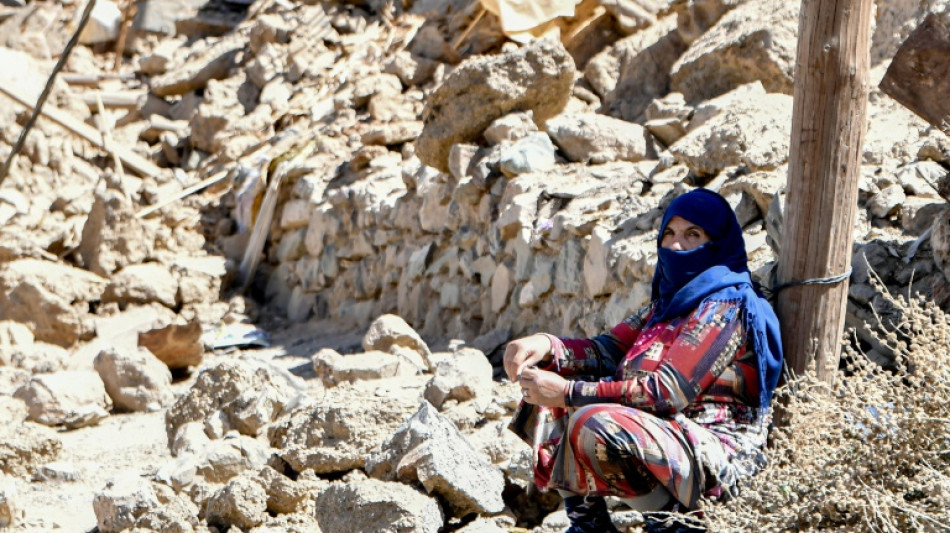
About eight hours passed after Morocco's earthquake before help reached the hamlet of Ardouz, one of many tiny mountain villages whose remoteness is both appealing and cruelly risky.
Some of the settlements perched in the High Atlas are still not accessible by road nearly a week after the nation's deadliest quake in generations, though the authorities have not said how many.
Yet the one-lane gravel road leading to Ardouz, home to some 200 before the disaster, is open, passing dusty apple trees and a dry riverbed before dead-ending into sharply rising mountain slopes.
Less than 10 kilometres (six miles) further south, beyond those steep hills, rests the epicentre of the quake that killed over 2,900 people and left hundreds of thousands homeless.
The trauma of that night, which claimed around 20 lives in Ardouz, is imprinted on 28-year-old Abdelakim Housaini's face.
He lost his mother and grandparents when their home collapsed on September 8 and then suffered through the wait for help for the injured -- which was long but less than in some other isolated places.
"The nearest hospital is an hour away and doesn't offer many treatments," he said.
"We couldn't transport or even care for the injured. We kept them warm and waited for rescuers to arrive, which took about eight hours," said Housaini, who works as a cook in Casablanca and was home visiting his family when the quake struck.
Lack of opportunity sends many locals into urban centres for work, while farming is a key employer and means of survival in many of the tiny Atlas villages.
The area is not wealthy, with the surrounding Al Haouz province notching a per capita GDP of $2,000, while nearby Marrakesh province reports nearly $2,800.
But poverty is not the sole factor that determines how locals live.
"The people here were very happy. They led simple and peaceful lives," said native Mohamed Alayout, 62.
"But after the disaster, things have gotten very difficult," added the day labourer who rushed home from Casablanca to help within hours of the quake.
- 'We're not isolated here' -
The remoteness of places like Ardouz means an early end to schooling and the start of work for many -- a situation that will not get better after the quake.
The local primary school is still standing, but has cracks big enough to fit a hand in and holes in its masonry walls large enough to climb through.
At the head of its child-size chairs and tables, the blackboard still has the lesson from the last class and date: September 8.
"We don't know yet what will happen with the children. We don't have a school anymore," said village native Fatima Ajijou, 55.
"Life was already very hard here before. It's very isolated here and the earthquake has only made it worse," added Ajijou, who had been living in Marrakesh even before the disaster.
Housaini grew up in the village and stopped his studies at 15 due to lack of access to a secondary school. He has been working ever since.
He acknowledges the difficulty of life for the people who lived in Ardouz even before the powerful quake killed about 10 percent of the population there, and either flattened or left uninhabitable nearly every home.
The survivors are now living in government-issued aid tents that don't have floors and will be completely inadequate shelter once the rainy season and cold hit the village, which sits at 1,700 metres (5,500 feet).
But Housaini holds tight to his memories of playing there when he was a boy and his walks on the mountain trails that offer views across miles of mountains.
"We aren't isolated here -- that's in the cities where you can't breathe," he said, smiling slightly.
T.Germann--VB