Floods drown hope in Pakistan's impoverished Punjab villages / Photo: © AFP

 Wimbledon giving Serena 'as much time' as possible for doubles

 Chinese investors flock to Hong Kong as trading curbs tighten
 Projected 'super typhoon' heads for US Pacific islands

 UN warns of strong looming El Nino

 Hunt for last signs of life in Venezuela quake zone

 Asian markets rise as beaten-down tech stocks enjoy bounce

 David v Goliath as Cape Verde face Messi's Argentina at World Cup

 Nagelsmann quits as Germany coach after World Cup exit: reports

 All Blacks return to Christchurch 'a blessing', says Savea

 'Not a museum': Slovak UNESCO village strains under tourism

 DR Congo opposition builds against presidential third-term bid

 China sports brands score NBA stars to assist global ambitions

 Man dies after setting self ablaze outside UN in New York: police

 VAR 'taking joy' from football says Croatia coach Dalic after loss

 Afghans come home but risk exclusion without any ID

 'Coincidence of life' says Ronaldo after Jota tribute a year from death

 Japan face Italy without banned coach Jones

 Ronaldo, Portugal advance after VAR drama to set up Spain showdown

 AI romance scam impersonating Dubai prince ensnares victims

 Portugal advance in World Cup thanks to last-gasp Ramos winner

 Mission impossible? England take the World Cup high road against Mexico

 Ukraine, Russia vow escalation as strikes on Kyiv kill 27

 Messi meeting the "game of our lives", says Cape Verde coach

 Do not open until 2276: US burying time capsule to mark July 4

 Scaloni warns Argentina that Cape Verde success 'no accident'

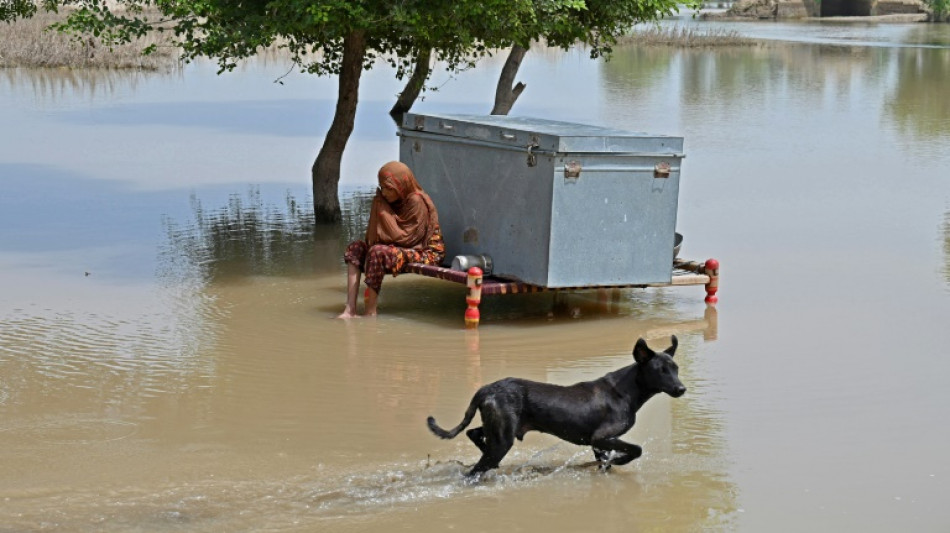
The coursing floods in eastern Pakistan first swallowed Nasreen Bibi's corn crop, then the cattle that fed on it, and finally her family home.
They retreated to the roof to escape the rising water, before fleeing for their lives by boat.
"We didn't bring any of our belongings with us, everything we own is abandoned back there," said Bibi, who guesses her age in the 30s, from a relief camp inside a school in Mandi Ahmedabad, a village in eastern Punjab province.
"There is nothing left back home," she said, wiping away tears in a tent she shares with three young daughters.
"Fear plays on my children's minds."
Swaths of Pakistan's breadbasket were inundated this month, with at least 130,000 people evacuated, after the Sutlej river burst its banks and spilled over hundreds of villages and thousands of acres.
The head of Punjab's government, Mohsin Naqvi, said the flooding was caused by India releasing excess reservoir water into the Sutlej river, causing flooding downstream on the Pakistani side of the border.
With the water slowly receding, a ramshackle armada of 40 boats makes twice-daily food and aid deliveries to 80 water-bound villages where men perch on roofs guarding sodden possessions.
The floodwaters are still some eight feet (2.4 metres) deep, and the boats skim past the tops of waterlogged corn stalks blanched by the sun.
A family's financial security depends on agriculture in this largely impoverished corner of Pakistan.
Mud houses lie in ruins, with tumbled walls pooled in stagnant water, in Falak De Bheni, a village of 100 homes surrounded by drowned fields of sesame and rice.
"I don't want to plant a crop here next year, my heart can't bear it," Muhammad Tufail, 38, said as he stood at his ruined door surveying the damage.
"I don't even know how much money I spent, how many troubles I went through, to plant these crops. But the flood has left nothing in its wake."
More than 175 people were killed in Pakistan in rain-related incidents since the monsoon season began in late June, mainly due to electrocution and buildings collapsing, emergency services have reported.
- Flooding back -
Large tracts of rural Pakistan were ruined by record monsoon floods last summer that scientists linked to climate change and from which it is still recovering.
A third of the country was submerged and 1,700 people were killed, while eight million were displaced.
The villages along the Sutlej River were spared in that deluge but are now battling the highest water levels in 35 years, authorities have said.
The assistant commissioner of Dipalpur -- the hardest-hit area in this year's flood -- said 11 rescue centres and five relief camps had been set up, with 4,600 emergency boat trips made since the floods came in mid-August.
The flooded villages of Dipalpur remain without electricity two weeks after the floods started.
Most of the cattle have been evacuated but those left behind have nothing left to feed on.
"Fodder has washed away," said 50-year-old Taj Bibi, struggling to keep a buffalo, a cow and a calf alive on leaves chopped from trees.
"Our cattle are begging us for food but we have nothing to give them," she said. "We are dying of hunger and so are our animals."
At Bashir De Bheni, a small hamlet of 15 houses built on the submerged river bank, rescue workers dropped off antibiotics and rehydration medicine for a toddler suffering diarrhoea and high fever.
"Every problem imaginable has befallen us," said 60-year-old villager Muhammad Yasin.
C.Kovalenko--BTB