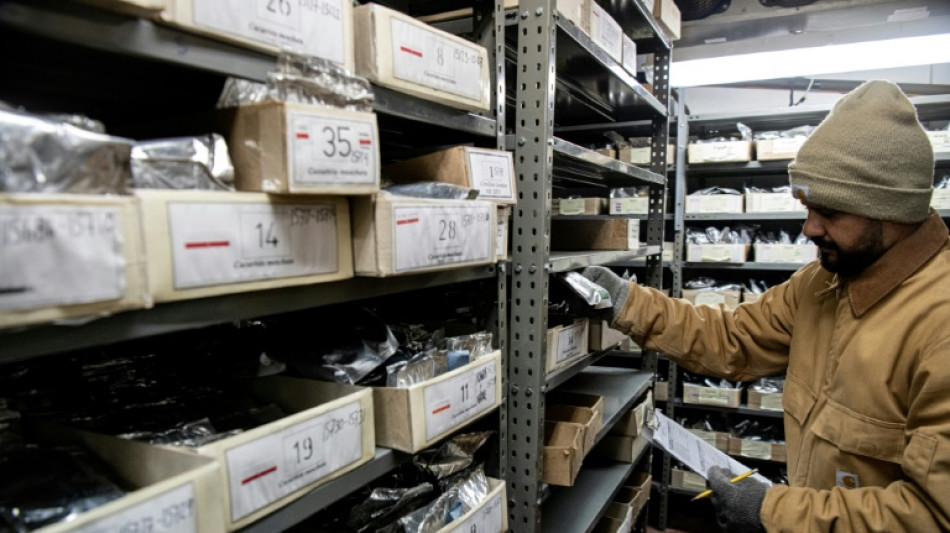
In Costa Rica, saving seeds to feed future generations / Photo: © AFP

 Frustrated families demand recovery of Venezuela's earthquake dead

 Williams sisters return, Swiatek faces Eala test at Wimbledon

 'Ecstatic' Hamilton rolls back the years with Silverstone pole

 England enter World Cup lion's den as Mexico host them at Azteca fortress

 Hamilton beats Antonelli to British GP sprint pole with supreme lap

 Title rivals Djokovic and Sinner advance at Wimbledon

 Ferrari confirm Hamilton staying next year

 Global frenzy over Swift, Kelce's glittering 'royal wedding'

 Three acquitted of 2019 murder of N.Irish journalist Lyra McKee

 Stokes bids farewell to fans after 'mad 15 years'

 One for the history books: what we know about the European heatwave

 Dutch FA to sue over racist slurs after World Cup exit

 Mercedes demos set stage for wave of German auto protests

 Iran leaders pay last respects to Khamenei as mourners gather

 UN issues 'red alert' over 'catastrophe' in Sudan's El-Obeid

 Tour de France to start with team time-trial 'bang'

 Dressed for success: Osaka reaches Wimbledon last 16 for first time

 Bayern sign Germany defender Brown until 2031

 MEXC's June Highlights: $437 Billion in Trading Volume, Offering Access to 7,000+ US Stocks and ETFs

 Stocks mostly rise as beaten-down tech stocks enjoy bounce

 Iranian leaders pay respects to supreme leader as Tehran prepares for funeral

 Doubles not a 'carnival sideshow' say players amid schedule row

 Klopp in 'talks' for Germany job after Nagelsmann exit: federation

 Surging real estate development divides opinion on Athens' riviera

 Move over, Messi! Robot footballers thrill crowds in South Korea

In the tropical mountains of Costa Rica, scientists guard a treasure trove of seeds collected over decades as a bulwark against food insecurity and climate change.
Some 6,200 samples from 125 species of squash, chilli, tomato and other edible plants are held at the Tropical Agricultural Research and Higher Education Center (CATIE) near the town of Turrialba.
In temperatures as low as minus 20 degrees Celsius, the seeds can be kept for up to 40 years for purposes of research, genetic engineering of plants more resistant to pests, diseases or changing weather, or to replace species that die out.
The bank "is a resource we have for use now or in the future," plant geneticist William Solano told AFP at the facility some 60 km east of the capital San Jose.
It holds seeds from 57 countries, he said, but about 90 percent are from the Central American region, collected from markets and farms or growing wild.
The CATIE stockpile, stacked on shelves in hundreds of small, silver envelopes, includes the second-largest collection of squash family seeds in the world.
Many of the seeds are not present in banks anywhere else in the world, according to the center.
- 'Genetic archive' -
"In response to climate change, we have here important materials for food security that are locally adapted" to a variety of climate conditions, ranging from humidity to extreme drought, Solano told AFP.
As ever-more extreme weather threatens food production, traditional, native seeds are essential to "give sustainability to agri-food systems," he added.
According to seed expert Ester Vargas of the University of Costa Rica, "there is variability in native seeds that gives them the ability to adapt to different conditions" in the areas of their origin.
Seed banks like the one at CATIE serve to guarantee an availability of "crops with high nutritional value" for generations to come, she added.
The UN's Food and Agriculture Organization (FAO) estimates that almost one in ten people in the world suffered hunger in 2022 -- some 735 million in total -- with increases in parts of Africa, western Asia and the Caribbean.
The FAO says seed banks help preserve "the most adapted varieties" for a given region.
"As climate change has a significant impact on agricultural production, growing local varieties, which have a high degree of genetic diversity, is highly important because these varieties have the ability to better withstand and adapt to environmental stresses and changes," a document on the organization's website states.
CATIE agronomist Daniel Fernandez said the bank also served another purpose: as a "genetic archive" of species that were replaced by more modified crops and that one day may need to be brought back.
O.Lorenz--BTB