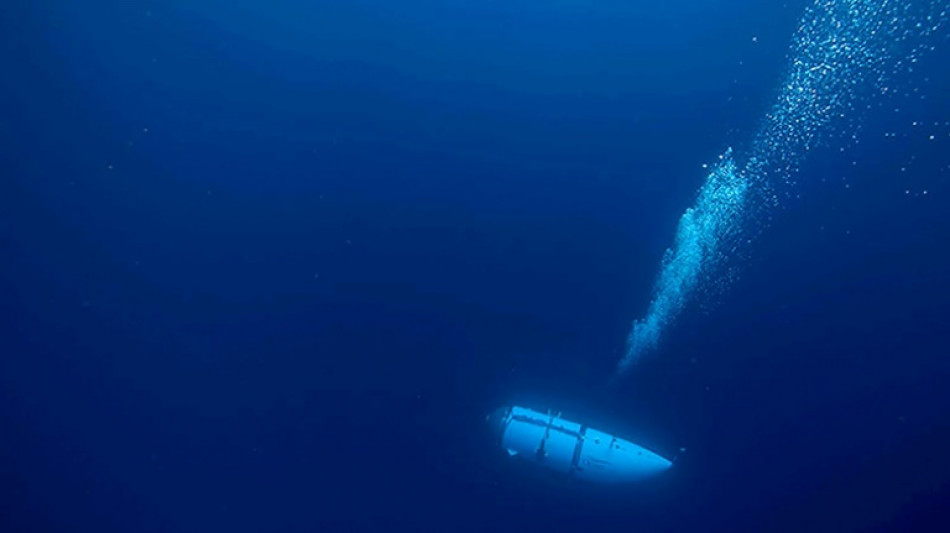
Search for missing Titanic sub like 'going into space' / Photo: © OceanGate Expeditions/AFP

 Trump says American identity under 'renewed attack' as US turns 250

 World Cup serves up Wimbledon dilemma: football or tennis?

 Huge crowds gather as Khamenei funeral ceremonies begin in Iran

 Trump set for Mount Rushmore address as US turns 250

 New species of ghost shark may have been found in Costa Rica

 Argentina advance after Cape Verde World Cup scare, Egypt through

 Huge crowds expected as Khamenei funeral ceremonies open in Iran
 Swift and Kelce marry as global stars swarm 'royal wedding'

 Hurdles record-breaker Tharp says 'sky's the limit'
 Salah says 'had to do it' after coolest of penalties in World Cup win

 Australia's Popovic on defensive as gamble fails in World Cup exit

 Maiden ton for Udara as Sri Lanka pile on the runs in 2nd Test

 Norway pin hopes on Haaland against Brazil in World Cup last 16

 Egypt down Australia to reach World Cup last 16, Cape Verde face Messi

 Families demand help with recovering Venezuela's quake victims

 England's Rashford unfazed by high-altitude Mexico World Cup test

 In Brazil, Bolsonaro family airs feud ahead of elections
 Postecoglou links up with Ronaldo at Al Nassr

 Sabalenka sets up Wimbledon last-16 clash with Osaka

 Dangerous heatwave hits peak temps along US east coast

 LeBron's agent makes case for 10 new clubs for 41-year-old star

 Trump heads for Mount Rushmore as US turns 250

 French Top 14 champions Toulouse fined for salary cap breaches

 Record-equalling Djokovic powers into Wimbledon last 16
 Ruthless Sinner powers into Wimbledon last 16

Rescuers trying to find the orca-sized submersible that vanished on its way to visit the wreck of the Titanic are facing a gargantuan task that will test the limits of technical know-how, experts say.
Teams from around the world were racing against the clock Tuesday to locate the vessel and its five-person crew before their oxygen runs out -- projected at under a day and a half from now.
But scouring a 7,600-square-mile (20,000-square-kilometer) area of the North Atlantic to a depth of more than two miles is not easy.
"It's pitch black down there. It's freezing cold. The seabed is mud, and it's undulating. You can't see your hand in front of your face," Titanic expert Tim Maltin told NBC News Now.
"It's really a bit like being an astronaut going into space."
The 21-foot (6.5-meter) submersible, named Titan, was carrying three fee-paying passengers when it vanished Sunday: British billionaire Hamish Harding, Pakistani tycoon Shahzada Dawood and Dawood's son Suleman.
OceanGate Expeditions, which runs the Titan's trips, charges $250,000 for a seat.
The company's CEO Stockton Rush and French submarine operator Paul-Henri Nargeolet, nicknamed "Mr Titanic" for his frequent dives at the site, are also aboard.
US Coast Guard Captain Jamie Frederick told reporters Tuesday that his organization was co-ordinating the search.
But, he said, it was incredibly difficult, and far beyond what the coast guard would normally tackle.
"While the US Coast Guard has assumed the role of search and rescue mission coordinator, we do not have all of the necessary expertise and equipment required in a search of this nature," he said.
"This is a complex search effort, which requires multiple agencies with subject matter expertise and specialized equipment."
Frederick explained that rescuers were using multiple methods as they comb the vast area for the Titan, which lost contact with its mothership just two hours into its dive near the Titanic's watery grave.
"The search efforts have focused on both surface with C-130 aircraft searching by sight and with radar, and subsurface with P3 aircraft, we're able to drop and monitor sonar buoys."
- Seafloor, water column or surface -
So far, the searches have proved fruitless.
The effort was being augmented Tuesday by a huge pipe-laying vessel, which has a remotely operated vehicle expected to be deployed at the Titan's last known position.
Jules Jaffe, who was part of the team that developed the optical imaging system used to find the Titanic in 1985, said rescuers would have to look in three separate places.
"It's either sitting on the seafloor, somewhere in the water column, or sitting on the surface," he told ABC10 in San Diego.
"It could be in the water column. I think that's probably the most likely place it is."
Jamie Pringle, a professor of forensic geosciences at Keele University in Britain, said if the mini-sub had settled on the ocean floor, it could be very difficult to spot.
"The bottom of the ocean is not flat; there are lots of hills and canyons," Pringle said, according to NBC.
Adding to the challenge: the enormous pressure four kilometers under water, around 400 times what it is on the surface.
Such pressures put enormous strains on equipment, and very few vessels can survive these depths.
Nuclear submarines generally operate at just 300 meters, according to the Woods Hole Oceanographic Institution.
M.Odermatt--BTB