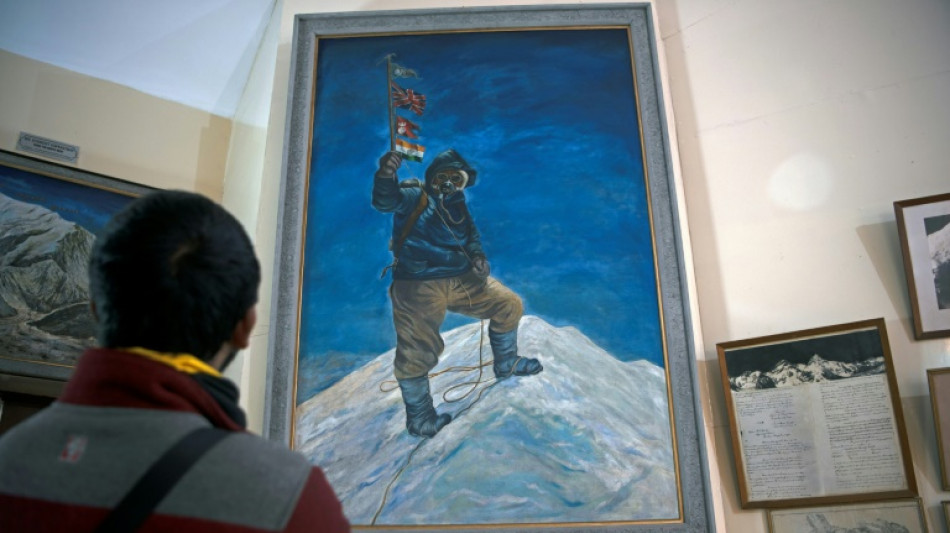
70 years after first summit, Everest keeps giving / Photo: © AFP

 Japan beat Italy 27-10 in Nations Championship opener
 Struggling German auto supplier Continental to sell unit
 Pope urges Europe to protect migrants in visit to island frontier

 Mass protests in Germany as far-right AfD meets

 France face Philly furnace as World Cup last 16 gets under way

 Australia goalkeepers were in dark about World Cup shootout switch
 Billboards, cologne and flowers: Turkish capital gets NATO makeover

 Trump says American identity under 'renewed attack' as US turns 250

 World Cup serves up Wimbledon dilemma: football or tennis?

 Huge crowds gather as Khamenei funeral ceremonies begin in Iran

 Trump set for Mount Rushmore address as US turns 250

 New species of ghost shark may have been found in Costa Rica

 Argentina advance after Cape Verde World Cup scare, Egypt through

 Huge crowds expected as Khamenei funeral ceremonies open in Iran

 Swift and Kelce marry as global stars swarm 'royal wedding'
 Hurdles record-breaker Tharp says 'sky's the limit'
 Salah says 'had to do it' after coolest of penalties in World Cup win

 Australia's Popovic on defensive as gamble fails in World Cup exit

 Maiden ton for Udara as Sri Lanka pile on the runs in 2nd Test

 Norway pin hopes on Haaland against Brazil in World Cup last 16

 Egypt down Australia to reach World Cup last 16, Cape Verde face Messi

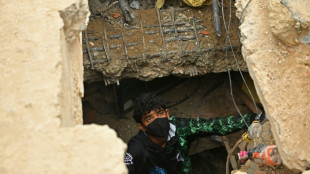
 Families demand help with recovering Venezuela's quake victims

 England's Rashford unfazed by high-altitude Mexico World Cup test

 In Brazil, Bolsonaro family airs feud ahead of elections

 Postecoglou links up with Ronaldo at Al Nassr
When Edmund Hillary and Tenzing Norgay Sherpa first climbed Everest 70 years ago, they paved the way for thousands of foreign climbers to try to follow in their footsteps.
The eight-day trek to the Everest base camp is among the most popular multi-day hikes in Nepal, with tens of thousands of tourists making the journey every year.
What were small agrarian villages when the British expedition passed through in 1953 have since been transformed into tourist hubs with hotels, tea houses and equipment shops, boosting the livelihoods of local communities.
In many homes, three generations have found employment in mountaineering -- a far more lucrative occupation than farming or yak-herding.
The work is hazardous by definition, but in a climbing season of about three months, an experienced guide can make up to $10,000 -- several times the country's average annual income.
And other Sherpas and Himalayan community members have opened restaurants and guesthouses that line Everest's money trail.
Veteran mountain guide Phurba Tashi Sherpa was born and raised in Khumjung, a village about 10 kilometres (6.2 miles) from base camp.
He grew up watching his father and uncles go to the mountains for work, and soon joined them on expeditions, eventually climbing Everest 21 times before he retired.
"There would be just a few expeditions before but now there are so many every year," he said.
"That means an increase in income. It has helped improve the lifestyle here. A lot has changed."
Since the first British teams set their sights on summiting Everest in the 1920s, Nepali climbers -- mostly from the Sherpa ethnic group -- have been by their side.
"Sherpa" became synonymous with high-altitude guiding as they became the backbone of the multimillion-dollar industry, bearing huge risks to carry equipment and food, fix ropes and repair ladders.
Now local expedition groups -- instead of playing second fiddle to foreign climbing agencies -- bring the bulk of paying clients into Nepal.
And a younger generation of Nepali climbers is slowly being recognised in their own right.
Renowned Italian climber Reinhold Messner told AFP in a 2021 interview that it was a well-deserved climb up the ladder.
"It is an evolution," he said. "And this is also important for the future economy of the country."
- 'Gift of the mountains' -
The first ascent of Everest brought Nepal to the world's attention and its mountains have since captivated adventurers and tourists alike.
That has played a crucial role for Nepal's branding as a destination, according to tourism writer Lisa Choegyal.
"Through Covid and earthquakes and all the other setbacks, the insurgency even, that Nepal has suffered over the decades, mountaineering has really endured," she said.
The Khumbu region welcomes more than 50,000 trekkers a year.
"It is a gift of the mountains and we have to thank the first summit for opening this region to tourism," said Mingma Chhiri Sherpa, chairman of the local municipality.
"Education and modern amenities have come here because of it."
Driven to help the community he worked with, Hillary funded the region's first school in Khumjung and is said to have hauled timber himself to help build it.
One of its first students, Ang Tsering Sherpa, now owns an expedition company.
"It is because of mountaineering that the young Sherpas today have higher education," he said. "It has brought a wave of economic prosperity."
More than 10 percent of Nepalis are employed in tourism and the government this year collected over $5 million in Everest permit fees alone as a record number of summit hopefuls arrived.
Tenzing Chogyal Sherpa, 30, whose grandfather Kancha Sherpa was part of the 1953 expedition, is a glaciologist and said that education had opened up options for Sherpa youths.
"A Sherpa can now be a doctor, engineer or a businessman, anything they want to be. That is very good," he said.
"And if they want to be a mountaineer, they can."
D.Schneider--BTB