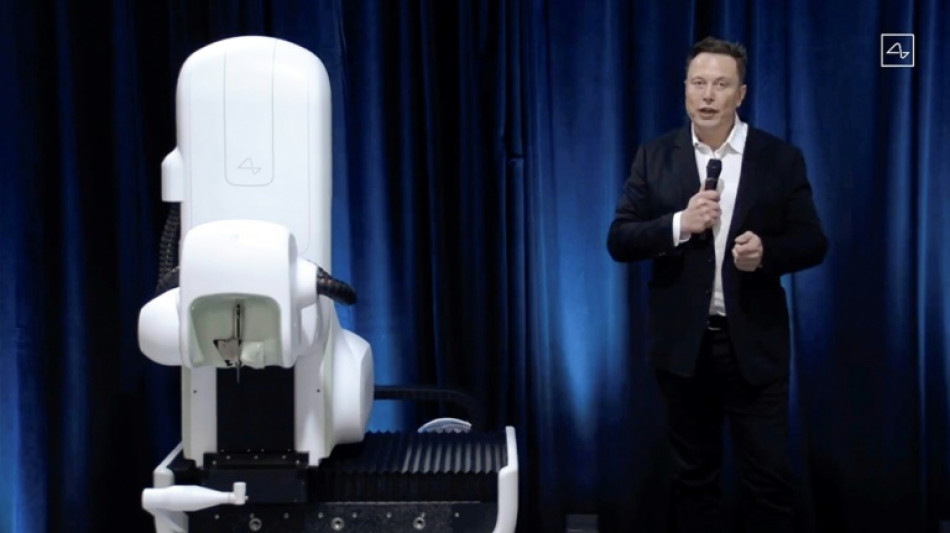
Key facts about Neuralink, Musk's cyborg gamble / Photo: © Neuralink/AFP

 Japan beat Italy 27-10 in Nations Championship opener

 Struggling German auto supplier Continental to sell unit

 Pope urges Europe to protect migrants in visit to island frontier

 Mass protests in Germany as far-right AfD meets

 France face Philly furnace as World Cup last 16 gets under way

 Australia goalkeepers were in dark about World Cup shootout switch

 Billboards, cologne and flowers: Turkish capital gets NATO makeover

 Trump says American identity under 'renewed attack' as US turns 250

 World Cup serves up Wimbledon dilemma: football or tennis?

 Huge crowds gather as Khamenei funeral ceremonies begin in Iran

 Trump set for Mount Rushmore address as US turns 250

 New species of ghost shark may have been found in Costa Rica

 Argentina advance after Cape Verde World Cup scare, Egypt through

 Huge crowds expected as Khamenei funeral ceremonies open in Iran

 Swift and Kelce marry as global stars swarm 'royal wedding'
 Hurdles record-breaker Tharp says 'sky's the limit'

 Salah says 'had to do it' after coolest of penalties in World Cup win

 Australia's Popovic on defensive as gamble fails in World Cup exit

 Maiden ton for Udara as Sri Lanka pile on the runs in 2nd Test

 Norway pin hopes on Haaland against Brazil in World Cup last 16

 Egypt down Australia to reach World Cup last 16, Cape Verde face Messi

 Families demand help with recovering Venezuela's quake victims

 England's Rashford unfazed by high-altitude Mexico World Cup test

 In Brazil, Bolsonaro family airs feud ahead of elections

 Postecoglou links up with Ronaldo at Al Nassr

Neuralink, Elon Musk's brain-implant company, has won US approval to test on humans. Here is what to know about the multi-billionaire's dream project to enable the human brain to communicate directly with computers.
- Cyborg future? -
Neuralink is a neurotechnology company co-founded by Musk along with a team of scientists and engineers in 2016 to build direct communication channels between the brain and computers.
The aim is to supercharge human capabilities, treat neurological disorders like ALS or Parkinson's, and ultimately achieve a symbiotic relationship between humans and artificial intelligence.
Neuralink's technology would mainly work through an implant called the "Link" -- a device about the size of five stacked coins that would be placed inside the human brain through invasive surgery.
The hardware would harbor electrodes capable of both recording neural activity and stimulating specific regions of the brain.
Researchers hope the implant's powers will also treat paralysis, spinal cord injuries and brain disorders.
It could also potentially blur the line between human consciousness and computing, an idea that has long excited technologists, while feeding nightmares of a dystopian future taken over by cyborgs.
Last year, 78 percent of US adults surveyed by Pew Research said they probably or definitely would not want a computer chip implanted in their brain to process information faster.
- Many competitors -
According to data company Pitchbook, California-based Neuralink has more than 400 employees and has raised at least $363 million.
Though he wins most of the headlines, Musk is hardly alone in trying to make advances in the field, which is officially known as brain-machine or brain-computer interface research.
Hit with delays, the tycoon had reportedly reached out to join forces with implant developer Synchron about a potential investment. Its implant version does not require cutting into the skull to install it, unlike Neuralink's Link.
The Australia-based Synchron implanted its first device in a US patient in July 2022.
Another implant project, but designed for research purposes, is from company Blackrock Neurotech and has also received FDA approval for human testing.
A Neuralink co-founder has also split from Musk and raised venture capital for his own project at a startup called Science.
Other companies seeking to make a play in the sector include BrainCo, Kernel and CTRL-Labs, now a part of Meta's virtual reality division.
- Animal testing -
The FDA approval for human testing comes at a great relief for Neuralink which until now had been testing its implants in monkeys and other animals.
Reuters reported in December that the United States Department of Agriculture (USDA) had opened an investigation into potential violations of the Animal Welfare Act at Neuralink.
The report estimated that Neuralink killed about 1,500 animals, including more than 280 sheep, pigs and monkeys for research since 2018.
The USDA refused to confirm or deny the report to AFP at the time.
Arch rival Synchron reportedly killed only about 80 sheep as part of its research, according to documents seen by Reuters.
I.Meyer--BTB