On the edge: DR Congo city stalked by fear of landslides / Photo: © AFP

 Ireland pip Australia 33-31 in Nations Championship nailbiter

 Antonelli edges Hamilton in sprint to extend title lead
 Rennie 'relief' as All Blacks tenure begins with narrow win over France

 Europe's baked rice bowl seeks escape from drought

 Ukraine says still fighting for eastern stronghold

 Mali hit by new wave of coordinated attacks

 New Zealand edge France 34-32 in thriller to open Nations Championship
 Pope defends migrants at Mediterranean island frontier

 Pope to defend migrants at Mediterranean island frontier

 US turns 250 as Trump warns of 'attack' on American identity
 Feels like 'victory': Cape Verde celebrates heroic World Cup defeat

 Haaland's stetson, Cape Verde's pride: World Cup last-32 moments
 Colombia overcome Ghana to reach World Cup last-16

 Cape Verde show anything is possible at World Cup with 'big hearts'

 Huge crowds gather as Khamenei funeral ceremonies open in Iran

 Mass protests expected as German far-right AfD meets

 Argentina survive Cape Verde scare to reach World Cup last 16

 England v Mexico World Cup game kickoff time unchanged: FIFA

 McDonald's, bus station convert into Venezuela quake clinics

 'Super typhoon' Bavi heads for US Pacific islands

 England seek end to Australia agony in Women's World Cup final

 President-elect Fujimori hails 'new chapter' for Peru

 Global celebrities pay court at Swift, Kelce "royal wedding"

 Dangerous heat wave roasts America's big birthday party

 Egypt edge Australia on penalties to reach World Cup last 16
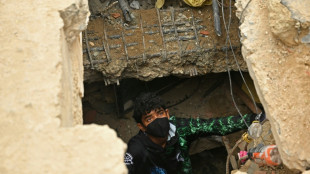
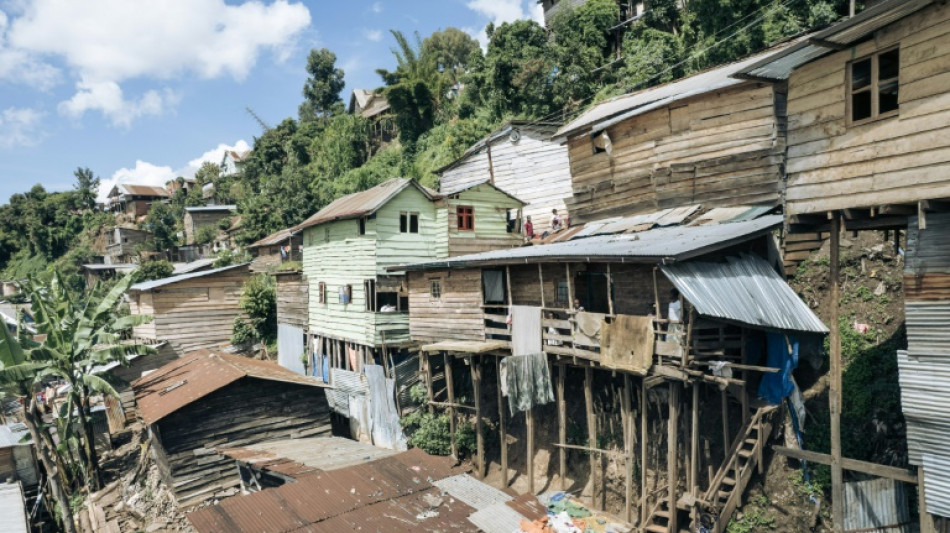
"We're scared, but where can we go?" said Christine Nzigire, in her rickety wooden house perched precariously on a hillside.
She once had tenants, but they left in a panic after a mudslide ripped through the neighbourhood in March.
"When it rains too hard, we take shelter with our neighbours," Nzigire, 37, explained.
To the outside world, Bukavu, the capital of South Kivu province in eastern Democratic Republic, presents a picturesque image.
Clapboard houses pack the hills that overlook Lake Kivu, one Africa's Great Lakes.
But the city's genial appearance belies a growing risk, for the poor, of being swept away.
Bukavu's chronic fear of landslides rose a further notch this month when over 400 people were killed in Kalehe, just to the north.
Nzigire's neighbour Isabelle Zaninga, 38, was luckier than most -- her house stands on relatively solid ground.
Families took refuge inside her home during the most recent downpours, she told AFP.
Zaninga, like many other residents of Bukavu's Nyakaliba neighbourhood, fled to the city to escape conflict that has plagued eastern Congo for decades -- a legacy of regional wars that flared in the 1990s and 2000s.
With little if any money, and practically no support, displaced people sought out the cheapest parts of the city and built on tiny plots of land.
Homes were often raised on slopes, without proper foundations or drainage that would channel rainwater safely away.
- Graveyard living -
Over the past 20 years, a new neighbourhood has even sprung up inside Bukavu's largest cemetery, by the Ruzizi river, which marks the border with neighbouring Rwanda.
Eric Zaluke, a father of two, lives in a small corrugated-iron shack abutting a tomb.
"No problem, we live in peace," Zaluke said.
Nearby, beans and manioc, also called cassava, grew between the graves.
Founded at the beginning of the 20th century by Belgian settlers, Bukavu was originally designed for 100,000 people, according to local civil-society figure Elvis Mupenda.
Today, the population is believed to be two million, although precise figures are hard to come by.
Jean de Dieu Cikonza Maroyi, 54, a communications officer in the provincial urban planning department, described the Bukavu of his childhood as a "fragrant" city of tree-lined avenues.
"It was a good place to live," he said.
Now, he said bluntly, the city was a "slum." Trees are a rarity and traffic clogs the major arteries.
Ladislas Witanene, a green activist, said that petty corruption had allowed people to circumvent building codes.
"We're building in drainage channels, on river banks," he said. "We're even pushing back the lake water to build" on reclaimed lake bed, he added.
"Imagine what will happen when water reclaims these spaces," added Witanene, noting that the city was studying options for relocating people to safer sites.
Climate change is also raising the risk of disaster, he explained: "Even in the dry season we can have torrential rains."
- Dilemma -
But hopes of moving people out of the hillside slums run into two hurdles.
Any relocation plan will come to naught if the shops and offices of central Bukavu -- the economic magnet that has lured the people to the city -- do not also move.
And money, too, is a perennial problem.
Faustin Buroko, the administrator of the Nyakaliba district, explained that 62 people there had been given new plots of land, but "most are not leaving because they cannot afford to rebuild" their homes.
In this district of 65,000 souls, the authorities recorded 270 fires or landslides between January and May alone, he said.
Robert Banywesize, a 45-year-old civil servant, pointed to a collapsed retaining wall that was holding back the earth by his house. His living-room floor had also caved in.
"This season it's rained a lot. There are no more trees to support the earth," he said, adding that there were also frequent earthquakes in the volcanic region.
"We were told to leave but without compensation, what can we do?" Banywesize asked.
Farther down the road stood a one-storey wooden house leaning dangerously forward.
Spooked by fears of imminent collapse, the owner had left. But he was replaced by his brother Justin, 32, and wife Sarah, 24, as well as their 16-month-old child.
"We don't have anywhere else to go," said Sarah, as Justin attempted to lighten the weight of the house by breaking up the concrete flooring with a hammer.
C.Meier--BTB