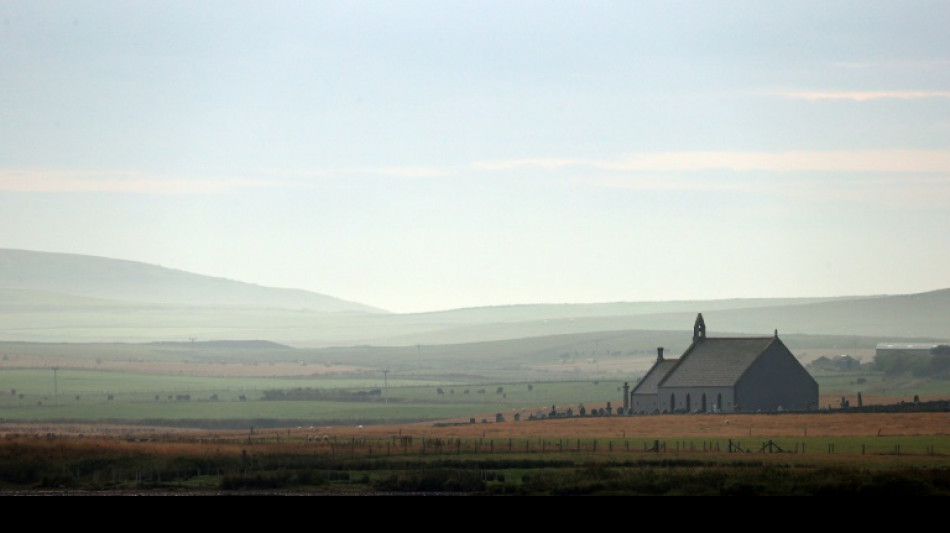
Shetland knitters lament fading island tradition / Photo: © AFP

 Former champ Rybakina crashes out at Wimbledon

 Mass protests in Germany fail to stop far-right AfD congress

 Ireland pip Australia 33-31 in Nations Championship nailbiter

 Antonelli edges Hamilton in sprint to extend title lead
 Rennie 'relief' as All Blacks tenure begins with narrow win over France

 Europe's baked rice bowl seeks escape from drought

 Ukraine says still fighting for eastern stronghold

 Mali hit by new wave of coordinated attacks
 New Zealand edge France 34-32 in thriller to open Nations Championship
 Pope defends migrants at Mediterranean island frontier

 Pope to defend migrants at Mediterranean island frontier

 US turns 250 as Trump warns of 'attack' on American identity

 Feels like 'victory': Cape Verde celebrates heroic World Cup defeat

 Haaland's stetson, Cape Verde's pride: World Cup last-32 moments

 Colombia overcome Ghana to reach World Cup last-16

 Cape Verde show anything is possible at World Cup with 'big hearts'

 Huge crowds gather as Khamenei funeral ceremonies open in Iran
 Mass protests expected as German far-right AfD meets

 Argentina survive Cape Verde scare to reach World Cup last 16

 England v Mexico World Cup game kickoff time unchanged: FIFA

 McDonald's, bus station convert into Venezuela quake clinics

 'Super typhoon' Bavi heads for US Pacific islands

 England seek end to Australia agony in Women's World Cup final

 President-elect Fujimori hails 'new chapter' for Peru

 Global celebrities pay court at Swift, Kelce "royal wedding"

Hazel Tindall sits in the armchair of her living room, her fingers moving with speed and precision as her knitting needles click together and the brightly-coloured yarn in her lap takes shape.
For Tindall, who first picked up her needles as a young child and is now 70, knitting was always a way to earn income on Shetland, off the far northeast coast of Scotland.
But with the discovery of oil off the remote islands in the North Sea in the 1970s, mechanisation and cheap imports pushed many into more lucrative professions.
Now Tindall and other locals fear the islands' once thriving hand-knitting tradition is facing extinction.
"I reckon in 10 years' time, you won't be able to come here and buy any hand-knitted stuff," she told AFP at her home north of the main Shetland town of Lerwick.
"You might get machine-knit stuff, but hand-knits? No."
Knitting is a time-consuming craft that requires planning and patience.
Tindall once timed herself knitting a jumper and found it took about 90 hours, excluding the planning time.
"People don't really realise how long it takes to knit something," she said. "Once you've been paid, it's barely over the minimum wage."
- Cost -
Knitting circles and groups have helped to preserve traditional patterns and techniques such as the complex "Fair Isle" pattern, named after one of the islands in the Shetland archipelago.
But they have also become less popular over the years, as young people move on to more lucrative careers.
Tindall, who says there is no substitute for practice and watching others at work, says she regularly wears one jumper that is more than 40 years old.
Knitting clothes -- especially with soft, strong and lightweight Shetland wool -- can reduce waste and protect the planet, she adds.
"And if you're wearing wool, well, it's very environmentally friendly and it keeps reproducing. The sheep grow a fleece every year."
Juliet Bernard, who represents the UK Hand Knitting Association, agrees that the pay for hand-knitted items does not make it viable for most people.
"I have turned down so many people who have requested me to hand-knit an item," she said.
A hand-knitter would have to earn between £400 to £500 ($505 to $631) a week to make a living, she estimates.
Despite the decline in professional hand-knitting, there has been a surge of interest in the craft as buyers become more conscious of "slow fashion" and "ethical consumerism".
The 2021 Craft Intelligence Report found that seven million people in the UK now enjoy knitting. About one million took up the craft since the start of the Covid pandemic.
Bernard attributed much of that interest to British Olympic gold-medallist diver Tom Daley, who was spotted knitting and crocheting during the Games.
He regularly shares his creations on Instagram.
- Skills -
Craft sales surged to over £3 billion in 2019, according to a report by the UK Craft Council in 2020.
But the average price per object decreased from £157 in 2006 to £124 in 2020. Most crafters said they made less than £30,000 profit from sales in the last financial year.
"More egalitarian market conditions and fewer barriers to entry for makers mean that whilst more people are now buying craft, they are buying craft at a lower value," the report says.
As a result, highly skilled crafters have to "differentiate their skill to justify their higher prices", it added.
On Shetland, locals first started exchanging knitwear for supplies like flour and sugar with passing fishermen centuries ago.
"Knitting is everything to me -- without it, well I don't know what I would have," she smiles, and the sound of clicking needles fills the air.
A.Gasser--BTB