Mutilated bodies, gang wars shock once-peaceful Ecuador / Photo: ©

 Brewers rout Rays to reach brink of World Series sweep

 Mbappe dropped by Chinese brands for 'offending national sentiments'

 Kuwait exhibition presents Ukraine’s Islamic heritage and cultural ties

 Tech firms track Wall St rally on mixed day for Asian markets
 Jay-Z to perform at Super Bowl LXI halftime show: NFL

 Climate-threatened Fijian utopia rejects calls to relocate

 Israel to give verdict on Netanyahu in pivotal election

 $1m bounties, dawn arrests: Trump presses voter fraud campaign

 Gasping for air: Borneo residents struggle as island burns
 Doha exhibition charts a millennium of Chinese maritime ceramics trade
 New Zealand ex-PM Ardern to teach leadership in Sydney

 Ballon d'Or 'beyond wildest dreams' but Kane has plenty more to prove
 No envy, no secrets: How Spain's Gipuzkoa became football coaching hotbed
 South Korea economy grows three times faster than expected in Q3

 Al-Thawadi urges technology to deepen human connection through shared experiences
 Ballon d'Or: Harry Kane's crowning moment

 Harry Kane wins men's Ballon d'Or

 Lula win rattles Brazil markets over spending spree fears

 De la Fuente wins men's Ballon d'Or coach of year

 Trump slams 'rigged' Brazil election after ally loses to leftist Lula

 Nadal returns for Vegas hardcourt event

 Fainga'anuku named as loose forward for All Blacks northern tour

 Anthropic points to AI dangers, soaring sales in IPO filing

 Sinner to play rescheduled Saudi Six Kings in December
 Brazilian lawmaker Andre Janones, Lula's social media 'general'

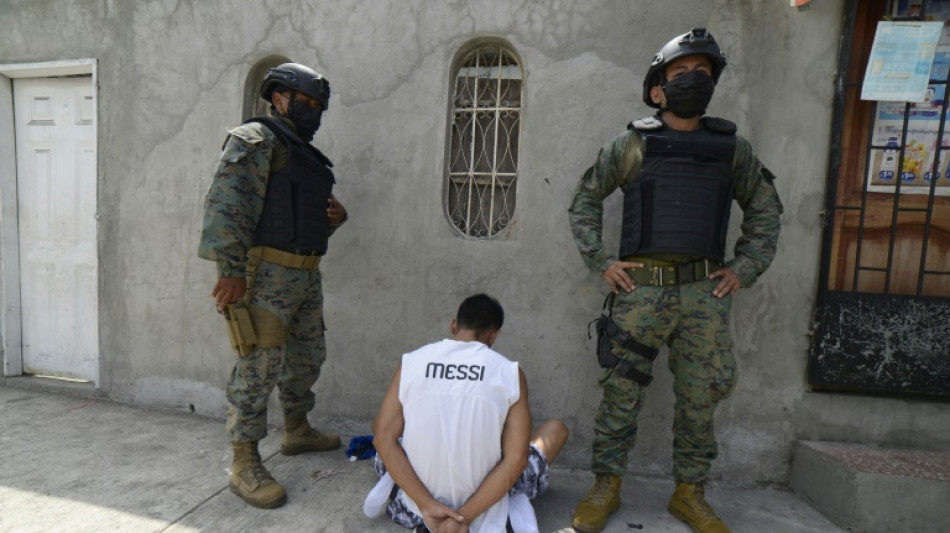
A headless body discarded in the street. Two corpses dangling from a bridge. An intensifying drug war has shocked once-peaceful Ecuador with scenes of horrific violence.
Experts say the two crimes committed within a single week last month evoked the savage methods of Mexican narco gangs which, according to the government in Quito, has infiltrated the South American country of 17.7 million people.
"The cruelty is something new," Daniel Ponton, dean of the security and defense school at Ecuador's IAEN university told AFP. He blamed "emulation" by local criminals of the well-documented atrocities committed by drug lords in Mexico or Colombia.
The local gangs soon learn, he added, that "violence has a value in itself" as a tool "to intimidate rival criminal gangs (and) diminish the will of the State... and the general population" to fight crime.
Wedged between Colombia and Peru -- the world's largest cocaine producers -- Ecuador long managed to escape drug violence even as the illegal but lucrative trade started showing benefits for its economy and domestic consumption grew.
The country used to be a drug transit and storage point favored by foreign traffickers for its porous borders, dollarized economy and major Pacific seaports for export.
But the ports -- especially at Guayaquil -- have since become battlegrounds themselves as the presence of local gangs has exploded, and murder figures with it.
- 'Super-violent messages' -
In January and February this year, 468 people were killed in Ecuador -- 277 more than in the same two months of last year.
More than 320 of this year's victims have been inmates -- many dismembered and burnt in grisly wars between rival prison gangs allied to drug cartels beyond Ecuador's borders.
In 2021, the country recorded a rate of 14 murders per 100,000 inhabitants -- nearly double the 2020 figure, though still not among the highest in the world.
Especially hard hit is Guayaquil, a city of 2.8 million people home to Ecuador's main commercial port, and the violence is increasingly filtering through to the streets.
On February 20, residents of Guayaquil were shocked when the body of a 21-year-old man was thrown from a moving vehicle in a city street, followed by his severed head.
Six days earlier, in the nearby town of Duran, the bodies of two men were found handcuffed and hanging from a pedestrian bridge.
Since late last year, five decapitated bodies have been found in Duran and Guayaquil, authorities say, and last month a head was found stuffed in a backpack at the port of Puerto Bolivar to the south.
There have also been neighborhood shootouts, a previously alien phenomenon.
"Drug trafficking has gained ground in Ecuadorian society," President Guillermo Lasso said last month after the latest bodies were so publicly displayed.
He blamed previous governments for allowing "microtrafficking" to find a foothold in the country, only to be swiftly followed by gangs and their territorial disputes.
For Renato Rivera, a researcher at the Latin American Network for Analysis of Security and Organized Crime, the mutilated corpses were meant as "super-violent messages" of warning.
The victims are often killed as punishment for being short on a drug delivery -- possibly after police seizures -- while at the same time serving as "a message of intimidation for rivals," he added.
- 'Weakened' state -
Faced with the expanding violence, Lasso's government recently ordered troops to Guayaquil to retake control of the city and "prevent the entry of drugs from the north (Colombia) or weapons from the south (Peru)."
The president also replaced the commander of the police, an entity widely seen as unwilling or unable to address the growing crime wave.
So far this year, the authorities have seized 37 tons of drugs. The number was 210 tons for the whole of 2021.
For Ponton, the escalating violence was "a kind of cumulative and growing time bomb," for Ecuador.
"The problem of Ecuador is that the state's response capacity is totally weakened in key areas: intelligence, criminal investigation, arms control," partly due to corruption.
According to a Transparency International report on corruption perception, Ecuador scored 36 in 2021 on a scale on which 100 represents clean government. This was lower than the average score of 43 for the Americas.
"Organized crime cannot live without corruption," said Rivera.
R.Adler--BTB