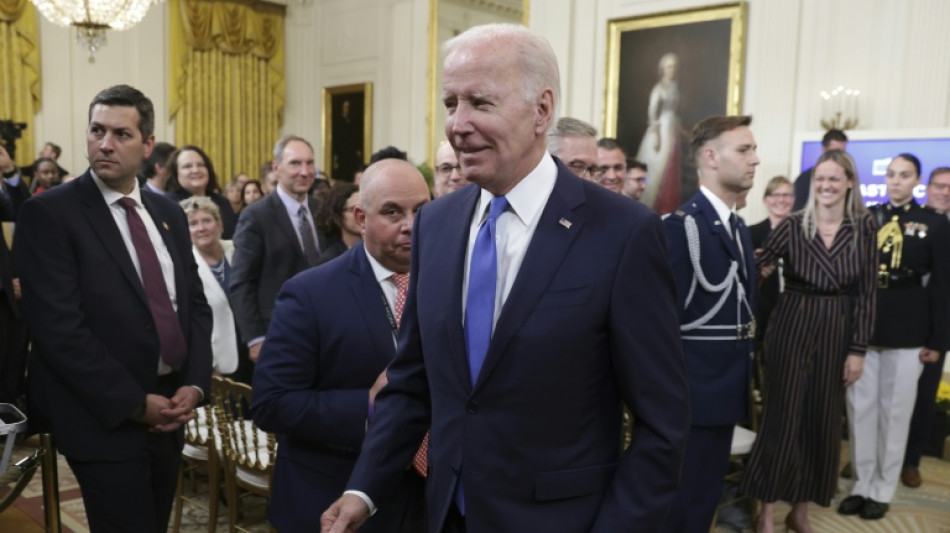
Biden's climate plan strains ties with European allies / Photo: © GETTY IMAGES NORTH AMERICA/AFP/File

 Monaco taken off global money-laundering 'grey list'

 Canada, EU launch new alliance with deals on Ukraine, minerals, AI

 Tears, fear, anger: relatives of Spain train crash dead await fate

 Spurs get Maddison boost ahead of Palace clash
 French authorities fear new street violence at Halloween protests

 Rickelton, Mulder centuries lift South Africa's chances in Test decider

 Maresca adamant Donnarumma can be dropped but first name selected

 EU and Canada to 'withstand shocks together' with new alliance

 Flick praises Yamal 'mentality' after missing out on Ballon d'Or

 Binance heist: How were cryptocurrency billions stolen?

 France boards up ahead of Halloween protests

 Is Bukele's troop deployment in Haiti just a rescue mission?

 Relatives' anguish grows as Spain identifies train crash dead

 Italy inflation surges to 5.4% as economy stalls

 US jury hands win to Bayer in weedkiller cancer case

 Scotland's Kinghorn hails Toulouse move for enhancing career

 Eala aiming to finish season with bang after Tokyo exit
 Bournemouth boss Rose vows to be patient with Kroupi
 Eurozone growth holds up despite energy crunch
 Thousands of students, workers protest in Italy under heavy security

 New Zealand's Phillips hits sublime century in 87-run win over India
 'Get them there alive': Ukraine's railways under Russian barrage

 Dakar Rally moved to Portugal and Morocco following Houthi attacks in Gulf

 German economy logs 0.2% growth, faster than expected

 Crypto platform Binance confirms 'complex' $6.3 bn hack

US President Joe Biden's landmark climate action plan has become a subject of tension between the United States and European Union, which fears it could hurt European industry.
With French Finance Minister Bruno Le Maire and his German counterpart Robert Habeck headed to Washington in the coming week to discuss the consequences of the Inflation Reduction Act (IRA), here is what you need to know:
- What is the IRA? -
The IRA, a massive piece of legislation that largely focuses on climate and social spending, provides more than $430 billion in US investments.
Of that sum, $370 billion will go toward cutting greenhouse gas emissions 40 percent by 2030, making it the largest ever American program to combat climate change.
Some investments are in the form of tax cuts for companies that invest in clean energy, but there are also significant subsidies for electric vehicles, batteries and renewable energy projects -- if they are manufactured in the United States.
One is a $7,500 subsidy for households buying US-made electric vehicles, while another gives benefits to manufacturers of wind turbines and solar panels who use US steel.
The measures have sparked concern in Europe as they impact key industries on the continent.
- How are both sides reacting? -
The IRA has caused a stir at EU headquarters in Brussels and in other European capitals, which see the various subsidies as discriminatory, in particular against the bloc's auto manufacturers.
At the start of the month, the EU unveiled proposals including a controversial expansion of state aid rules partly to counter the threat from US green subsidies.
The new measures give flexibility on providing aid to companies in the green and renewable energy sector, as well as those involved in the decarbonization of industry.
There will also be tax breaks for companies in strategic net-zero sectors.
But US and EU officials struck a conciliatory tone after recent talks, underlining a commitment to address EU concerns "constructively."
US Secretary of State Antony Blinken said in December after meeting with European officials: "We are committed to moving forward together not at the expense of each other, but to the benefit of each other."
Le Maire and US Trade Representative Katherine Tai agreed in November that both sides "should work together to deepen the bilateral understanding of the legislation," according to a statement.
Meanwhile US Senator Joe Manchin, who was key in passing the IRA, has expressed surprise at European reactions at a time when the US works to tackle climate change.
- Is there room for maneuver? -
Even if Biden wanted to walk back certain measures or broaden the number of beneficiaries, his legislative options are quite limited.
Biden's Democratic Party has lost its House of Representatives majority in January.
The new Republican majority is keen on slashing federal government spending, threatening to block the usual rubber-stamp approval for raising the nation's debt limit if Democrats do not agree to steep budget cuts.
It is also unclear that Biden is considering touching a key plank of his presidential legacy, which he salvaged only after protracted negotiations in the Senate.
The subsidies in question are very popular, especially in states such as Ohio and Michigan, where the automotive industry remains powerful. Their "swing state" status gives them considerable political clout.
- What does the EU want? -
Before the EU, Canada and Mexico expressed concerns about the IRA, which they saw as incompatible with the free trade agreement between the three North American countries.
They obtained an extension of subsidies for electric vehicles made in North America, a key issue for Mexico in particular where many global manufacturers have factories.
This is the type of treatment the EU wants to obtain -- with the bloc previously urging the US to grant it the same exemptions.
In December, the EU said it seeks "non-discriminatory treatment" of the bloc's clean vehicle producers under the IRA's clean vehicle credits, although the specifics could prove complicated to iron out.
J.Fankhauser--BTB