Sweden battles disinformation on 'kidnappings' of Muslim children / Photo: ©

 Brewers rout Rays to reach brink of World Series sweep

 Mbappe dropped by Chinese brands for 'offending national sentiments'

 Kuwait exhibition presents Ukraine’s Islamic heritage and cultural ties

 Tech firms track Wall St rally on mixed day for Asian markets

 Jay-Z to perform at Super Bowl LXI halftime show: NFL

 Climate-threatened Fijian utopia rejects calls to relocate

 Israel to give verdict on Netanyahu in pivotal election
 $1m bounties, dawn arrests: Trump presses voter fraud campaign

 Gasping for air: Borneo residents struggle as island burns

 Doha exhibition charts a millennium of Chinese maritime ceramics trade
 New Zealand ex-PM Ardern to teach leadership in Sydney

 Ballon d'Or 'beyond wildest dreams' but Kane has plenty more to prove

 No envy, no secrets: How Spain's Gipuzkoa became football coaching hotbed

 South Korea economy grows three times faster than expected in Q3

 Al-Thawadi urges technology to deepen human connection through shared experiences

 Ballon d'Or: Harry Kane's crowning moment

 Harry Kane wins men's Ballon d'Or

 Lula win rattles Brazil markets over spending spree fears

 De la Fuente wins men's Ballon d'Or coach of year

 Trump slams 'rigged' Brazil election after ally loses to leftist Lula

 Nadal returns for Vegas hardcourt event

 Fainga'anuku named as loose forward for All Blacks northern tour

 Anthropic points to AI dangers, soaring sales in IPO filing
 Sinner to play rescheduled Saudi Six Kings in December

 Brazilian lawmaker Andre Janones, Lula's social media 'general'

Swedish authorities are fighting back against claims its social services are "kidnapping" Muslim children, denouncing a "disinformation campaign" of viral videos spreading mistrust among immigrant families.
Videos began appearing on Arabic-language social media sites in late 2021 of real interventions by child welfare services, showing crying children being separated from distraught parents.
With limited context about the situations portrayed, the videos accuse Sweden of being a fascist state where social services place Muslim children in Christian homes with paedophiles or where they are forced to drink alcohol and eat pork.
After Mideastern media outlets reported on the claims, Swedish government officials and social services have come out in force to deny the allegations.
"We absolutely do not do that," Migration and Integration Minister Anders Ygeman told AFP, stressing the main goal was to support families.
Ygeman said the campaign was being fuelled in part by "frustrated parents who have failed in their parenting" and were projecting their anger at authorities.
- 'Malevolent forces' -
"There are also malevolent forces that want to exploit these parents' frustration to spread mistrust and division," he said.
Sweden's newly created Psychological Defence Agency has described many of the videos as old, presenting a false context with a "purpose to polarise".
Magnus Ranstorp, a terrorism expert at the Swedish Defence University, told AFP the campaign was primarily based on a Facebook group called "Barnens Rattigheter Mina Rattigheter" (Children's Rights My Rights), where parents share experiences of having their children "unfairly" removed from their care.
Radical imams in Sweden and abroad picked up on the stories, as did a new fringe political party Nyans (Nuance), which has made the forced removal of children a rallying cry ahead of the general election in September.
Muslim online influencers with millions of followers also joined the fray, as well as Arabic site "Shuoun Islamiya" ("Islamic Affairs"), which has published around 20 videos.
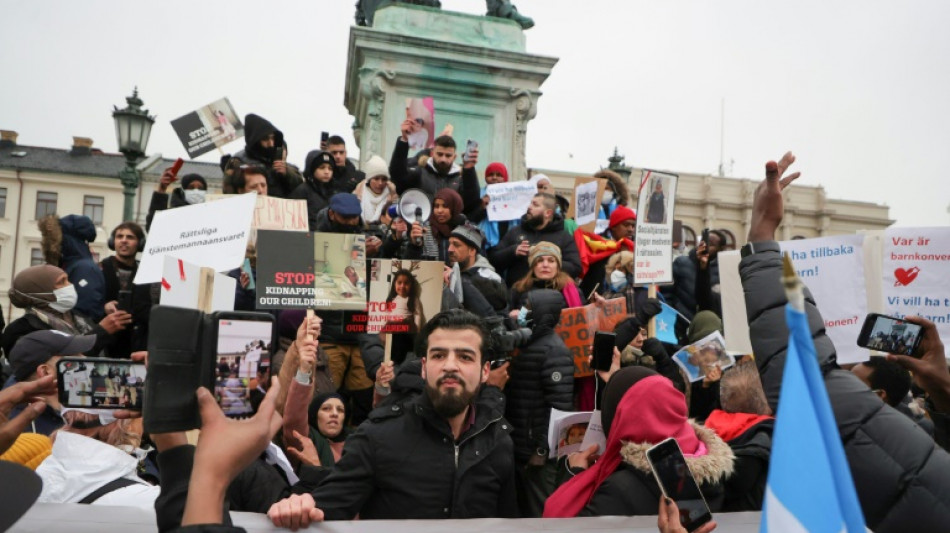
Several protests have also been held across Sweden.
Ranstorp said that while there may be some legitimate criticism against social services, the harsh rhetoric in the media posts was "inciting".
Julia Agha, head of the Arabic-language news outlet Alkompis based in Stockholm, has followed the campaign closely.
"Starting out, it was probably intended as a campaign where families of those whose children have been taken into custody have felt unjustly treated and wanted to criticise social services," she told AFP.
"What's happened is that this campaign has ended up in the hands of forces abroad that have put a religious filter over it and are spreading disinformation, which now looks more like a hate campaign against Sweden and Swedish society."
- 'Integration challenges' -
Sweden's National Board of Health and Welfare, which oversees social services, insists that removing children from their homes is always a last resort.
It is only done "when voluntary measures are not possible and there is a considerable risk that the child's health or development is harmed", the agency told AFP in an email.
In 2020, a total of 9,034 children were in state-ordered care without their parents' consent, official statistics show.
Researchers and social workers have noted that while more immigrant children are removed from their homes than ethnic Swedes, immigrant families are also less likely to accept earlier stages of assistance from social workers.
Sweden is often hailed as a pioneer in children's rights and was the first country to ban corporal punishment of children, including spankings, in 1966.
But critics say that dismissing the issue as disinformation ignores real issues with social services.
Mariya Ellmoutaouakkil, 35, who immigrated to Sweden 12 years ago from Morocco, organised a protest outside the social services office in her hometown of Gallivare last year, after two of her three children were removed from her care.
She told AFP her son, aged 10, and daughter, six, were taken after social services alleged violence in the home.
She said the decision was not based on evidence, only on social workers' interviews with the children that she has never been allowed to see.
Social services typically do not comment on individual cases.
Ellmoutaouakkil said she understood her children had not been "kidnapped", but did understand why some people use the term.
"It can start to feel like a kidnapping for me as a mother," she said. "When we as parents don't get answers, I can understand that they call it that".
Sweden has struggled for years to integrate immigrants.
The wealthy country of 10.4 million granted asylum and family reunifications to more than 400,000 people from 2010 to 2019 -- more per capita than any other European country.
"Sweden still has many integration challenges, not least when it comes to segregation," Agha told AFP.
She said many immigrants struggle to learn Swedish, live in areas where they only interact with other immigrants, and don't feel a part of Swedish society.
M.Furrer--BTB