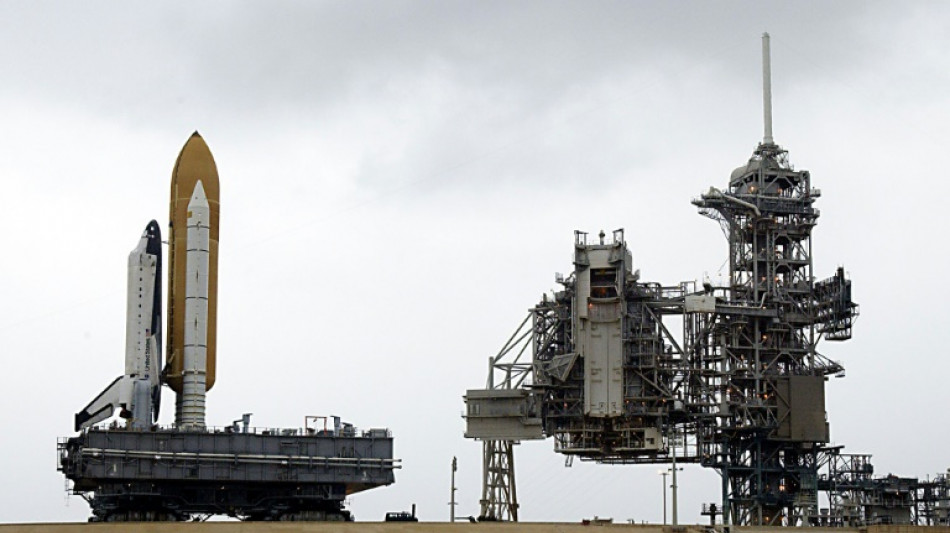
Columbia disaster that scuttled the space shuttle
/ Photo: © AFP/File

 Experts urge caution as demand grows for AC in heatwave-hit UK

 Thousands flee raging wildfires in southern Europe

 Tuchel hails 'heroic' England win in Mexico, but joy soured by Henderson injury

 Bellingham savours 'best night of England career' after Mexico heroics

 Ancelotti fails in mission to end Brazil's World Cup woe

 Bellingham powers 10-man England past Mexico, into World Cup quarters

 Canada's McIntosh breaks 200 fly world record, oldest in women's swimming
 Norway dance to Haaland's beat in 'surreal' World Cup run
 Daddy issues? NATO's Rutte sticks to charm to keep Trump on side
 Norway's World Cup win over Brazil beyond my dreams, says Haaland

 Neymar calls time on Brazil career after World Cup elimination
 Ancelotti promises Brazil will bounce back after World Cup exit

 Mexico-England World Cup match delayed one hour due to storms
 Gotterup wins PGA John Deere after Kohles splashdown
 Haaland knocks Brazil out of World Cup as Norway reach quarters

 'Catastrophic' Super Typhoon Bavi hits US island of Rota

 West Indies trail Sri Lanka by 231 runs

 FIFA clear US star Balogun to play after Trump call

 Venezuela quake survivor 'reborn' after eight days in rubble

 Red-card U-turn rocks World Cup as England face Azteca test
 Struff oldest first-time men's Slam quarter-finalist in Open era

 Banana!: 'Minions' knocks 'Toy Story' off N.America box office perch

 Sabalenka wants to drink, 'forget about tennis' after Wimbledon exit

 Mooney stars as Australia hammer England in women's World Cup final

 Djokovic makes history, Osaka sends Sabalenka crashing out of Wimbledon
America may now be aiming to put astronauts back on the Moon, but for years the United States turned its back on manned missions after the Columbia space shuttle disaster.
Its space programme suffered a catastrophic setback when all seven astronauts were killed when the shuttle broke up on re-entering the Earth's atmosphere 20 years ago on February 1, 2003.
It was the second shuttle disaster after the Challenger explosion of 1986 which also killed the crew and led to sharp criticism of the safety culture at NASA.
The shuttle fleet was grounded for two and a half years and it sparked a major shift in American space flights.
In 2004, president George W. Bush announced that the eye-wateringly expensive programme would be retired.
For years after the last shuttle flight in 2011, NASA found itself dependent on Russia for transport to the International Space Station (ISS) until Elon Musk's Space X began flying passengers there in 2020.
As well as the Moon, Washington is now preparing for a manned mission to Mars, scheduled tentatively for the late 2030s or early 2040s.
- 'Trails of smoke' -
Columbia broke up at 203,000 feet (61,900 metres) over eastern Texas just as the mission controller in Houston was talking to Columbia commander Rick Husband.
"To Columbia, here is Houston... we did not copy your last" message.
After a moment, Husband replied: "Roger but..."
After a brief crackling noise, contact was lost.
Columbia disappeared from radar screens at 9:00 am (1400 GMT), 16 minutes before it was due to land.
The flaming debris from the 80-tonne craft was caught streaking across the sky over the southern US by local TV stations, with parts scattered over Texas and Louisiana.
Bob Molter from Palestine, Texas, told National Public Radio how he saw the shuttle break up in the sky.
"There was a big boom that shook the house for more than a minute, and I went outside because I thought there had been a train accident on the nearby line.
"But there was nothing, and then I looked up and saw the trails of smoke zig-zagging, going across the sky."
- Heroes -
Columbia was the oldest shuttle to fly in orbit.
When it took off on its 28th flight on January 16, 2003 for a 16-day mission to carry out experiments it had been in operation for over 20 years.
Flight STS-107 was launched under extremely tight security in the wake of the September 11, 2001 attacks and due to the presence on board of Israel's first astronaut, Ilan Ramon.
Bush cut short a stay at the Camp David presidential retreat and raced back to Washington following the tragedy. In a televised address he hailed the crew, two of whom were women, as heroes.
A probe revealed that the shuttle disintegrated due to damage caused by a piece of foam from the external fuel tank that took a chunk out of the orbiter's left wing during liftoff.
This left it unable to withstand the extreme temperatures generated by re-entry.
- End of shuttle programme -
The shuttle programme was born in 1972 under president Richard Nixon and went on to become the major focus of US human spaceflight ambitions over the next four decades.
The fleet also acted like space trucks, carrying more than 1,500 tonnes of equipment to help build the first space telescope, Hubble, and the International Space Station.
After the Columbia disaster, NASA underwent sweeping changes aimed at improving its culture and safety.
The agency resumed shuttle flights in July 2005, with Discovery, then Endeavour and finally Atlantis continuing to fly missions to the ISS until 2011.
C.Kovalenko--BTB