Evangelical churches thrive in traditionally Catholic DR Congo / Photo: © AFP

 Rickelton, Mulder centuries lift South Africa's chances in Test decider

 Maresca adamant Donnarumma can be dropped but first name selected
 EU and Canada to 'withstand shocks together' with new alliance
 Flick praises Yamal 'mentality' after missing out on Ballon d'Or
 Binance heist: How were cryptocurrency billions stolen?

 France boards up ahead of Halloween protests

 Is Bukele's troop deployment in Haiti just a rescue mission?

 Relatives' anguish grows as Spain identifies train crash dead
 Italy inflation surges to 5.4% as economy stalls

 US jury hands win to Bayer in weedkiller cancer case
 Scotland's Kinghorn hails Toulouse move for enhancing career
 Eala aiming to finish season with bang after Tokyo exit
 Bournemouth boss Rose vows to be patient with Kroupi

 Eurozone growth holds up despite energy crunch
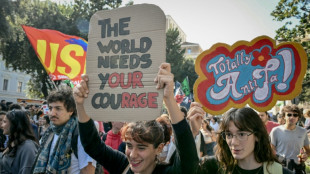 Thousands of students, workers protest in Italy under heavy security
 New Zealand's Phillips hits sublime century in 87-run win over India
 'Get them there alive': Ukraine's railways under Russian barrage

 Dakar Rally moved to Portugal and Morocco following Houthi attacks in Gulf
 German economy logs 0.2% growth, faster than expected
 Crypto platform Binance confirms 'complex' $6.3 bn hack
 Spanish inflation stays at three-year high before election
 Drugs giant AstraZeneca reveals higher profits, savings plan
 French economy 'headed for a wall' as GDP shrinks
 South Korea to prosecute students cheating with smart glasses
 Surging costs of living top US voter concerns

In the DR Congo's boisterous capital Kinshasa, a road close to the city centre is lined with traders hawking unusual merchandise: church pulpits.
The typical buyers are evangelical preachers, whose numbers have mushroomed over the years in the traditionally Catholic country which Pope Francis is set to visit on Tuesday.
"Pastors come here," said vendor Frederic Kimbaya. "It's good business."
Catholicism has long been the dominant religion in the Democratic Republic of Congo, a vast nation the size of continental western Europe that gained independence from Belgium in 1960.
But since the 1990s, evangelical churches, also called revivalist churches, have exploded in popularity, appealing particularly to the poor.
Despite huge mineral wealth, the DRC is one of most impoverished countries on the planet. About two-thirds of the population of around 100 million lives on under $2.15 a day, according to the World Bank.
The turn from Catholicism also traces its roots to former dictator Mobutu Sese Seko, who ruled between 1965 and 1997, said Gauthier Muzenge Mwanza, a sociologist at the University of Kinshasa.
Mobutu encouraged evangelical pastors in order to weaken the power of the Catholic Church, an independent force that often rallied opposition against him, said Mwanza.
"Anyone could start a church," he said, explaining that no legal restrictions were placed on starting religious establishments.
According to estimates, about 40 percent of the country is Catholic, 35 percent Protestants of various denominations, nine percent Muslims and 10 percent Kimbanguists -- a Christian movement born in the Belgian Congo.
Official Vatican statistics put the proportion of Catholics in the DRC at 49 percent of the population.
- Miracles, money -
Today, many Congolese evangelical leaders style themselves as archbishops and prophets, or even apostles.
They are often well spoken and immaculately dressed. Some own television channels.
Most also promise their flock a better life, or money or love, according to Mwanza.
All that is required of the faithful is prayer, dance -- and cash donations to the preacher.
Despite the popularity, some former Catholics who joined the evangelicals are beginning to return to the mother church as the promised miracles fail to show up, said political scientist Christian Ndombo Moleka.
More people are questioning their moral conduct, politics and "relationship with money," he said.
Evangelical churches nevertheless remain ubiquitous in Kinshasa, a megacity of an estimated 15 million people.
Ascertaining their precise number is difficult. But last year, a Congolese MP pushed to close 10,000 churches deemed to be corrupt.
- 'Wolves' -
Emie Kutino, a snappily dressed evangelical preacher, pushed back against the image that revivalist churches are all on the take.
There are "wolves" who exploit people's misery among evangelicals and Catholics alike, she said.
"There are also real ones, who do a great job," added Kutino, who has a degree in theology, on a Sunday before a service in her church.
Kutino's husband Fernando is the founder of Kinshasa's "Army of Victory," which is one of the oldest revivalist churches in the city.
He was imprisoned between 2006-2014 due to an arms-possession charge, and is now living in France after suffering a stroke.
Kutino said the charge had been "fabricated" for political reasons, as her husband had criticised the government of the time.
"If it wasn't for the presence of the churches, this nation would fall apart," she said, pointing to the ravages of the long-running conflict in eastern DRC.
"But we pray, and in church we can offer something to the widow and the orphan," she added.
Although not a Catholic, Kutino said the Pope's visit on January 31 would be a "blessing" that may encourage peace.
O.Krause--BTB