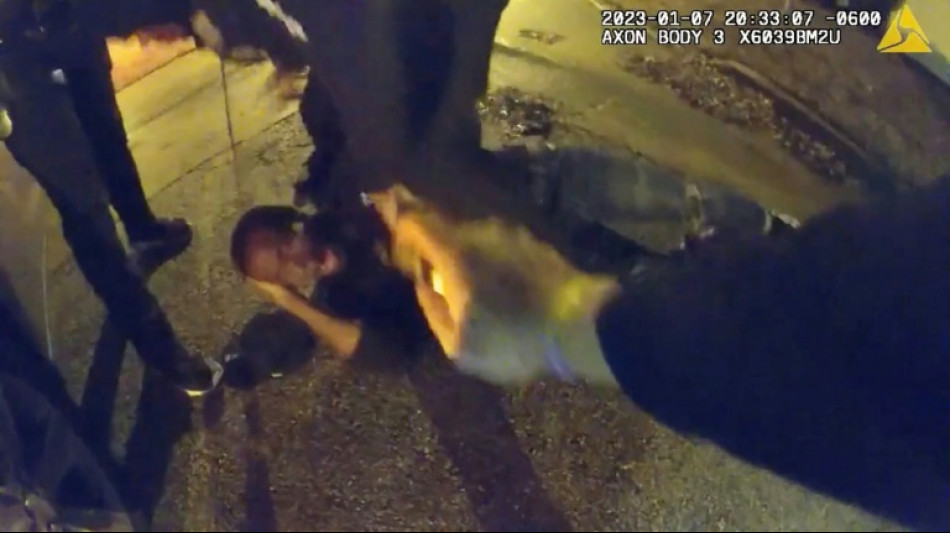
Efforts since George Floyd killing fail to stem US police violence / Photo: © City of Memphis/AFP/File

 Experts urge caution as demand grows for AC in heatwave-hit UK

 Thousands flee raging wildfires in southern Europe

 Tuchel hails 'heroic' England win in Mexico, but joy soured by Henderson injury

 Bellingham savours 'best night of England career' after Mexico heroics

 Ancelotti fails in mission to end Brazil's World Cup woe

 Bellingham powers 10-man England past Mexico, into World Cup quarters

 Canada's McIntosh breaks 200 fly world record, oldest in women's swimming

 Norway dance to Haaland's beat in 'surreal' World Cup run
 Daddy issues? NATO's Rutte sticks to charm to keep Trump on side

 Norway's World Cup win over Brazil beyond my dreams, says Haaland

 Neymar calls time on Brazil career after World Cup elimination

 Ancelotti promises Brazil will bounce back after World Cup exit

 Mexico-England World Cup match delayed one hour due to storms
 Gotterup wins PGA John Deere after Kohles splashdown

 Haaland knocks Brazil out of World Cup as Norway reach quarters

 'Catastrophic' Super Typhoon Bavi hits US island of Rota

 West Indies trail Sri Lanka by 231 runs

 FIFA clear US star Balogun to play after Trump call

 Venezuela quake survivor 'reborn' after eight days in rubble

 Red-card U-turn rocks World Cup as England face Azteca test
 Struff oldest first-time men's Slam quarter-finalist in Open era

 Banana!: 'Minions' knocks 'Toy Story' off N.America box office perch

 Sabalenka wants to drink, 'forget about tennis' after Wimbledon exit

 Mooney stars as Australia hammer England in women's World Cup final

 Djokovic makes history, Osaka sends Sabalenka crashing out of Wimbledon

The shocking death of Tyre Nichols after a police beating has reopened anguished debate across the United States about police violence, fueling a sense that the huge, nationwide demonstrations of 2020 have done little to solve the problem.
Nichols, a 29-year-old Black man, died in a hospital on January 10, three days after a brutal beating by five Black police officers in the southern city of Memphis, Tennessee.
The five have since been charged with second-degree murder.
Memphis police released body-cam footage of the incident -- after starkly warning viewers of its brutality -- late Friday.
"I'm just sad for where we are in America; we’re still here," said Lora King, whose father Rodney King sustained a violent beating by police in Los Angeles in 1991, also caught on camera. The incident fueled lethal and destructive riots in that city and elsewhere. "I'm in disbelief."
"We have to do better," she told CNN. "This is unacceptable."
- Deaths at 10-year high -
Nichols' death left many Americans questioning how much real progress had been made since 2020.
The killing that year in Minneapolis of George Floyd, a Black man whose videotaped death under the knee of a white officer was viewed millions of times, reignited the historic Black Lives Matter movement across the US and abroad.
In the wake of Floyd's death, promises of police reform swept across the country.
And yet two years later, the number of people who have died during interactions with police hit a 10-year high in 2022, at 1,186 deaths, according to the website Mapping Police Violence.
"They say it's a new year, but same old, same old," said Robert Jones, a 26-year-old salesman in Memphis.
African Americans accounted for 26 percent of those deaths, though Black people represent only 13 percent of the US population.
By way of comparison, fewer than 20 people die in France each year during police interventions.
A huge factor explaining the difference is the enormous number of privately owned firearms in the United States -- there are more guns than there are people -- which sharply increases the sense of vulnerability police feel during interactions with the public, making them much quicker to draw their own arms.
Last year, 66 police officers were killed by gunfire while on duty, according to a fund created to honor them.
But attorney Ben Crump, who represented Floyd's relatives and is now working with Nichols' family, sees a deeper dynamic at work.
"We have to talk about this institutionalized police culture that has this unwritten law that you can engage in excessive use of force against Black and Brown people," he said during a press conference Friday.
- 'Unnecessary and aggressive' -
The tumult of 2020 led, among other things, to efforts to curb the considerable legal immunity granted to American police, or to establish a register of officers who have been found to use excessive force.
Proposed federal legislation, initially supported by both political parties, ultimately failed in Congress at a time when homicides were rising sharply, with Republicans falling back on their traditional appeals for "law and order."
In the absence of progress on the federal level, the push for reform advanced primarily on the local level -- modestly and unevenly, producing a patchwork of different approaches.
Across the United States, there are nearly 18,000 autonomous policing entities -- city police, county sheriffs, state highway patrols -- each with its own rules for recruitment, training and on-the-job practices.
Some of them have reviewed and revised their rules, notably banning strangleholds, such as the one killed George Floyd, requiring greater use of body-cams and increasing the penalties for unjustified violence.
The Memphis police were among those adopting reforms. Officers were barred from forcing their way into homes unannounced; were told they must step in to stop colleagues engaging in violence; and were given additional training in de-escalating dangerous confrontations.
Despite all that, the officers who stopped Nichols for a simple traffic violation were "riled up" from the beginning, and "the escalation was already at a high level," said Cerelyn Davis, the Memphis police department's first Black female chief.
For activists, the central problem is the extensive arrest powers American police have, even over minor infractions.
"We must stop relying on police to respond to issues related to poverty and disinvestment," said Kathy Sinback, director for Tennessee of the American Civil Liberties Union.
That approach, she said in a statement, "leads to more frequent, unnecessary and aggressive actions by law enforcement toward community members."
US police have killed nearly 600 people during traffic stops since 2017, according to Human Rights Watch.
C.Kovalenko--BTB