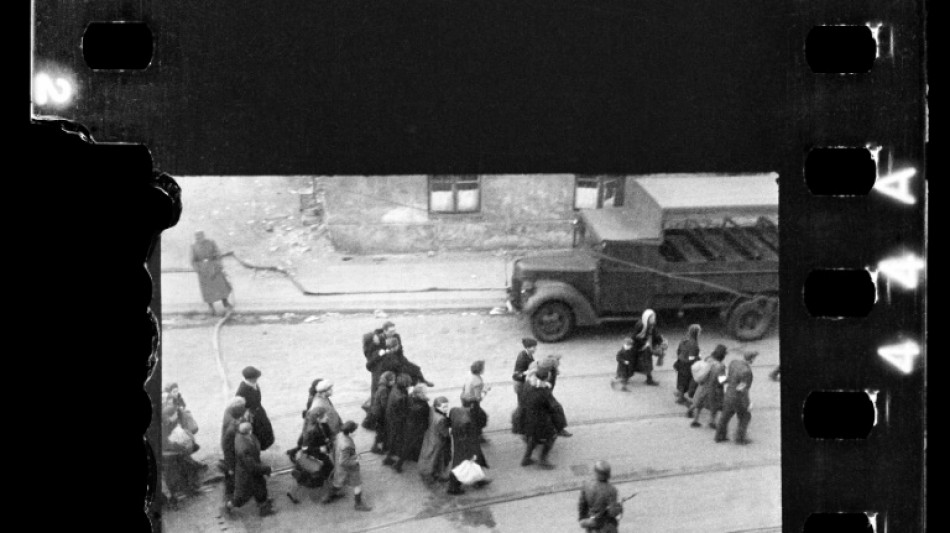
Rare photos from WWII Jewish ghetto shown in Warsaw / Photo: © AFP

 Italy inflation surges to 5.4% as economy stalls

 US jury hands win to Bayer in weedkiller cancer case
 Scotland's Kinghorn hails Toulouse move for enhancing career
 Eala aiming to finish season with bang after Tokyo exit
 Bournemouth boss Rose vows to be patient with Kroupi
 Eurozone growth holds up despite energy crunch
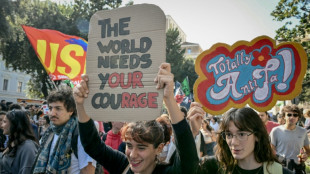 Thousands of students, workers protest in Italy under heavy security

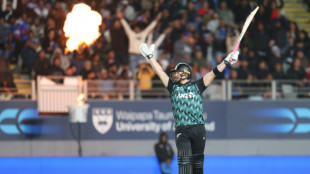 New Zealand's Phillips hits sublime century in 87-run win over India

 'Get them there alive': Ukraine's railways under Russian barrage

 Dakar Rally moved to Portugal and Morocco following Houthi attacks in Gulf

 German economy logs 0.2% growth, faster than expected

 Crypto platform Binance confirms 'complex' $6.3 bn hack
 Spanish inflation stays at three-year high before election

 Drugs giant AstraZeneca reveals higher profits, savings plan

 French economy 'headed for a wall' as GDP shrinks

 South Korea to prosecute students cheating with smart glasses
 Surging costs of living top US voter concerns

 Basic services, fading loyalties loom over South Africa's vote

 Shock, vindication, regret: Scientists react to AI roiling life's work

 Crypto platform Binance confirms $6.3 bn hack

 Boozer shines as Grizzlies top Blazers in battle of NBA unbeatens
 Jorge Martin confirmed to race at Malaysian MotoGP

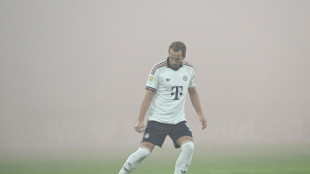 Bayern and Kane host Dortmund after week of 'extremes'
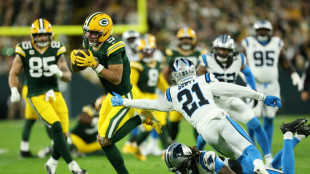 Packers beat Panthers 27-19 as Watson returns from hospital

 Affordable supermarket fashion offers designer-inspired autumn alternatives

Never-before-seen photos of the Warsaw Ghetto -- from a roll of film shot by a Polish firefighter under the noses of the occupying Germans -- were unveiled to journalists Wednesday.
Although taken during the 1943 Warsaw Ghetto uprising when Jews rose up against the Nazi occupiers, they do not depict the actual fighting.
But they do show apocalyptic scenes of buildings on fire, deserted streets strewn with rubble, and German soldiers escorting Jews to their deaths.
Recently discovered in an attic, the photos will go on show to the public in the Polish capital in April on the 80th anniversary of the uprising.
"Photos taken by Germans constitute the quasi-majority of the photographic documentation of the Holocaust," historian Jacek Leociak told reporters. "We see the ghetto through their eyes.
"This roll of film is a priceless record because it goes beyond the German perspective, the perspective of executioners showing Jews as dehumanised, anonymous victims," he said.
"These are the only known photographs (from the ghetto during the uprising) not taken by the Germans and not taken for propaganda purposes," Zuzanna Schnepf-Kolacz curator at the POLIN Museum of the History of Polish Jews, told AFP.
- Lost for decades -
The roll of film, which includes 33 photos from the ghetto, was shot by Zbigniew Grzywaczewski, a non-Jewish Pole and firefighter.
It was only rediscovered in December 2022 by his son, Maciej.
He found the old roll, its edges slightly mangled, in a cardboard box with photo archives. They had lain there forgotten for decades since Grzywaczewski's death in 1993, he told AFP.
"My father never told us that he took photos inside the ghetto -- maybe because it was too difficult for him," said Maciej Grzywaczewski, 68.
His father's journal entries from that time -- May 1943 -- made it clear that he had seen far worse than the photos depicted.
The faces of those in the ghetto would stay with him forever, he wrote.
"Figures staggering from hunger and dismay, filthy, ragged. Shot dead en masse.
"Those still alive falling over the bodies of the ones who have already been annihilated."
As a firefighter, his father had been called to put out fires started by the Nazis following the outbreak of the uprising.
The Germans had systematically set fire to buildings in the ghetto to force out the residents and insurgents hiding inside.
A year after invading Poland in 1939, Germany created the Warsaw ghetto -- the biggest of its kind in World War II -- to hold almost half a million Jews.
People were crammed into a small neighbourhood where disease and hunger were rife.
Of those who survived the conditions, 260,000 -- a quarter of Warsaw's population -- were deported to the Treblinka extermination camp and killed as part of the Holocaust.
On April 19, 1943, hundreds of Jewish fighters launched their revolt against the Nazis, preferring to die fighting than in the gas chambers.
- 'War and Love' -
Most of the photos Grzywaczewski shot inside the ghetto had been lost to history until now. Only 12 cropped prints on low-quality paper had been shown before.
They were made during or just after the war and given by the author to a Jewish family he had been hiding in his apartment.
After emigrating to the US, the family donated the prints in the 1990s to the United States Holocaust Memorial Museum.
About six months ago, the curators preparing the upcoming exhibition -- who knew about those prints -- got in touch with the late photographer's family in the hopes of locating other images.
That was when his son, Maciej, found them.
At first, he said, he failed to uncover anything in response to the museum's request.
"Then, finally, as I was looking through the last of the boxes containing my father's photo archives, I found the roll of film."
Most of the scenes were from the ghetto, but there were also images of Maciej's mother and other family members.
"You could label the roll of film, 'War and Love'," he said.
F.Müller--BTB