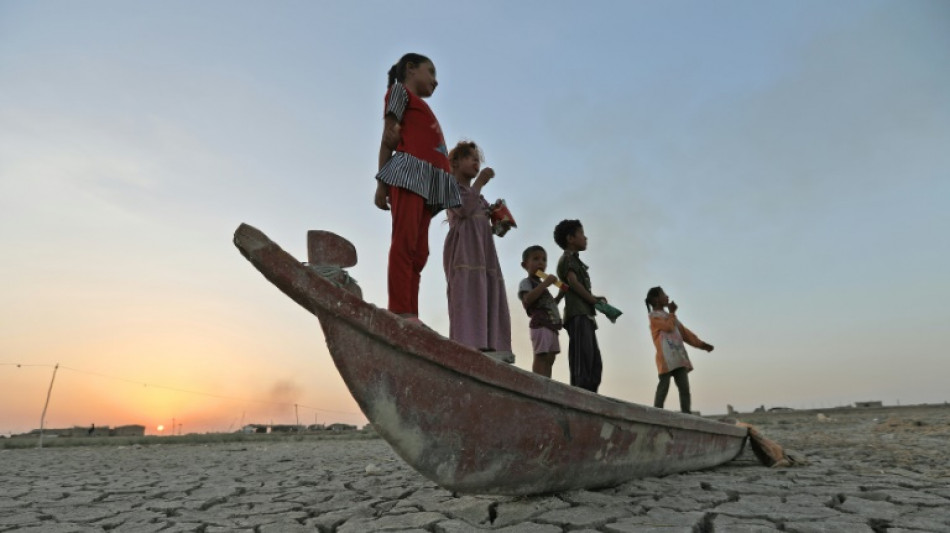
UN confirms 2022 among eight hottest years on record / Photo: © AFP/File

 Russian strikes kill 18 in Kyiv region on eve of NATO summit

 Netflix, Disney+, Amazon appeal French investment rules

 Thousands flee new wave of European wildfires

 Norway releases first image of crown princess after lung transplant

 Stock markets diverge as tech recovery stutters

 Springboks recall Papier and make 10 changes for Scotland Test

 Indonesia, Singapore say key oil passage will remain 'accessible'

 USA face Belgium and World Cup date with destiny after Trump intervention

 Oldest quasars ever discovered add to 'perplexing' space mystery

 German factory orders unexpectedly rebound in May

 Russian strike kills 14 around Kyiv on eve of NATO summit

 USA face Belgium and World Cup date with destiny after Balogun reprieve

 Immobilised by heatwave, handicapped man sues Austria in rights court
 Bellingham tells England to believe after Mexico masterclass

 'Major' damage as super typhoon hits US islands

 Kane says England found a way to win

 England, Norway advance at World Cup, FIFA ruling triggers uproar

 Asian markets mixed as tech recovery stutters, oil slips

 Russia launches deadly barrage on Kyiv region on eve of NATO summit

 'Major' damage as Super Typhoon Bavi hits US island of Rota

 Australia signs defence alliance with Pacific nation Fiji

 Philippine Senate trial to decide VP Duterte's political future

 Australia PM apologises for Kylie Minogue comments

 Penalty save inspired Norway, says 'keeper Nyland

 As Venezuela quake deaths pass 3,000, attention turns to mourning, burials

The past eight years were the hottest since records began, the United Nations confirmed Thursday, despite the cooling influence of a drawn-out La Nina weather pattern.
Last year, as the world faced a cascade of unprecedented natural disasters made more likely and deadly by climate change, the average global temperature was about 1.15 degrees Celsius above pre-industrial levels, the World Meteorological Organization said.
"The past eight years were the warmest on record globally, fuelled by ever-rising greenhouse gas concentrations and accumulated heat," the UN agency said in a statement.
The hottest year on record was 2016, followed by 2019 and 2020, it found.
Last year meanwhile marked the eighth consecutive year that annual global temperatures were at least one degree over the pre-industrial levels seen between 1850 and 1900.
The Paris Agreement, agreed by nearly all the world's nations in 2015, called for capping global warming at 1.5C, which scientists say would limit climate impacts to manageable levels.
But the WMO warned Thursday that "the likelihood of -- temporarily -- breaching the 1.5C limit... is increasing with time."
The WMO reached its conclusions by consolidating six leading international datasets, including the European Union's Copernicus climate monitor (C3S) and the US National Oceanic and Atmospheric Administration (NOAA), which have announced similar findings this week.
- La Nina effect 'short-lived' -
The UN agency highlighted that the warmest eight years on record had all been since 2015, despite consecutive La Nina events since 2020.
The weather phenomenon has a cooling effect on global temperatures.
Last year was therefore "just" the fifth or sixth hottest year ever recorded, the WMO said.
The situation last year was more extreme in some places.
Copernicus said in its annual report Tuesday that the planet's polar regions experienced record temperatures last year, as did with large swathes of the Middle East, China, central Asia and northern Africa.
Europe endured its second-hottest year ever as France, Britain, Spain and Italy set new average temperature records and heatwaves across the continent were compounded by severe drought conditions, it said.
For the planet as a whole, the WMO said the impact of La Nina, which is expected to end within months, would be "short-lived".
The weather pattern, it said, "will not reverse the long-term warming trend caused by record levels of heat-trapping greenhouse gases in our atmosphere."
- 'Dramatic weather disasters' -
"In 20200, we faced several dramatic weather disasters which claimed far too many lives and livelihoods," WMO chief Petteri Taalas said, pointing to floods that submerged a third of Pakistan, record-breaking heatwaves in China, Europe and the Americas and a drawn-out drought in the Horn of Africa.
The WMO said the trend was clear.
"Since the 1980s, each decade has been warmer than the previous one," it said.
The average temperature for the period 2013-2022 was 1.14 degrees Celsius above the pre-industrial baseline.
It stood at 1.09 degrees Celsius between 2011 and 2020, according to estimates by the UN's climate science advisory panel, the IPCC.
This, WMO said, "indicates that long-term warming continues," with the world "already approaching the lower limit of temperature increase the Paris Agreement seeks to avert."
The spurt in extreme weather events underscores the need for "enhanced preparedness," Taalas said.
At the COP27 climate summit in November, UN chief Antonio Guterres unveiled a five-year, $3-billion plan to build a global early warning system for deadly and costly extreme weather events amplified by climate change.
So far, only half of the 193 UN member states have such systems, Taalas said.
He warned that "big gaps" in basic weather observations, including in Africa, had "a major negative impact on the quality of weather forecasts."
E.Schubert--BTB